
Baking rewards precision more than almost any other kind of home cooking. A stew forgives an extra splash of stock; a sponge cake does not forgive a mismeasured leavener. That is why the tools you keep on the counter matter so much. The right spatula folds without deflating, the right scale weighs in grams without drifting, the right bowl gives you room to work, and the right whisk reaches into the corners of a saucepan. None of those things require a professional kitchen — they require knowing what to look for in a listing before you click buy. Nothing else in the kitchen tools for baking category changes a result as much as an accurate scale and a real spatula.
This guide is not a lab test and it is not a taste test. The Spoonist does not test products. What we do here is walk through the categories that matter most for baking, explain the listing details that actually predict whether a tool will serve you well, and point out the specific numbers you should verify yourself on the product page. We will also look at four real Amazon listings — a silicone spatula set, a digital kitchen scale, a stainless steel mixing bowl set, and a whisk set — and talk about who each one tends to suit. Prices and ratings below come from those listings as fetched on 2026-09-18, and they change constantly, so always confirm the current figure on Amazon.
As an Amazon Associate we earn from qualifying purchases. Prices and availability change — the links below go to Amazon.
Quick picks — all four
-
Etekcity Food Kitchen ScaleAccurate gram measurement for dry and liquid ingredients$24.12 · 4.6/5Check Price
-
NileHome 3-Pack Stainless Steel Whisk SetWhipping, blending, and light mixing$9.44 · 4.7/5Check Price
More guides in this series
Key Takeaways
- For baking, a digital scale that reads in grams is usually the single highest-value upgrade — volume measuring is the biggest source of inconsistency in home baking.
- Silicone spatulas need to be genuinely heat resistant and stiff enough to scrape a bowl clean; flexibility is a feature, floppiness is not.
- Mixing bowls should be sized for the job: a bowl that is too small forces you to work in batches and makes folding awkward.
- Whisk shape matters more than whisk count. A balloon whisk for whipping and a narrower whisk for sauces cover most baking needs.
- Ratings and review counts are useful signals, but read the recent reviews for the specific failure modes — rust, cracking, drifting readings — rather than trusting the average alone.
Product Reviews
ChefAide 5 Pieces Silicone Spatulas Set, Heat Resistant Rubber Spatula

The ChefAide 5 Pieces Silicone Spatulas Set, Heat Resistant Rubber Spatula is the kind of purchase that quietly improves every bake you make afterward. A spatula is the tool you touch more than any other during a session — folding batter, scraping the last of the brownie mix out of the bowl, spreading frosting, stirring a custard over gentle heat. If it is too stiff, it tears at delicate batters. If it is too soft, it bends instead of scraping.
At $9.17 for five pieces, this set is priced as an entry point rather than a specialty tool, and the listing carries 6,748 ratings with a 4.8 average. That combination — a low price with a high rating across thousands of buyers — is a reasonable signal that the product does the basic job without obvious defects. It does not prove the silicone is food-grade or that the heat resistance is adequate for your stovetop work, because those specifics are not published in the data we have. Check the listing for the stated temperature rating before you plan to use one of these over a hot pan.
Pros
- Five pieces means you can dedicate one to savory cooking and keep the rest for baking
- Very low entry price for a full set
- Strong rating across a large number of reviews
Cons
- Silicone quality and heat tolerance are not specified in the listing data — verify on the page
- Five spatulas is more than many bakers need; a two- or three-piece set may be enough
- Very inexpensive silicone can stain or retain odors over time
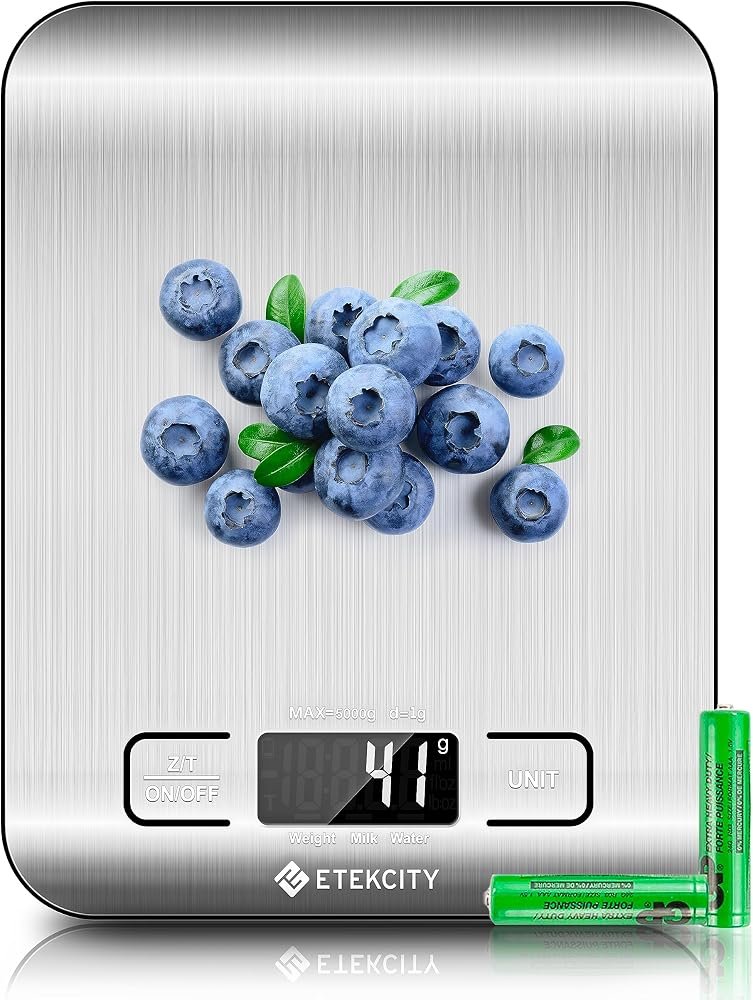
Etekcity Food Kitchen Scale, Digital Grams and Ounces, 11lb

If you buy only one thing from this guide, make it the Etekcity Food Kitchen Scale, Digital Grams and Ounces, 11lb. Weighing ingredients is the single change that most reliably improves home baking, because a cup of flour can vary enormously depending on how it was scooped and settled. A scale removes that variable entirely. This model is listed with an 11lb capacity and reads in both grams and ounces, which covers essentially every home baking task from a pinch of yeast to a full batch of dough.
The listing shows $24.12 and a 4.6 rating across 177,202 ratings — an unusually large review base, which means the failure modes are well documented in the reviews. Read them for the things that matter to you: how the scale behaves when you add ingredients incrementally (tare accuracy), whether the display stays readable under a large bowl, and whether the platform is easy to wipe clean. The listing data we have does not state the resolution or the minimum readable weight, so if you need to weigh very small quantities like a fraction of a gram, verify that number on the page rather than assuming.
Pros
- Grams and ounces on the same device suits both metric recipes and US measurements
- 11lb capacity handles large dough batches
- Enormous review base makes it easy to research real-world reliability
Cons
- Resolution and minimum weight are not stated in the listing data — check before buying for precision work
- Battery type and auto-off behavior are not specified here
- At this price, a scale with a higher resolution may exist if you weigh very small amounts
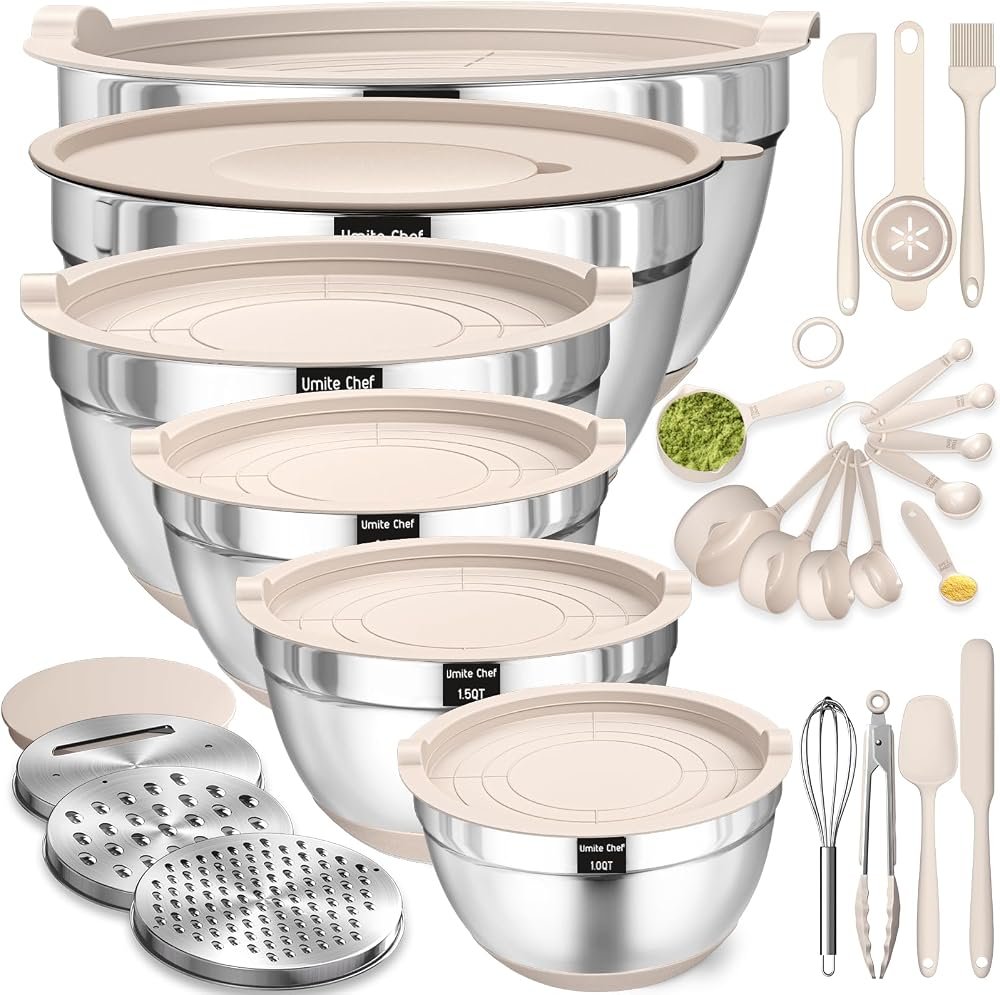
Mixing Bowls with Airtight Lids Set, 26PCS Stainless Steel Khaki Bowls with Grater Attachments, Non-Slip Botto

The Mixing Bowls with Airtight Lids Set, 26PCS Stainless Steel Khaki Bowls with Grater Attachments, Non-Slip Botto is the most feature-dense item in this guide. Stainless steel bowls are a strong choice for baking because they are lightweight, they do not retain odors the way some plastics can, and they chill quickly when you need to firm up dough. The airtight lids turn the bowls into storage vessels, which matters when you are proofing dough or holding a batch of cookie dough overnight. The grater attachments and non-slip base add functionality beyond simple mixing.
Listed at $39.99 with a 4.8 rating across 5,115 ratings, this set sits in the middle of the price range for a multi-piece bowl collection. The “26PCS” count is worth reading carefully on the listing, because in sets like this the piece count often includes lids, grater plates, and measuring accessories rather than 26 separate bowls. The listing data we have does not state the capacity of each bowl in quarts or liters, and that is the number that matters most for baking — you want at least one bowl large enough to fold a full batch of batter without overflow. Check the individual capacities on the page before you buy.
Pros
- Stainless steel is durable, non-staining, and easy to clean
- Airtight lids double as storage for dough and batters
- Grater attachments and non-slip base extend usefulness beyond mixing
Cons
- Individual bowl capacities are not stated in the listing data — verify before buying
- Piece counts in large sets can be inflated by accessories rather than bowls
- Stainless steel is not microwave-safe, unlike glass or silicone bowls
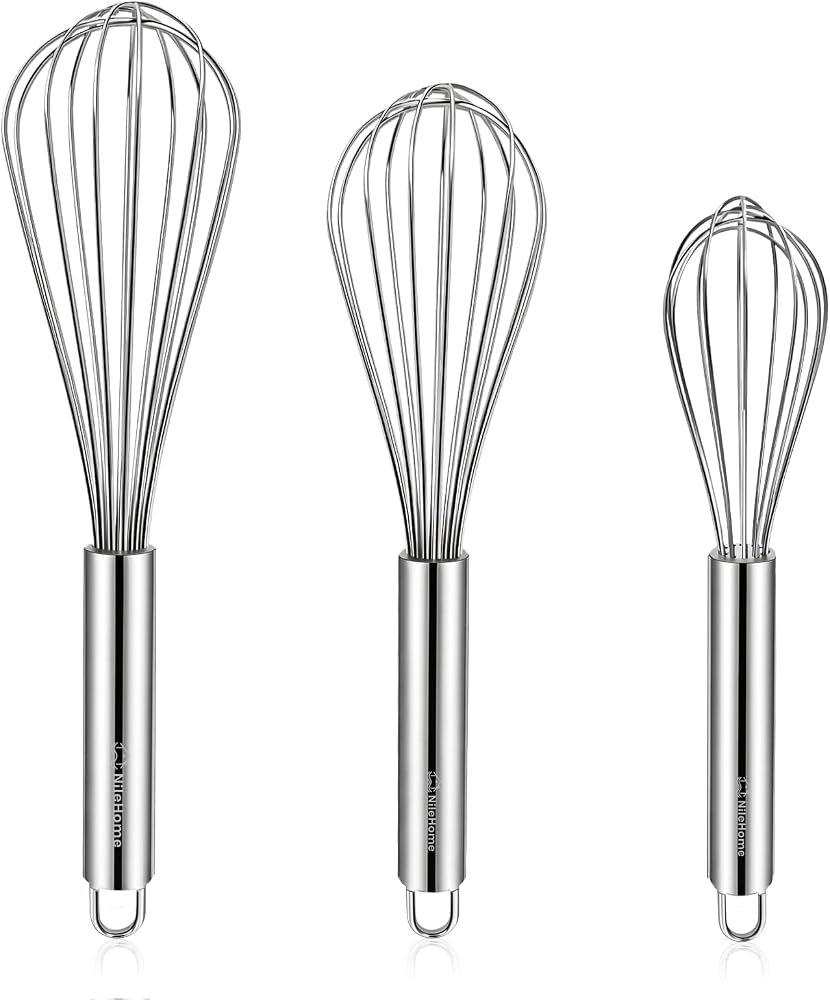
NileHome 3-Pack Stainless Steel Whisk Set, Kitchen Utensils for Cooking

The NileHome 3-Pack Stainless Steel Whisk Set, Kitchen Utensils for Cooking covers a category where shape matters more than brand. A whisk is essentially a bundle of wire loops, and the geometry of those loops determines what the tool does well. A wide balloon whisk incorporates air efficiently, which is what you want for whipping cream or egg whites. A narrower whisk with tighter loops is better for blending dry ingredients or working out lumps in a batter. A flat or spiral whisk is the tool for gravies and custards because it sweeps the bottom of a pan.
At $9.44 for three whisks, with a 4.7 rating across 5,466 ratings, this set is priced to be an easy add-on. The listing data does not specify the length of each whisk or the wire gauge, and both matter: a very short whisk is awkward in a deep bowl, and very thin wire can deform under stiff dough. Look at the listing photos and any stated dimensions to judge whether the three sizes cover the range you need. Stainless steel construction is a genuine advantage here, since it resists rust and does not react with acidic mixtures.
Pros
- Three whisks at a low price covers multiple tasks
- Stainless steel resists rust and staining
- Strong rating across a substantial review base
Cons
- Whisk lengths and wire gauge are not stated in the listing data
- Handle construction and whether wires are sealed into the handle are not specified
- Thin wire can bend if used for stiff dough rather than batters
Why Baking Tools Are Different From General Kitchen Tools
Most kitchen gear is judged on convenience. Baking tools are judged on repeatability. If your spatula leaves a streak of batter in the bowl, you lose a little yield. If your scale reads inconsistently, you lose the ability to reproduce a recipe that worked last weekend. If your bowl is too shallow, your flour clouds the counter every time you fold.
That distinction shapes what you should prioritize. In baking, the hierarchy of importance runs roughly like this: measurement accuracy first, then mixing and folding tools, then containment (bowls), then finishing tools. A beautiful stand mixer is useless if the flour going into it was scooped rather than weighed. A cheap whisk can outperform an expensive one if its wire gauge and shape suit the task.
It also means you should be skeptical of tool sets that promise everything. A 40-piece baking kit usually contains a handful of genuinely useful pieces and a lot of filler. Buying four good tools individually often costs less than a big bundle and serves you better. The four listings we examine below are a reasonable illustration of that principle: each one covers a distinct job, and together they cover most of what a home baker actually reaches for.
How to Evaluate a Baking Tool Listing Before You Buy
Product pages are marketing documents, but they contain real information if you know where to look. Here is a checklist that applies to nearly every baking tool category.
1. Look for specific materials, not vague claims
“Premium material” tells you nothing. “Stainless steel,” “food-grade silicone,” “borosilicate glass,” and “tempered glass” tell you something. For anything that touches heat — spatulas, bowls, whisks used over a double boiler — the listing should name the material and state a temperature rating. If it does not, that is a gap you should notice rather than fill in with an assumption.
2. Check whether the dimensions are stated
Bowl capacity, whisk length, spatula width, and scale platform size all matter, and all of them should appear as numbers on the page. A bowl set described only as “large, medium, small” is hard to compare against your recipe. If the listing omits capacity in quarts or liters, treat that as a reason to keep scrolling.
3. Read the one- and two-star reviews first
Average ratings compress a lot of information. The low-star reviews are where you learn about the specific failure modes: handles that crack at the seam, silicone that stains permanently with tomato or turmeric, scales that drift after a few months, whisk wires that pop out of the handle. If the same complaint appears repeatedly across recent reviews, it is probably a design issue rather than a fluke.
4. Note the review count, not just the rating
A 4.9 average from twelve reviews is a much weaker signal than a 4.6 average from tens of thousands. Volume of reviews tells you the product has been in many kitchens for a while, which is its own kind of evidence. It does not replace reading the content, but it contextualizes the score.
5. Verify the numbers on the page yourself
Where a spec matters to you — wattage, capacity, temperature limit, weight resolution — check that exact number on the listing. We deliberately do not estimate specs that are not published, because a guessed number is worse than no number. If the listing does not state it, assume you will not know until the box arrives.
Comparison Table: Four Baking Staples at a Glance
| Product | Price (as listed 2026-09-18) | Rating | Review Count | Best For |
|---|---|---|---|---|
| ChefAide 5 Pieces Silicone Spatulas Set, Heat Resistant Rubber Spatula | $9.17 | 4.8 | 6,748 | Folding, scraping, and bowl-cleaning |
| Etekcity Food Kitchen Scale, Digital Grams and Ounces, 11lb | $24.12 | 4.6 | 177,202 | Accurate gram measurement for dry and liquid ingredients |
| Mixing Bowls with Airtight Lids Set, 26PCS Stainless Steel Khaki Bowls with Grater Attachments, Non-Slip Botto | $39.99 | 4.8 | 5,115 | Multi-bowl prep, storage, and grating |
| NileHome 3-Pack Stainless Steel Whisk Set, Kitchen Utensils for Cooking | $9.44 | 4.7 | 5,466 | Whipping, blending, and light mixing |
These four cover the core of a baking setup: something to measure with, something to mix in, something to fold and scrape with, and something to aerate with. Everything else — piping tips, rolling pins, bench scrapers, cooling racks — is additive. Start here and expand as your baking habits tell you what you actually need.
How to Build a Baking Toolkit in the Right Order
If you are starting from nothing, the temptation is to buy a big bundle and be done. Resist that. Baking tools accumulate better when you add them in response to a problem you actually had. Here is a sensible order of acquisition.
First: measurement
A digital scale comes first because it changes how every subsequent recipe turns out. Once you are weighing flour, sugar, and butter, you will notice that your results become consistent in a way they never were with cups. This is the highest-leverage purchase in the entire category.
Second: mixing and folding
A spatula and a bowl come next. The spatula handles folding, scraping, and spreading; the bowl gives you somewhere to do it. If you bake cakes and quick breads, a spatula that can reach the bottom curve of the bowl without scratching is worth more than one with a fancy handle.
Third: aeration
A whisk enters the picture when you start making things that need air incorporated — meringues, whipped cream, sponge cakes, or even just smooth batters. A three-piece set lets you match the whisk to the task instead of forcing one tool to do everything.
Fourth: everything else
Rolling pins, bench scrapers, piping tips, cooling racks, and parchment rounds are all genuinely useful, but they are task-specific. Buy them when a recipe demands them. You will spend less and end up with a drawer full of tools you actually use.
Materials Compared: Silicone, Stainless Steel, and What Each Is Good For
Baking tools come in a small number of materials, and each has a personality.
Silicone
Silicone is flexible, non-stick by nature, and gentle on non-stick pans and bowls. It is the right material for spatulas and scrapers because it conforms to curved surfaces. The trade-off is that quality varies widely, and inexpensive silicone can absorb odors or discolor over time. Heat resistance is the spec to check, and it should be stated on the listing.
Stainless steel
Stainless steel is rigid, durable, and non-reactive. It is the natural choice for whisks and mixing bowls. It does not hold onto smells, it does not stain from berries or tomato, and it can go from fridge to counter without cracking. It is not microwave-safe, and it conducts heat, which is a consideration if you are working with chocolate or butter that you want to keep cool.
Glass and ceramic
Glass bowls are microwave-safe and let you see what is happening at the bottom of the bowl, which is useful when melting chocolate or checking whether sugar has dissolved. They are heavier and can break if dropped. Ceramic is similar but often heavier still.
Plastic
Plastic is light and inexpensive, but it scratches, stains, and can retain flavors. For baking specifically, plastic bowls are a reasonable secondary option but rarely the best primary choice.
Maintenance: Making Baking Tools Last
Baking tools are simple enough that most people never think about caring for them, which is exactly why they fail early. A few habits extend their life considerably.
Spatulas
Wash silicone spatulas by hand when you can, especially if they have a wooden or two-piece handle. Dishwasher heat and prolonged soaking are the two things most likely to loosen a handle or degrade silicone over time. Avoid leaving them resting against a hot pan; even heat-resistant silicone has a limit, and the listing will tell you what it is.
Scales
Keep a digital scale dry and store it flat. Wipe the platform rather than submerging it. If the readings start to drift, check the battery before assuming the sensor has failed — a weak battery is a common cause of erratic behavior. Also check whether the scale has an auto-off feature that might shut down mid-measurement; if it does, learn the timing so you are not caught out.
Stainless steel bowls and whisks
Stainless steel is forgiving, but it is not indestructible. Dry bowls thoroughly after washing to avoid water spots, and do not leave acidic mixtures sitting in them for days. Whisks should be washed promptly after use, particularly after eggs, because dried egg is difficult to remove from the interior of the wire loops. Store whisks so the wires are not compressed against other tools, which can bend them out of shape.
Quick Tip: Weigh Your Bowl First
One habit that makes a digital scale dramatically more useful: place your mixing bowl on the scale, note its weight, and tare it before adding ingredients. If you forget an ingredient or need to split a batch, knowing the empty bowl weight lets you back-calculate what is already in there. It takes ten seconds and saves a lot of guesswork.
Common Mistakes When Buying Baking Tools
Buying a giant set instead of individual tools
Large sets look like value, but the piece count is often padded with items you will never use. Four well-chosen tools usually outperform a forty-piece kit at the same total cost.
Ignoring capacity and dimensions
A bowl that is too small for your standard cake recipe is a daily annoyance. A whisk that is too short for your deepest bowl is the same. Always check the stated dimensions and capacities, and if they are not stated, treat that as a warning sign.
Trusting the average rating without reading reviews
A high average can hide a consistent flaw that only shows up after months of use. Sort reviews by most recent and read the critical ones. That is where the useful information lives.
Assuming heat resistance without checking
Not all silicone is created equal, and “heat resistant” without a number is a marketing phrase. If you plan to use a spatula in a hot pan, find the stated temperature limit on the listing.
Frequently Asked Questions
Do I really need a digital scale for baking?
It is the single most impactful tool you can add. Volume measurement of dry ingredients varies a great deal depending on how the flour is scooped, while weight is consistent every time. If you bake regularly, a scale pays for itself in fewer failed batches.
How many spatulas does a home baker need?
Two or three is plenty for most people: one for baking, one for savory cooking, and optionally a narrow one for jars and small bowls. A five-piece set like the ChefAide listing gives you spares, which is convenient but not strictly necessary.
Are stainless steel mixing bowls better than glass for baking?
They solve different problems. Stainless steel is lighter, more durable, and non-staining, which suits mixing and proofing. Glass is microwave-safe and lets you see through the bowl, which suits melting and checking. Many bakers keep both.
What should I check before buying a whisk set?
Look at the stated lengths and the shape of each whisk. You want a balloon shape for whipping, a narrower shape for blending dry ingredients, and ideally a flat or spiral shape for sauces. If the listing does not state dimensions, examine the photos carefully.
How often do prices and ratings on these listings change?
Frequently. The figures in this guide were fetched on 2026-09-18 and are a snapshot only. Always confirm the current price, rating, and specifications on the Amazon listing before purchasing.
Final Thoughts
Baking tools are not complicated, but they are unforgiving of the wrong choice in a way that other kitchen gear is not. A scale that reads accurately, a spatula that folds without tearing, a bowl with enough room to work, and a whisk shaped for the job will carry you through nearly every recipe you are likely to attempt. The four listings in this guide each address one of those needs, and each is priced modestly enough that you can build the set gradually rather than all at once.
Start with measurement, add mixing tools as your baking expands, and read the listings carefully for the specs that matter — capacity, temperature rating, dimensions, and resolution. Where a number is not published, ask yourself whether you can live without knowing it. If you cannot, that is your answer.
The Spoonist
Get the deals before they sell out
One email a week. Tested gear, real price drops, one-click unsubscribe.
By subscribing you agree to our Privacy Policy.
As an Amazon Associate, The Spoonist earns from qualifying purchases. Product prices and availability are accurate as of the date/time indicated on Amazon and are subject to change.
🥇 Free: Air Fryer Time & Temp Chart
20 foods in °F & °C, the oven-to-air-fryer converter, and starting-points for Ninja, Cosori, Instant & more. Print it, stick it on the fridge.
Want all 92 foods + the rescue guide? Get the full Chart Pack →