


Quick picks — all four
More guides in this series
How to Choose a Kitchen Drawer Organizer You’ll Actually Use
Why Deep Drawers Are a Different Organizing Problem
A standard shallow drawer holds one layer of utensils and calls it a day. A deep drawer — the kind that swallows a stack of sheet pans, a jumble of serving spoons, and three stray oven mitts — is a different beast entirely. Depth is a gift and a trap at the same time. You get volume, but volume without structure turns into a pile. Items migrate to the back, small things sink to the bottom, and the thing you need is always underneath the thing you don’t.
The fix is not one magic product. It is a system: the right combination of bins, dividers, and expandable inserts sized to your drawer’s actual interior. That is what this guide is about. We are not going to tell you which organizer “won” a test, because we don’t test products here at The Spoonist. What we do is walk you through how to evaluate Amazon listings honestly — what the specs mean, which numbers matter, and how to match a product to your drawer before you click buy.
Below you’ll find a comparison table and dedicated sections for four real organizer options currently listed on Amazon, each with its own strengths and trade-offs. Then we’ll cover measuring, materials, maintenance, and the mistakes that lead to returns.
Quick Comparison: Four Deep-Drawer Organizer Options
| Product | Type | Price | Rating | Reviews |
|---|---|---|---|---|
| YouCopia DrawerFit® Sliding Drawer Bin, Expandable and Adjustable Kitchen Storage Organizer, Speckled White | Expandable sliding bin | $19.99 | 4.7 | 417 |
| 2 Pack Deep Drawer Organizer Adjustable Storage Bin(17.4-27.6″) | Adjustable bin, 2-pack | $31.99 | 4.4 | 134 |
| 4 Pack 6″ Deep Bamboo Drawer Dividers, 17-22″ Expandable Kitchen Organizers | Bamboo dividers, 4-pack | $39.99 | 4.6 | 56 |
| Vtopmart 6″ Tall Upgrade Drawer Dividers, 12.8″-22.3″ Expandable, 8 Pack | Tall dividers, 8-pack | $33.99 | 4.8 | 346 |
Prices and ratings above are as listed on Amazon on 2026-09-18 and will change. Treat the table as a starting point for your own comparison, not a final ranking.
Key Takeaways
- Measure your drawer’s interior width, depth, and height before shopping — expandable products only work within their stated range.
- Bins corral loose items; dividers create zones. Deep drawers usually benefit from both.
- Match the organizer’s height to your drawer’s usable depth, not the drawer’s exterior height.
- Higher review counts generally mean more real-world feedback, but read the recent reviews, not just the average.
- Every product below is listed on Amazon; prices and availability change constantly, so verify at checkout.
Product Deep Dive: YouCopia DrawerFit® Sliding Drawer Bin, Expandable and Adjustable Kitchen Storage Organizer, Speckled White

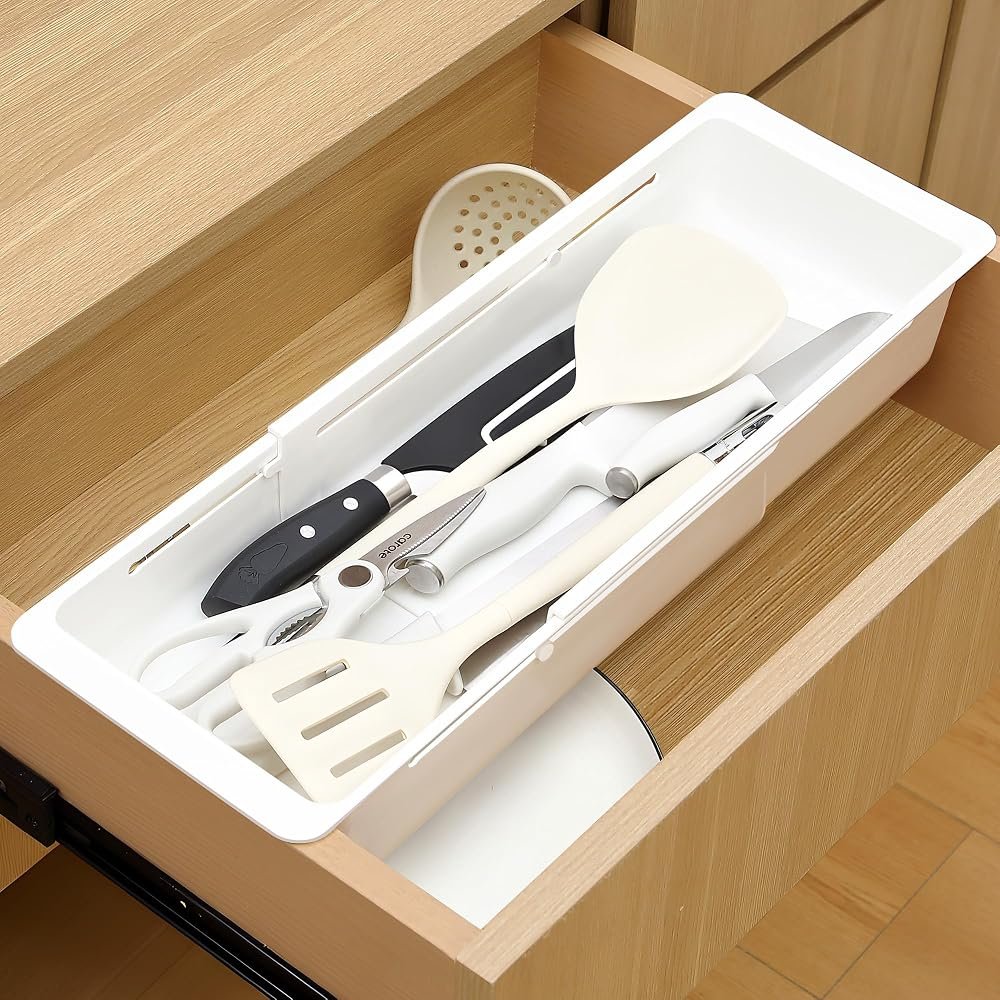
The YouCopia DrawerFit® Sliding Drawer Bin, Expandable and Adjustable Kitchen Storage Organizer, Speckled White is the smallest and least expensive option in this roundup, and it plays a specific role: it is a single bin that slides, designed to bring the back of a deep drawer within reach. If your deep drawer’s problem is that things disappear into the far end, a sliding bin is a direct answer to that.
Because it is expandable and adjustable, it can be tuned to a range of drawer widths rather than requiring an exact match. That flexibility is its main selling point. It is also the kind of organizer you can buy one of, try in a drawer, and then buy more if it works — a low-risk entry point.
Pros
- Lowest listed price of the four options here
- Expandable and adjustable, so it tolerates measurement error
- Sliding design addresses the reach problem in deep drawers
- High rating backed by a substantial number of ratings
Cons
- Single bin — you may need several for a large drawer
- Speckled white finish shows stains more than darker colors
- Sliding mechanism adds a part that can wear over time
Best for: a deep drawer where you want one movable zone for loose items, or a first organizer purchase you can expand later.
Product Deep Dive: 2 Pack Deep Drawer Organizer Adjustable Storage Bin(17.4-27.6″)

The 2 Pack Deep Drawer Organizer Adjustable Storage Bin(17.4-27.6″) is the widest-spanning option in this group. Its stated adjustable range runs from 17.4 inches to 27.6 inches, which covers a lot of drawer widths — including some wide, deep drawers that narrower organizers cannot fill. The two-pack format means you get two bins, which is often enough to divide a single large drawer into two zones without buying twice.
Because the range is broad, this is a good candidate for a drawer whose width you are not entirely sure about, as long as your measurement falls inside that span. The adjustable design is the whole point: it lets one product serve multiple drawer sizes, which is useful if you’re organizing several drawers at once.
Pros
- Wide adjustable range from 17.4 to 27.6 inches
- Two bins per pack, enough to zone a large drawer
- Adjustable design suits drawers of varying widths
Cons
- Lower rating than the other three options here
- Fewer ratings than the YouCopia or Vtopmart listings
- Adjustable bins can feel less rigid than fixed-size bins
Best for: wide deep drawers where you want two adjustable bins and your drawer width sits comfortably inside the stated range.
Product Deep Dive: 4 Pack 6″ Deep Bamboo Drawer Dividers, 17-22″ Expandable Kitchen Organizers

The 4 Pack 6″ Deep Bamboo Drawer Dividers, 17-22″ Expandable Kitchen Organizers is the bamboo option, and it is aimed squarely at the flat-item problem. Dividers like these are what you use to stand sheet pans, cutting boards, and platters on edge so you can flip through them instead of excavating. The stated expandable range is 17 to 22 inches, and the dividers are described as 6 inches deep — a height that suits many deep drawers without towering over them.
The four-pack format means you can create up to five lanes in a single drawer, depending on how you space them. Bamboo gives the set a warmer look than plastic, and the material’s rigidity helps the dividers hold their shape under the weight of heavy pans.
Pros
- Bamboo construction with a warmer look than plastic
- Four dividers create multiple lanes in one drawer
- 6-inch depth suits many deep drawers
- Expandable from 17 to 22 inches
Cons
- Highest listed price of the four options here
- Fewest ratings of the group, so less feedback to draw on
- Bamboo needs to stay dry to avoid swelling
Best for: baking drawers and cookware drawers full of flat items, especially if you want a natural-material look and your drawer width falls between 17 and 22 inches.
Product Deep Dive: Vtopmart 6″ Tall Upgrade Drawer Dividers, 12.8″-22.3″ Expandable, 8 Pack

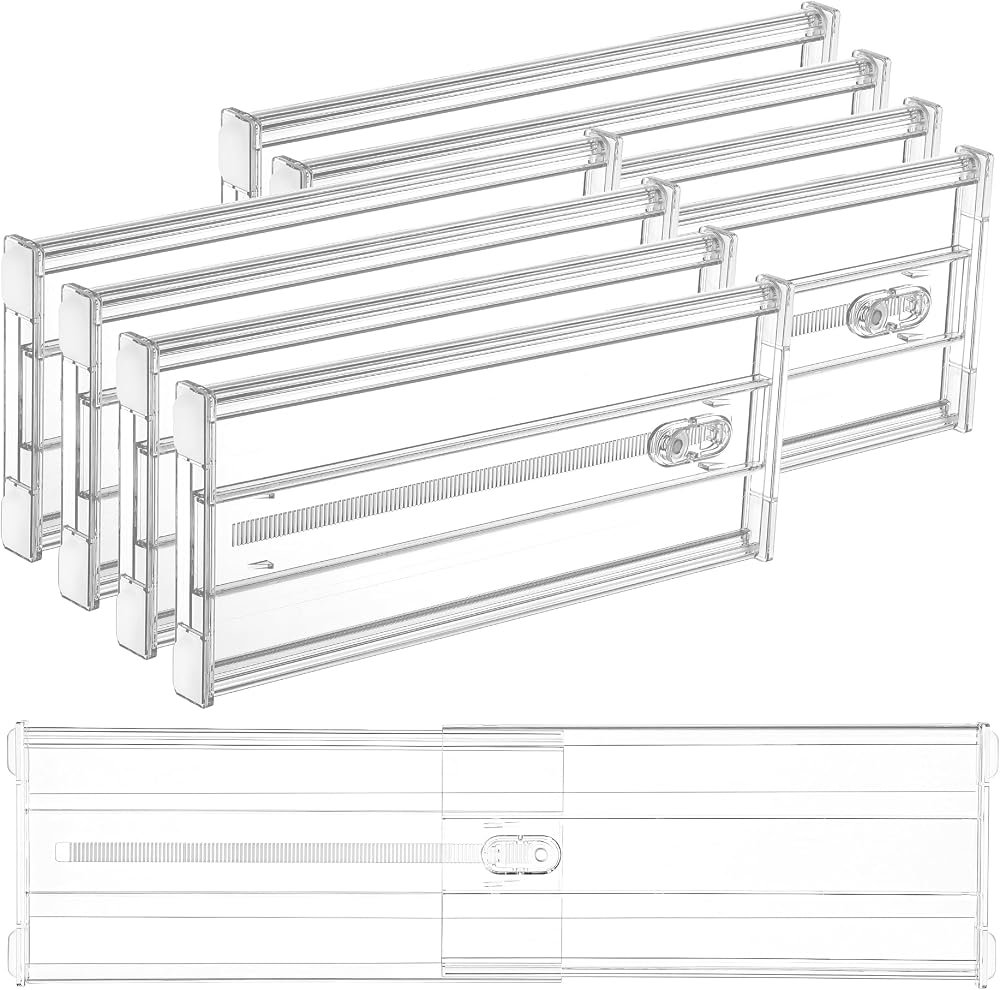
The Vtopmart 6″ Tall Upgrade Drawer Dividers, 12.8″-22.3″ Expandable, 8 Pack is the highest-rated product in this roundup and the one with the most ratings. It is an eight-pack of expandable dividers, each described as 6 inches tall, with a stated expandable range from 12.8 inches to 22.3 inches. That range starts narrower than the bamboo set, which makes it a candidate for smaller drawers as well as mid-size ones.
Eight dividers is a lot of structure. In a single deep drawer, you could create a dense grid of lanes — useful for separating many categories of flat items, or for dividing a long drawer into short, easy-to-scan sections. The “tall upgrade” framing suggests these are meant to support items standing upright rather than just separate them.
Pros
- Highest rating and most ratings of the four options here
- Eight dividers allow dense, highly organized layouts
- Expandable range starts at 12.8 inches, suiting narrower drawers
- 6-inch height supports upright items
Cons
- Eight dividers may be more than a single drawer needs
- Expandable dividers depend on their tension mechanism holding firm
- Not a bin, so it won’t contain loose small items on its own
Best for: drawers that need a lot of lanes, and buyers who value a strong rating history over a lower price.
How to Measure a Deep Drawer Before You Buy Anything
This is the step people skip, and it is the reason so many organizers get returned. You need three numbers, and you need them in inches.
Interior width. Measure between the inside faces of the drawer box, not the drawer front. If your drawer has a lip or a runner mechanism that intrudes, measure at the narrowest point. Expandable organizers state a range — for example, a product that expands from a smaller width to a larger one — and your drawer’s interior width must fall inside that range with a little room to spare.
Interior depth (front to back). This determines how many dividers or bins you can line up. A deep drawer that is also wide front-to-back can hold two rows of bins; a shallow-depth drawer cannot.
Usable height. This is the one that trips people up. Measure from the drawer bottom to the top edge of the drawer side, then subtract anything that hangs down — a cabinet frame, a countertop overhang, a drawer pull mechanism. A tall divider that fits the drawer box may still collide with the cabinet above when the drawer closes.
Tip: Write your three measurements on a sticky note and keep it with you while you shop. Every listing’s expandable range should be checked against that note, not against your memory.
One more measurement worth taking: the height of the items you plan to store. If you’re organizing baking sheets, you need a bin deep enough to hold them upright or flat without tipping. If you’re organizing utensils, a shallower insert may be enough even in a deep drawer. The organizer should match the contents, not just the cavity.
Bins vs. Dividers: What Each One Actually Does
These two categories get lumped together as “drawer organizers,” but they solve different problems.
Bins are containers. They hold a defined set of items and can be lifted out entirely — useful for things you carry to the counter, like measuring cups or spice jars. A sliding bin adds a rail or track so the bin itself moves, which is handy in a deep drawer where reaching the back is awkward. Bins are best when your items are loose, small, or numerous.
Dividers are walls. They don’t hold anything themselves; they subdivide the drawer into lanes. Dividers are best when your items are large and flat — sheet pans, cutting boards, lids, platters — and you want them standing upright in tidy rows. A deep drawer full of baking gear is almost always a divider job.
In practice, most deep drawers benefit from a hybrid: a couple of bins for small loose items at the front, dividers behind them for flat goods. The four products below cover both categories, and you can mix them within a single drawer as long as the widths work out.
Expandable vs. Fixed-Size: Which Fits Your Drawer?
Expandable organizers are the safer bet for most people, because they tolerate measurement error. A fixed-size bin that is a quarter inch too wide simply does not fit, and there is no adjustment. An expandable product that spans a range gives you slack on both ends.
The trade-off is stability. An expandable divider relies on tension or a locking mechanism to stay put. If the mechanism is weak, the divider can slide when you push items against it. That is why reading reviews matters: look for comments about whether the expander holds its position under load, not just whether it arrived in one piece.
Fixed-size organizers tend to feel more solid and are often cheaper per unit, but they demand precise measurements. If you have a standard-width drawer and you’ve measured carefully, fixed-size can be a fine choice. If your drawer is an odd width — older cabinets, custom builds, IKEA boxes — expandable is usually the pragmatic answer.
Also consider whether the expandable range overlaps with your drawer at all. A divider that expands from a narrow span to a wider one will not help a drawer that sits outside that span, no matter how good the reviews are.
Material Matters: Bamboo, Plastic, and What to Expect
Organizers come in a handful of materials, and each has a personality.
Bamboo is the aesthetic favorite. It looks warm, it’s rigid, and it holds up well in a dry drawer. The caveats: bamboo can swell if it sits in standing water, so it is a poor choice for a drawer under a leaky sink or one where you routinely toss wet items. It also tends to be heavier and pricier than plastic. Bamboo dividers with a locking expander are a common configuration, and the material’s rigidity is an asset for holding flat items upright.
Plastic is the practical workhorse. It’s light, inexpensive, easy to wipe clean, and available in every size imaginable. The trade-off is feel — thin plastic can flex under load, and cheap plastic can crack at stress points like expander joints. Look for listings that describe the plastic as thick or reinforced, and check reviews for complaints about cracking.
Metal organizers exist but are less common in the products below. They’re durable and easy to clean but can scratch drawer bottoms and rattle.
There is no universally correct material. A bamboo divider set in a baking drawer and a plastic bin set in a utensil drawer is a perfectly sensible combination. Match the material to the drawer’s environment and to how much you care about looks.
Height, Depth, and the “Will It Actually Fit” Question
Deep drawers invite tall organizers, but taller is not automatically better. A divider that is too tall for the drawer’s usable height will prevent the drawer from closing. A divider that is too short will let tall items flop over.
The right height depends on what you’re storing. For upright sheet pans and cutting boards, you want a divider tall enough to support the item’s full standing height — often around the height of the items themselves. For loose utensils or small tools, a shorter divider is fine and actually easier to reach over.
Depth matters too. A bin that is deeper than your drawer’s front-to-back measurement will not sit flat. An expandable bin that spans a range of widths may also have a fixed depth, so check both dimensions against your drawer. When a listing does not state a dimension you need, that is your cue to ask a question in the listing’s Q&A or look for a dimension diagram in the images — do not guess.
Tip: If a listing’s dimensions are unclear, treat that as a real cost. An organizer that doesn’t fit is worth zero, regardless of its rating.
Mixing and Matching Within One Drawer
You are not required to pick one product and commit. A deep drawer often works best with a layered approach: dividers at the back for flat items, a bin or two at the front for loose ones. The only constraint is geometry — the widths have to coexist.
Here is a simple planning method. Sketch your drawer as a rectangle on paper. Mark the interior width and depth. Then place your intended organizers as smaller rectangles inside it, leaving a little clearance between them. If the rectangles overlap or spill outside the drawer outline, adjust. This takes five minutes and prevents the most common return reason.
Also think about access. Items you use daily should be nearest the front. Items you use occasionally can go behind a divider at the back. A sliding bin is a way to make the back of a deep drawer behave like the front, which is why it pairs well with dividers that occupy the rear.
Tip: Leave a finger-width gap between organizers. Tightly packed inserts are hard to remove for cleaning, and they can bind against each other.
Cleaning and Maintenance for Drawer Organizers
Organizers collect crumbs, flour, and the occasional sticky spill. How you clean them depends on the material.
Plastic bins and dividers are the easiest: most wipe clean with a damp cloth and mild soap. Check the listing for whether the item is dishwasher safe before assuming it is — many expandable plastic organizers have mechanisms that should not go through a dishwasher cycle.
Bamboo needs more care. Wipe it with a barely damp cloth and dry it immediately. Do not soak it, and do not put it in a dishwasher. If bamboo absorbs water, it can swell and warp, which will ruin the fit of an expandable divider. A periodic wipe with a food-safe mineral oil can help maintain the surface, though you should confirm any treatment is appropriate for a kitchen environment.
Expandable mechanisms deserve a periodic check. Extend and retract each divider or bin a few times, and confirm it still holds its position. If a tension mechanism loosens over time, the organizer may need to be replaced rather than repaired.
Common Mistakes That Lead to Returns
Measuring the drawer front instead of the interior. The drawer front is wider than the space inside. Always measure inside the box.
Ignoring the cabinet above. A tall divider can fit the drawer and still hit the countertop or cabinet frame when the drawer closes. Check the clearance.
Buying for the drawer you wish you had. If your drawer is an awkward width, buy an expandable organizer that covers that width rather than a fixed-size one that almost fits.
Overbuying dividers. An eight-pack is a great value only if you have eight lanes’ worth of items. Otherwise you are storing dividers, not organizing with them.
Trusting the average rating alone. A high average with a small number of ratings is less informative than a slightly lower average with many ratings. Read the most recent reviews for fit and durability comments.
Frequently Asked Questions
How do I know if an expandable organizer will fit my drawer?
Measure your drawer’s interior width and compare it to the organizer’s stated expandable range. Your measurement should fall inside that range with a little clearance. If the listing does not state a range, look for a dimension diagram in the product images or ask in the listing’s Q&A.
Are dividers or bins better for a deep drawer?
It depends on what you store. Dividers suit flat, upright items like sheet pans and cutting boards. Bins suit loose, small items like utensils and gadgets. Many deep drawers benefit from both.
Is bamboo better than plastic for drawer organizers?
Bamboo looks warmer and is more rigid, but it must stay dry. Plastic is lighter, cheaper, and easier to wipe clean, but thin plastic can flex. Neither is universally better; match the material to your drawer and your habits.
Can I put drawer organizers in the dishwasher?
Only if the listing says so. Many expandable organizers have mechanisms that should not go through a dishwasher cycle. When in doubt, hand-wash with a damp cloth and mild soap.
How many dividers do I need?
Count the categories of items you want to separate, then add one. A four-pack creates up to five lanes; an eight-pack creates up to nine. Buy for your actual contents, not for the pack size.
Final Thoughts
There is no single best kitchen drawer organizer for deep drawers, because deep drawers vary so much in width, depth, and contents. The honest approach is to measure first, decide whether you need bins, dividers, or both, and then choose a product whose stated dimensions and expandable range actually cover your drawer.
Among the four options covered here, the YouCopia DrawerFit® Sliding Drawer Bin is the low-cost, flexible entry point; the 2 Pack Deep Drawer Organizer Adjustable Storage Bin(17.4-27.6″) covers the widest span; the 4 Pack 6″ Deep Bamboo Drawer Dividers, 17-22″ Expandable Kitchen Organizers is the natural-material choice for flat items; and the Vtopmart 6″ Tall Upgrade Drawer Dividers, 12.8″-22.3″ Expandable, 8 Pack offers the most lanes and the strongest rating history. Any of them can work — the fit is what decides it.
As an Amazon Associate, The Spoonist earns from qualifying purchases. Product prices and availability are accurate as of the date/time indicated on Amazon and are subject to change.
The Spoonist
Get the deals before they sell out
One email a week. Tested gear, real price drops, one-click unsubscribe.
By subscribing you agree to our Privacy Policy.
🥇 Free: Air Fryer Time & Temp Chart
20 foods in °F & °C, the oven-to-air-fryer converter, and starting-points for Ninja, Cosori, Instant & more. Print it, stick it on the fridge.
Want all 92 foods + the rescue guide? Get the full Chart Pack →