
Most makers need descaling every 1–3 months — sooner with hard water. The universal method: fill the reservoir with a 1:1 mix of white vinegar and water, run half through a brew cycle, pause 30 minutes, finish the cycle, then run 2–3 rinses of plain water. Keurig-style pod machines: use Descale Mode (hold 8oz and 12oz buttons 3 seconds). Breville espresso machines: use the manufacturer solution — vinegar can damage their boiler seals.
As an Amazon Associate we earn from qualifying purchases. Prices and availability change — the links below go to Amazon.
Quick picks — all four
Key Takeaways
- White vinegar at 1:1 dissolves scale for pennies, and citric-acid powder does the same chemistry for about $1-2 per run.
- Brand descaling solution costs $10-16 and earns its keep mainly while the machine is still under warranty.
- Denture and cleaning tablets are not formulated for scale – the page tells you to skip them.
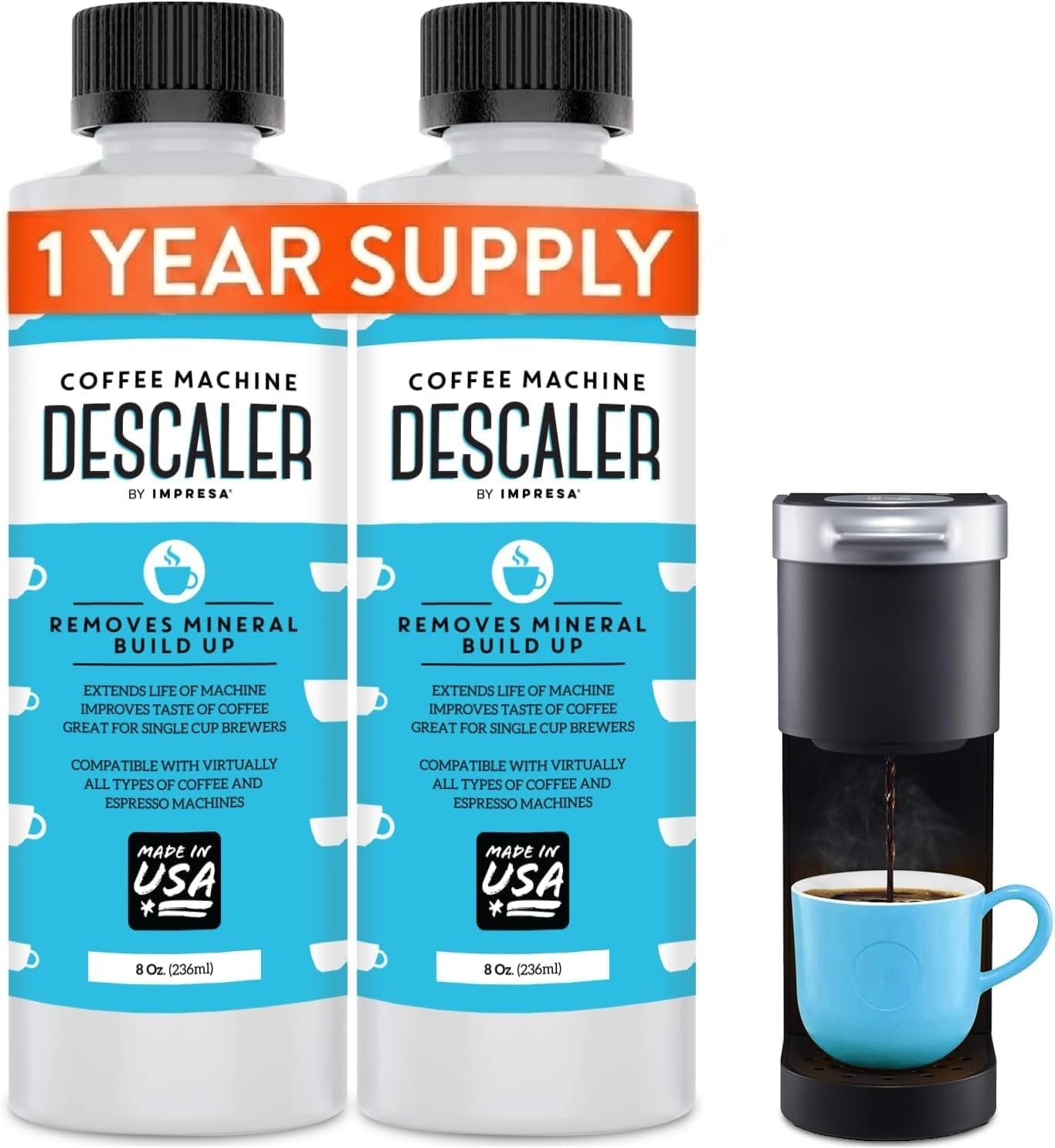
1. IMPRESA Coffee Machine Descaler, 2-Pack (1-Year Supply)
Why this product is good for you
Descaling usually gets skipped for a boring reason: the machine’s own branded cleaner costs more per cycle than the machine is worth to the owner. IMPRESA’s two-bottle pack is $16.99, and it is the most-rated descaling product on Amazon at 88,900 ratings — a sample size most kitchen categories never reach.
It is a liquid you pour into the reservoir with water, so there is no dissolving wait, and the label covers drip machines, pod machines and espresso machines rather than one brand. That matters when the machine in question is a gifted Keurig or an office Breville whose manual went in a drawer years ago.
Key features
- Verified listing price: $16.99 (checked at fetch time)
- Rated 4.4/5 across 88,900 ratings on Amazon at fetch time
- Two bottles, which the listing positions as a year of descaling for a household machine
- Liquid formula — mixes directly in the water tank
Pros
- Cheapest per treatment of the liquid descalers compared here
- No tablet-dissolving wait before the cycle starts
- Label lists broad machine compatibility, not one brand
Cons
- Needs measuring, so keep a spoon or cap handy
- A tall bottle to find shelf space for
Who it’s for
Anyone who descales a couple of times a year and wants the job finished in one sitting.
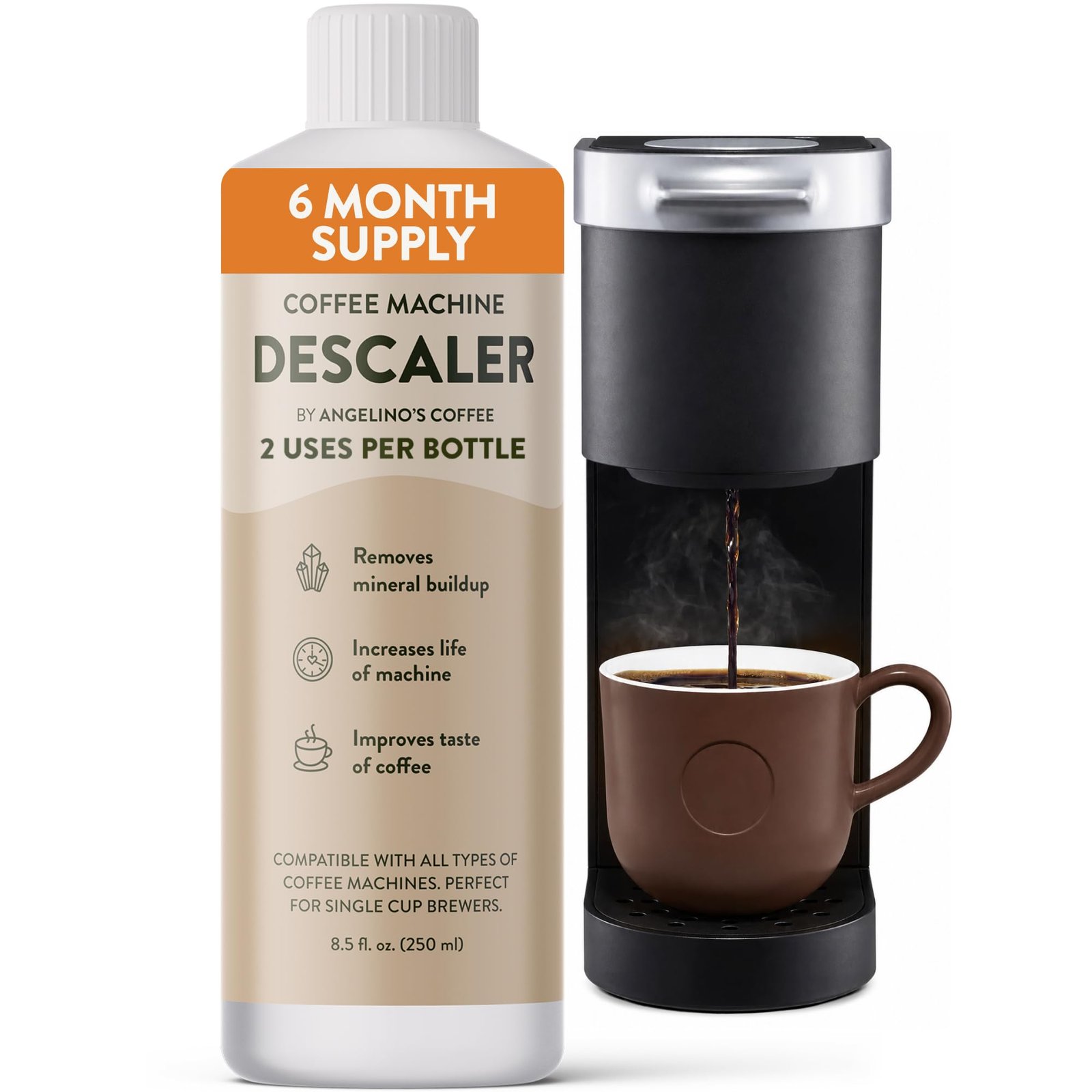
2. Universal Descaling Solution for Keurig, Nespresso, Breville, DeLonghi
Why this product is good for you
At $9.99 this is the cheapest liquid descaler that still carries a real rating base — 4.4 stars across 4,100 ratings. For a drip machine you descale twice a year, the price is the whole argument.
The listing names the four brands most often in the search: Keurig, Nespresso, Breville and DeLonghi. That printed compatibility list is the practical test for a universal acid — whether the bottle says your machine out loud.
Key features
- Verified listing price: $9.99 (checked at fetch time)
- Rated 4.4/5 across 4,100 ratings on Amazon at fetch time
- Keurig, Nespresso, Breville and DeLonghi printed on the label
- Liquid concentrate dosed into the tank
Pros
- Lowest price of the four picks here
- Compatible brands printed where you can check them
- Small enough to live in a cupboard door
Cons
- Smaller rating base than the IMPRESA pack
- One bottle — a second descaling means buying again
Who it’s for
The once-or-twice-a-year descaler who does not want a year of supply on the shelf.
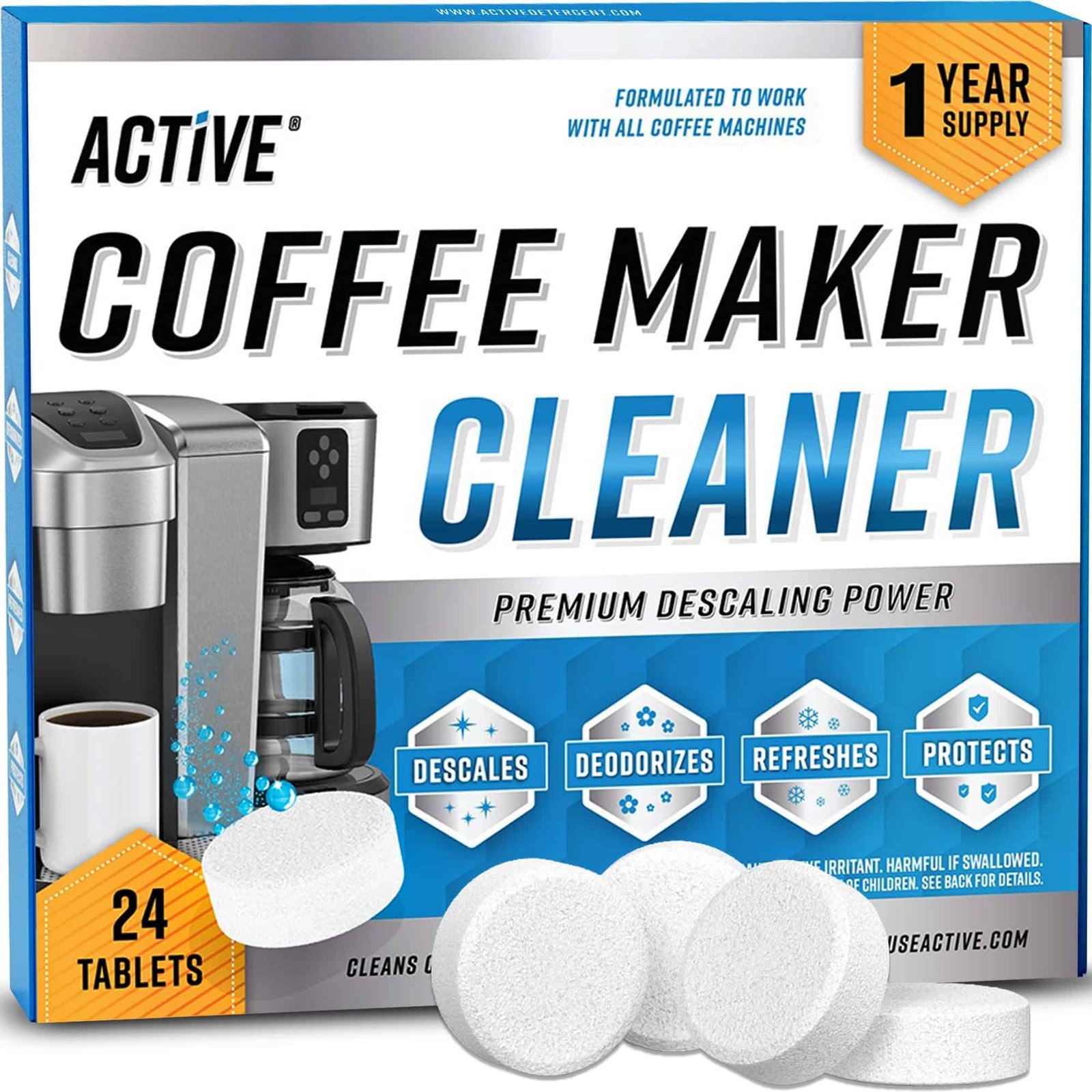
3. Coffee Machine Cleaner Descaler Tablets, 24 Count
Why this product is good for you
Tablets solve a measuring problem: no pouring, no spoon, no half-used bottle on the shelf. This 24-count pack is $23.95 — under a dollar a treatment if you descale monthly — and at 4.6 stars across 14,200 ratings it is the highest-rated format in this comparison.
The trade is time. A tablet has to dissolve before the run starts, which adds ten to fifteen minutes to a cycle you could otherwise pour and go. For a machine descaled on a Sunday afternoon, that cost is close to zero.
Key features
- Verified listing price: $23.95 (checked at fetch time)
- Rated 4.6/5 across 14,200 ratings on Amazon at fetch time
- 24 tablets per pack
- Drop-in format — no liquid to measure
Pros
- Highest rating of the four descalers here
- Cheapest per treatment if you descale monthly
- Pre-dosed, so nothing to measure
Cons
- Dissolve time before the cycle can run
- Upfront cost is nearly triple the budget bottle
Who it’s for
Households that descale on a schedule and want the dose already measured.
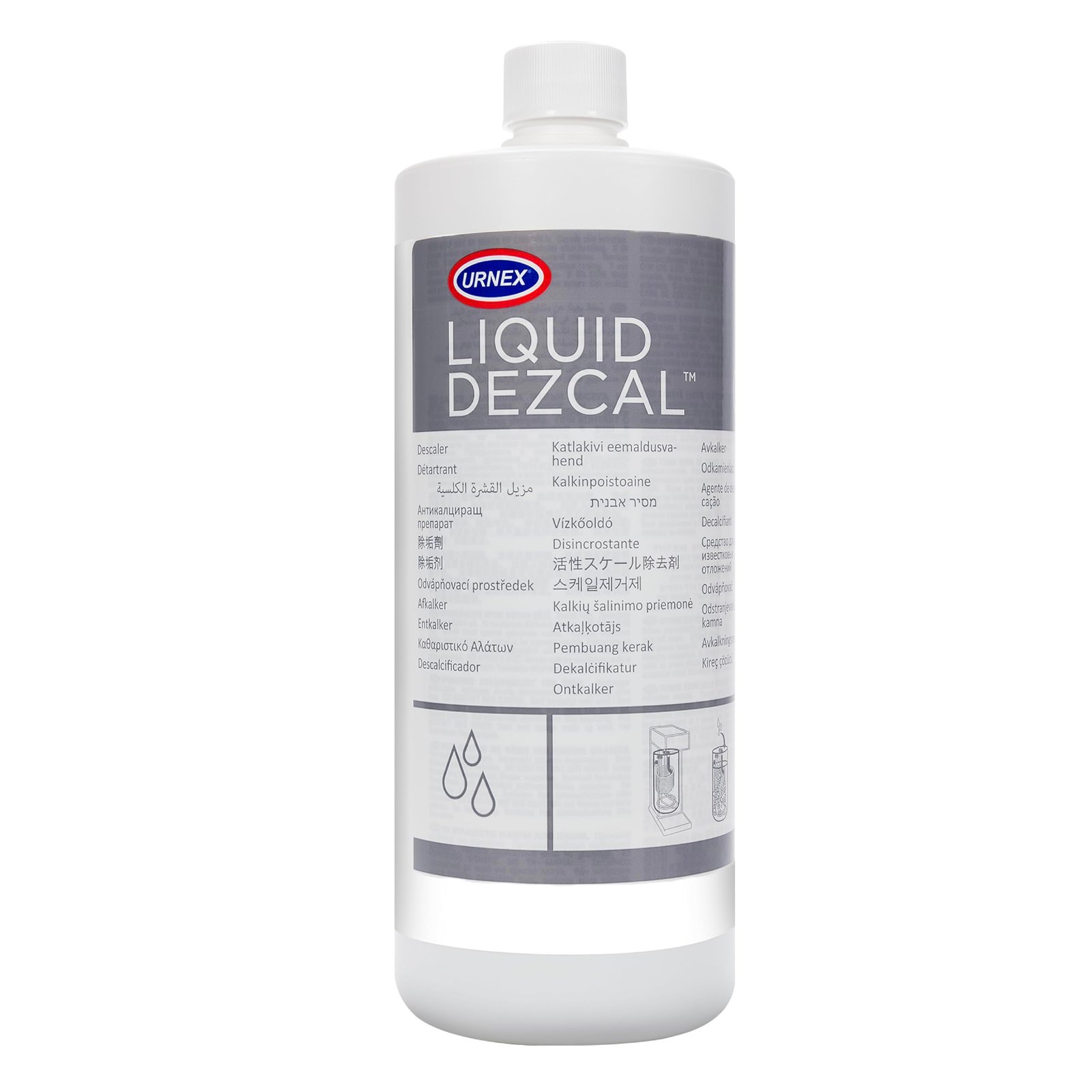
4. Urnex Liquid Dezcal Activated Descaling Solution, 33.6 Ounce (8 Uses)
Why this product is good for you
Urnex is the brand espresso-machine manuals actually name, and Dezcal is the product that has sat under café counters for years. Eight uses come out of a 33.6-ounce bottle at $17.99, rated 4.6 stars.
The honest caveat is the rating base: 1,200 ratings, not 88,900. That is normal for a specialist product bought by people who already own the machine — and it is the one to reach for when the machine is a portafilter espresso maker rather than a drip pot, where scale sits on the group head and in the boiler.
Key features
- Verified listing price: $17.99 (checked at fetch time)
- Rated 4.6/5 across 1,200 ratings on Amazon at fetch time
- 33.6 ounces, listed as 8 uses
- Concentrated liquid — small dose per cycle
Pros
- The descaler espresso manuals recommend by name
- Concentrated, so each use takes a spoonful rather than a cup
- 4.6 stars, the joint-highest here
Cons
- Only 1,200 ratings behind that score
- $2.24 a use, which the budget bottle beats on price
Who it’s for
Anyone with a real espresso machine, where scale is a repair bill rather than a flavour note.
Why Your Coffee Tastes Worse Every Month
If your machine brews slower than it used to, gurgles like it’s fighting for air, or pours coffee that tastes flat and faintly bitter, the cause is almost certainly limescale — calcium and magnesium deposited from your tap water as it heats. Scale builds on the heating element and inside the water lines, insulating the element, narrowing the passages, and throwing off extraction temperature.
Manufacturers list descaling as maintenance, not an option: Keurig’s own care guide and most drip-maker manuals recommend it every 1 to 3 months, and the frequency trade-off is stark — hard-water homes should lean monthly, soft-water homes can stretch to quarterly. Skip it long enough and the element works harder, the machine draws more power, and premature failure is the usual end.
The Universal Vinegar Method (Any Drip Maker or Pour-Over Machine)
White vinegar is roughly 5% acetic acid — enough to dissolve limescale, and it’s what Keurig’s own instructional video demonstrates as the budget option. Here is the full cycle from empty reservoir to coffee-ready:
- Empty and rinse the reservoir. Remove any water filter cartridge first — vinegar strips its capacity and you’ll want a fresh one anyway.
- Fill halfway with white vinegar, halfway with water. A 1:1 mix is the standard; for a machine that hasn’t been descaled in 6+ months, go 2:1 vinegar to water for the first pass.
- Run half the solution through a full brew cycle with an empty carafe and no coffee grounds. Stop the machine mid-cycle if yours allows — pausing lets the acid sit in contact with scale instead of rushing through.
- Let it sit 30–60 minutes. This is the step everyone skips, and it’s the one doing the work. The acid needs dwell time to break the mineral bond.
- Run the remaining solution through, then discard everything.
- Rinse with 2–3 full reservoirs of plain water. Brew a full carafe of water-only coffee on pass three to check you’re not tasting vinegar. If you are, rinse again.
Machine-Specific Instructions That Are Actually Different
Keurig and other pod machines
Pod brewers have a dedicated Descale Mode on most 2.0 models: with the machine powered on but idle, press and hold the 8oz and 12oz buttons together for 3 seconds, then follow the on-screen prompts with the reservoir filled (Keurig’s own guide says its bottled Descaling Solution diluted per label; the vinegar method above works on models without a descale button). K-Supreme and K-Duo models follow a variant — the button-hold combination differs, so check the model’s support page. Never run vinegar through with a pod in place.
Breville espresso machines
Breville’s manuals are explicit: use their descaling solution, not vinegar — the thermoblock boilers and internal seals tolerate citric-based commercial descalers better than household acetic acid, and repeated vinegar cycles can be what voids a warranty claim. The BES870 and BES878 series run a guided descale from the menu (settings → descale). Budget for the official solution even at ~$15 a bottle; it’s cheaper than the boiler.
De’Longhi and super-automatic machines
De’Longhi machines prompt for descaling through their own menu and are designed around De’Longhi descaler (citric-acid based). Vinegar is widely used as a substitute — diluted to 1:2 vinegar-to-water — but super-automatics have more build-in surfaces (milk circuits, brew units) where vinegar residue lingers. Rinse at least three full cycles if you substitute.
Moka pots and stovetop espresso
No electricity, so no internal scaling from the machine itself — but the pot’s interior still builds coffee-oil residue and occasional mineral film. A 1:1 vinegar simmer for 5 minutes, cool, rinse. Never scrub the interior with steel wool; the aluminum passivation layer is what keeps coffee tasting right.
Vinegar vs. Commercial Descaler: Which Should You Use?
Vinegar costs pennies and dissolves limescale — no contest on price. Commercial descalers (Keurig, De’Longhi, Urnex, and generic citric-acid powders) are formulated for the internals: citric acid dissolves scale at least as aggressively without the odor, and they rinse cleaner — vinegar’s smell can cling to plastic reservoirs for days, tainting the next carafe if the rinse cycles were sloppy.
| Method | Cost | Pros / catch | Best for |
|---|---|---|---|
| White vinegar (1:1) | Pennies | Dissolves scale; strong odor; rinse 2–3× | Drip makers, basic pour-over, budget descaling |
| Citric-acid powder | ~$1–2 per descale | Same chemistry as commercial descalers, no smell | All machines; the value choice |
| Brand descaling solution | $10–16 | Formulated for the machine; warranty-safe | Espresso machines, warranty-period machines |
| Denture/cleaning tablets | — | Not formulated for scale — skip | None |
How Often to Descale, Honestly
Use this test, not a calendar: brew a cup and look at the stream. Slow pour, machine gurgling, or steam spitting from the top — descale this week. Otherwise, hard-water homes (you’ll see white crust on the kettle spout) every 4–6 weeks; moderate water every 2–3 months; soft or filtered water quarterly. Descale more often than the taste deteriorates — waiting until it does is what shortens machine life.
The 30-Second Descaling Checklist
- Empty reservoir, remove filter cartridge
- Fill 50/50 white vinegar and water (or brand solution per label)
- Run half → pause 30–60 min → run the rest
- Rinse 2–3 full cycles of plain water
- Brew one throwaway cup and taste-test before the next real brew
What descaling actually does (and why water alone can’t)
Scale is calcium and magnesium that precipitate out of heated water and coat the heating element, the boiler wall, and the narrow tubes behind the pump. It insulates like mineral wool: the element takes longer to reach temperature, the pump works against narrower channels, and the water that finally reaches your grounds arrives off-temperature — which is why scale shows up in the cup as flat, sour, or inconsistently extracted coffee before it shows up on the machine.
Plain water can’t remove it because the deposits are not dirt; they are mineral solids bonded to the surfaces. Only an acid that reacts with carbonate — the acetic acid in white vinegar, citric acid, or a branded descale solution — dissolves them back into solution so the machine can flush them out.
The signs it’s time, before the reminder light
- Brewing takes noticeably longer than it used to
- The machine sounds louder or gurgles mid-brew
- Coffee is cooler than usual, or extraction runs fast then stalls
- White crusty residue appears in the reservoir or on the drip tray
On Keurig and Breville machines the descale reminder may come on time-based rather than condition-based, so use the signs above as the real check between scheduled descales.
How hard water changes the schedule
Manufacturers’ “every 2–3 months” guidance assumes moderately hard water. In hard-water regions — much of the Southwest, Florida, and parts of the Midwest — scale builds about twice as fast, so a monthly descale is the honest schedule. If you brew with filtered or reverse-osmosis water, you can stretch to every 4–6 months: RO water has almost no calcium to deposit. The scratch test is simple — wipe the reservoir dry; if a white film reappears within a day, your water is on the hard end.
Product Reviews: The Descalers Worth Buying
Frequently Asked Questions
Can I use apple cider vinegar instead of white?
You can, but don’t — it’s more expensive, its sugar residue can caramelize on the heating element, and it leaves a stronger taste to rinse out. White distilled vinegar is the one to use.
My Keurig still says “descale” after descaling — why?
The reminder is often time-based, not condition-based: it clears only when Descale Mode is run to completion. If you descaled without triggering the mode, run it once (hold 8oz + 12oz for 3 seconds on most 2.0 models) and follow the prompts through to the end.
Can I descale with citric acid?
Yes — about 1–2 tablespoons per liter of warm water. It’s the same active chemistry as most commercial descalers, odorless, and cheaper. Dissolve fully before filling the reservoir.
Does descaling fix slow brewing?
If the slowness is scale in the water lines, yes — often noticeably. If the machine still runs slow after two descales, the pump may be failing or a one-way valve is stuck; that’s a repair, not a cleaning problem.
Can I descale with baking soda or CLR?
No to both. Baking soda is a weak base and can’t dissolve carbonate scale, and CLR is toxic when heated and never food-safe for brewing equipment.
My machine still tastes like vinegar after descaling — how much rinse is normal?
Two full reservoirs of fresh water through the brew cycle is normal. If taste persists, a third takes care of it — persistent taste usually means the dwell step was skipped and solution is trapped in the boiler.
Does descaling fix coffee that tastes sour?
Often, yes — if the sourness comes from under-extraction caused by scale-cooled water. If a sour taste survives two full descales and a rinse, the cause is grind or freshness, not the machine.
The Spoonist
Get the deals before they sell out
One email a week. Tested gear, real price drops, one-click unsubscribe.
By subscribing you agree to our Privacy Policy.
🥇 Free: Air Fryer Time & Temp Chart
20 foods in °F & °C, the oven-to-air-fryer converter, and starting-points for Ninja, Cosori, Instant & more. Print it, stick it on the fridge.
Want all 92 foods + the rescue guide? Get the full Chart Pack →
As an Amazon Associate, The Spoonist earns from qualifying purchases. Product prices and availability are accurate as of the date/time indicated on Amazon and are subject to change.