
More guides in this series
End-grain boards stand wood fibers upright so the blade sinks between them — gentlest on knife edges and self-healing, but heavier and pricier, and they demand oiling. Edge-grain boards lie flat, are lighter and cheaper, show knife marks sooner, and are the everyday default. End grain wins for serious knife work; edge grain wins for most home kitchens.
As an Amazon Associate we earn from qualifying purchases. Prices and availability change — the links below go to Amazon.
Quick picks — all three
Key Takeaways
- End grain parts around the blade so knife marks stay hidden; edge grain meets the blade across the fibers and scars sooner.
- For a similar maple board the page lists $70-200+ for end grain against $30-80 for edge grain.
- The three picks here are priced $33.66, $74.99 and $128.00, rated 4.0 to 4.5, and one of them carries only 96 ratings.
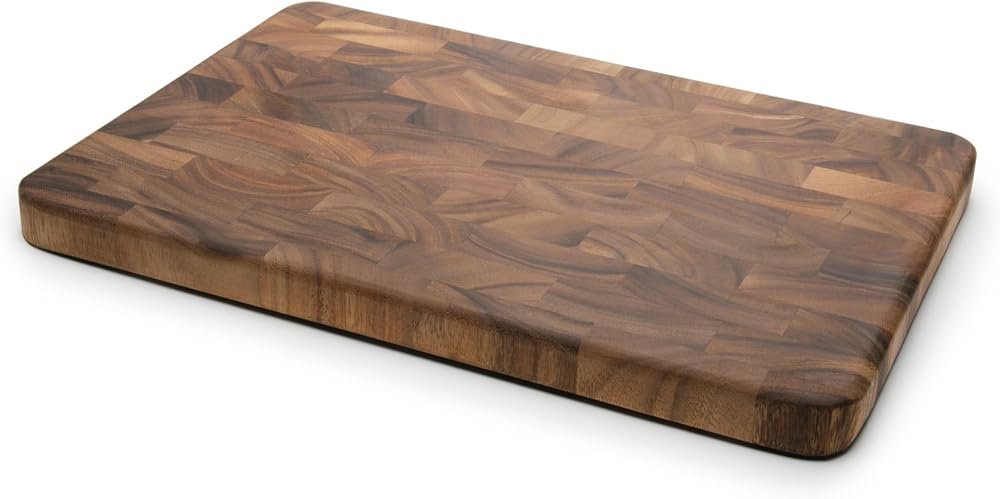
1. Ironwood Gourmet Large End Grain Prep Station Acacia Wood Cutting Board, 14 x 20
Why this product is good for you
End grain is the construction this guide argues for when knives matter, and this station is the most-reviewed affordable version of it: 14 by 20 inches of acacia laid with the fibres facing up, at 4.1 stars across 3,116 ratings.
Size is the practical argument. A 14×20 surface takes a whole chicken breakdown plus the vegetables without a second board, and the juice channels around the edge give runoff somewhere to go. Weight is the counter-argument — an end-grain station this size is a two-handed object, which is exactly why it should live on the counter instead of in a cupboard.
Key features
- Verified listing price: $74.99 (checked at fetch time)
- Rated 4.1/5 across 3,116 ratings on Amazon at fetch time
- 14 x 20 inch end-grain acacia surface
- Juice channels on both faces
Pros
- Largest working surface of the three picks
- End grain gives way to the edge, so knives stay sharper longer
- 3,116 ratings is a genuine sample, not a launch spike
Cons
- Heavy — not a board you wash and stow daily
- 4.1 sits below the composite boards in this price band
- Needs monthly oiling to keep the fibres sealed
Who it’s for
Someone who cooks with a sharp knife several times a week and wants the board left out.
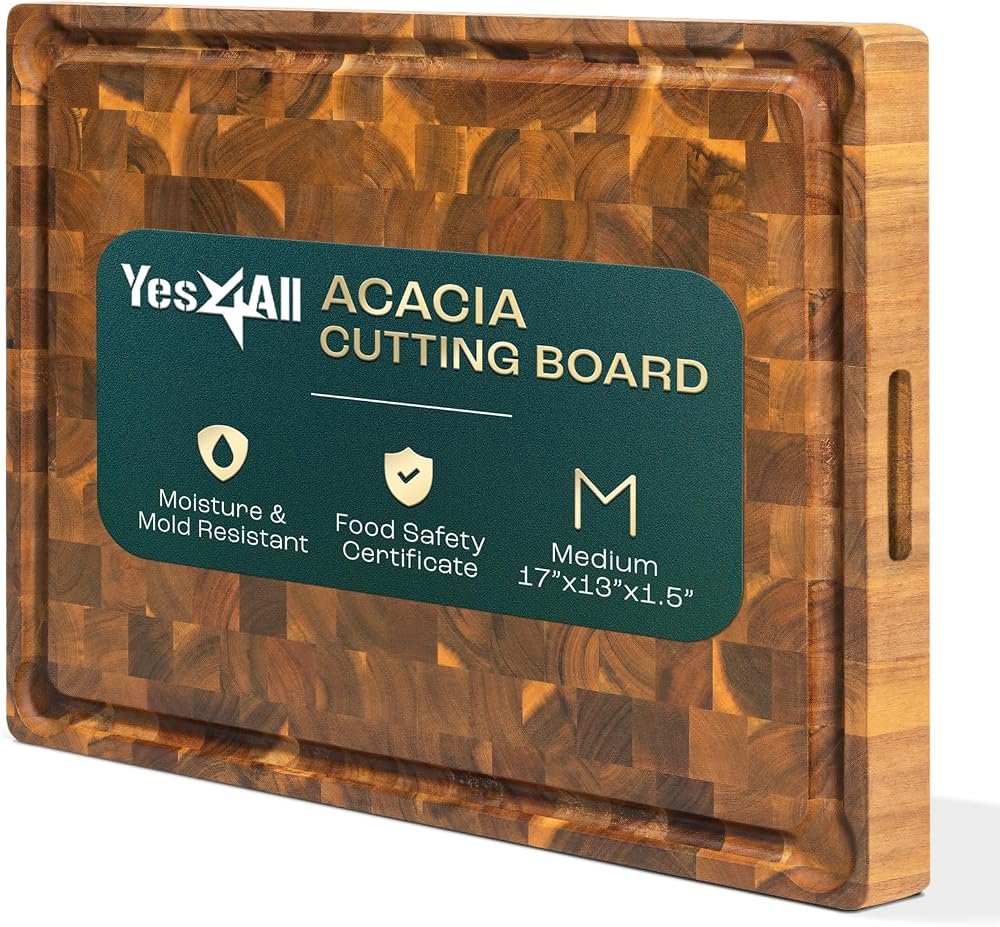
2. Yes4All Medium Acacia Cutting Board, End Grain
Why this product is good for you
End grain normally starts at roughly double this price. At $33.66 this is the cheapest genuine end-grain acacia board the listings support, and it is the right buy if the real question is whether you would notice the difference at all.
Be clear-eyed about the numbers: 96 ratings at 4.0 is a thin sample next to the Ironwood above, and the medium footprint makes it a vegetable board rather than a butcher station. As a low-cost experiment in whether end grain is worth the oiling habit, it does the job.
Key features
- Verified listing price: $33.66 (checked at fetch time)
- Rated 4.0/5 across 96 ratings on Amazon at fetch time
- Medium-size end-grain acacia board
- Same wood construction as boards at twice the price
Pros
- Cheapest end-grain board in this comparison
- End-grain acacia at an edge-grain price
- Light enough to wash and put away nightly
Cons
- Only 96 ratings behind the 4.0
- Small surface means a second board for a full meal
- Lowest rating of the three picks
Who it’s for
The cook testing end grain before committing to a full-size station.
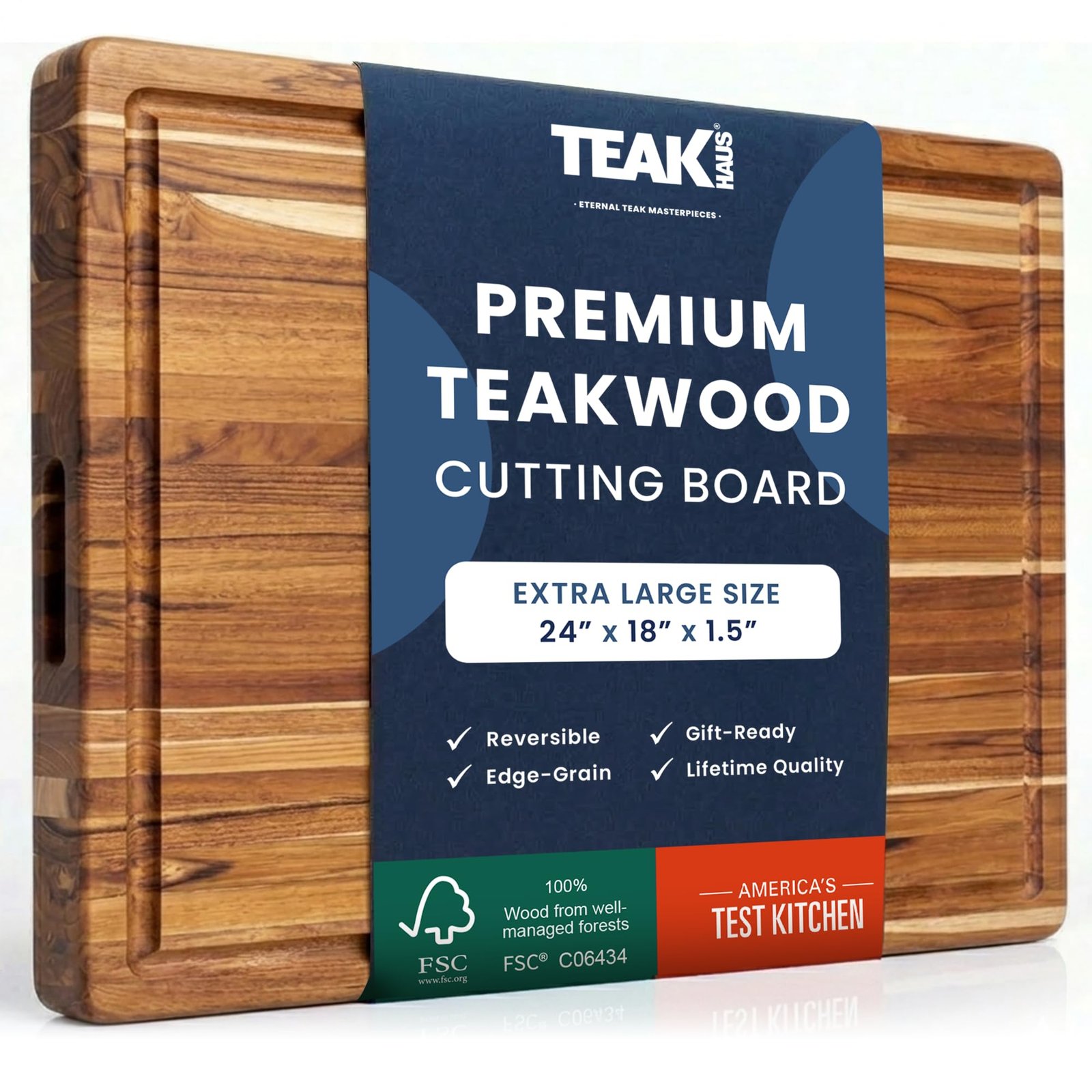
3. Teakhaus Edge-Grain Teak Wood Carving Board with Juice Groove, Extra Large
Why this product is good for you
Edge grain wins on stability and price-per-square-inch, and teak is the wood that makes that case: dense, oily, and the least reactive board material to water. This extra-large carving board carries 4.5 stars across 2,000 ratings.
At $128 the honest framing is purpose rather than value — the juice groove and the footprint are built for a turkey or a pork shoulder, and a flat edge-grain face is easier to keep up than an end-grain block. If the kitchen needs one board for roast nights, this is it; if it needs a daily chopping board, the Ironwood above is the better buy at half the price.
Key features
- Verified listing price: $128.00 (checked at fetch time)
- Rated 4.5/5 across 2,000 ratings on Amazon at fetch time
- Edge-grain teak, extra-large carving footprint
- Deep juice groove runs around the face to hold carving juices
Pros
- Teak’s natural oils mean the least water movement of any board here
- Edge grain sits flatter and more stable under a heavy roast
- Deep groove contains carving juices on a counter
Cons
- Most expensive pick in the guide at $128
- Edge grain dulls knives faster than end grain
- Extra-large means storage becomes a decision
Who it’s for
Thanksgiving, Sunday roast, and anyone carving more than chopping.
The One-Angle Difference That Explains Everything
Cut a board lengthwise down its thickness and you expose the edge grain: the tree’s growth rings seen from the side, fibers running horizontally. Slice a board across its length — like slicing a loaf of bread — and the top surface shows the logs’ growth rings from above: this is end grain. Same wood, two cuts, and they behave completely differently under a knife.
Edge grain is dense and flat — the blade lands on it like a floor. End grain is essentially thousands of tiny straws pointing up; the blade edge separates them slightly and they spring back. Knife-makers and chef forums repeat the same line because it’s true: end grain is kindest to edges.
What End Grain Actually Gives You
- Least edge wear. The blade slips between fibers instead of chopping across them — edges stay sharper measurably longer between honing sessions.
- Self-healing marks. Fibers close back after a cut, so visible knife scars build slowly.
- The butcher-block look — checkerboard construction, heft, and the premium feel of a board built to spend decades in service.
And the honest costs: end-grain construction takes ~3× the glue-ups and labor, so prices start higher for the same footprint. The boards are heavy and thick, they warp fast if left wet, and they demand monthly oiling because exposed end grain drinks moisture like a straw.
What Edge Grain Actually Gives You
- Lighter and thinner — easier to lift, store vertically in a cabinet, and carry to the sink.
- Cheaper for the same wood — the standard way every board is milled, so mid-range maple and walnut options are widely available.
- Fine for most knives — with reasonable honing habits the difference only becomes real with hard daily use.
The trade-off: fibers run horizontally, so every chop lands across them. Knife marks accumulate faster on the visible face, and a very hard chop on a hard board is where edge-rolling shows up first.
| End grain | Edge grain | |
|---|---|---|
| Edge wear on knives | Minimal — fibers part around the blade | More — blade lands across fibers |
| Visible knife marks | Slow to show; self-healing | Show quickly; scars accumulate |
| Weight and thickness | Heavy, typically 1.5–2”+ | Lighter, typically 0.75–1.25” |
| Maintenance | Monthly oiling; never soak or dishwasher | Oil occasionally; more forgiving |
| Price (maple, similar size) | $70–200+ | $30–80 |
| Best use | Daily heavy prep, butcher-style work | Everyday home cooking, most kitchens |
The Four Checkpoints That Decide It for You
1. How often do you cook with a good knife?
Cooking most days with a chef’s knife you sharpen seriously — end grain pays for itself in delayed honing alone. Cooking two or three weeks a month, or mostly serrated/santoku daily driving through onions? Edge grain, no regrets.
2. Do you care about how the board ages?
An end-grain board scars gracefully; an edge-grain board gets visibly knife-marked and becomes a special-of-the-day board faster. If the counter is a visible part of your kitchen, end grain stays photogenic longer.
3. Do you hate maintenance?
End grain without oiling becomes a cracked board within months. If monthly oiling is an unrealistic promise, wood-fiber composite or edge grain is the realistic choice.
4. What’s your actual budget?
For the same footprint and species, end grain runs 2–4× the edge-grain price. That’s honest manufacturing cost — more glue-ups, more hand-sanding. $40–60 buys an excellent edge-grain maple board; $100+ starts serious end grain.
Where Composite, Plastic, and Rubber Fit In
Not every board is wood-grain construction, and ignoring that cheats the comparison: rubber boards (the professional standard for sushi and butcher shops in Japan and Europe) protect edges better than plastics, don’t need oiling, and grip counters at any wetness. Wood-fiber composites split the difference — wood feel, dishwasher-safe, no oiling. Plastic remains the light, disposable, raw-meat option you can run through a full sanitize cycle in the dishwasher. Stainless and “titanium” boards we’ve covered separately — those are meat-prep boards, not daily chopping surfaces.
Our Verdict, and What We’d Actually Buy
Most kitchens should buy a good edge-grain board and stop believing the upgrade anxiety — the difference only matters when knife care is already part of your routine. Serious home cooks and anyone taking knife maintenance seriously should treat end grain as the one board worth a splurge. Neither choice requires the other: plenty of pros keep both, edge grain for vegetables, end grain for carving.
A 30-second anatomy of grain direction
Picture a loaf of bread. Slice it across the top — that’s edge grain: you are cutting across long, flat layers standing sideways. Push the knife straight down through the end of the loaf — that’s end grain: the blade parts bundles of fibers that stand vertically like straws. Wood behaves the same way. In an edge-grain board the fibers run left-to-right; in an end-grain board the block is built so fibers point up at the blade.
What Gordon Ramsay’s board choice actually tells you
Professional kitchens — the ones whose boards chefs like Ramsay work over all day — overwhelmingly use end-grain maple or rubber composite, because the people paying for knife replacement and hand fatigue chose these surfaces decades ago. That doesn’t mean a home cook needs an end-grain block: it means the trade-off (edge preservation and self-healing versus weight, price, and oiling) is exactly what the pros optimize, and you should weigh it with their priorities in mind only if you cook daily.
What woods to avoid, and where board grain fits in
Open-pored woods (red oak, ash) wick moisture and bacteria into unreachable pores; soft, splintery woods (pine) shed fibers into food; and bamboo — technically a grass — is harder on edge than almost any board wood while glues that hold its strands can be harsher than the wood itself. Between end grain and edge grain the wood choice matters less than construction: a closed-grain hard maple board in either construction outperforms an open-pored end-grain oak board on hygiene.
Weight, knife feel, and the numbers nobody publishes
- Typical end-grain maple board at 18×24×2: 8–12 lbs
- Same footprint edge-grain at 1.5″: 5–7 lbs
- End grain “self-heals”: fibers close behind the blade, so knife marks become invisible; edge grain shows a permanent record of cuts
- Refinishing: edge grain can be sanded flat 3–5 times over its life; end grain rarely needs it
The Knife-Science Behind the Preference (In Brief)
Edge geometry explains most of what cooks feel but can’t name. On an edge-grain surface, the blade cuts across fibers, which spring back and press on the steel — this is what gradually micro-blunts the edge. On end grain, the blade slips between vertical fiber bundles, which part and close: the famous self-healing action. The blade experiences less lateral force, and the board records the cut without holding a scar. Cooks who sharpen weekly on edge grain feel the difference within a month of switching.
Care: One Routine Works for Both
Hand-wash with mild soap, dry standing on edge, and oil monthly with food-safe mineral oil until the wood stops drinking it. Never submerge either construction, never dishwash, and never oil with vegetable or olive oil — they go rancid in the pores. Beeswax-in-mineral-oil blends (board butter) add a water-shedding topcoat once a season. Sand out deep edge-grain knife scars with 120-then-220 grit when they get ragged; end grain almost never needs sanding.
Product Reviews: End Grain and Edge Grain Picks
Frequently Asked Questions
Is end grain really better for your knives?
Yes — measurably. In end-grain construction the blade enters between wood fibers that close back up afterward, so the cutting edge stays sharp roughly 30–50% longer than on an edge-grain board of the same wood. It is gentlest when the board is kept oiled and flat.
Why are end-grain boards so much more expensive?
Construction, not materials. An end-grain board is built from dozens (sometimes hundreds) of blocks standing upright, glued, clamped, and planed flat on both faces. That is several times the labor of edge-grain lamination — and the price reflects it.
Does end grain stain or warp more?
It can stain more because exposed end-grain fibers absorb liquid faster — but that same absorption is why it needs oiling more often. With a monthly oil routine, warping is no more common than edge grain. Both boards should never soak or go in a dishwasher.
Is edge grain fine for everyday cooking?
For most home cooks, yes. If you sharpen or hone your knives regularly, use a plastic board for raw meat, and are not cutting tougher fibers all day, a quality edge-grain board — especially maple or walnut — is a perfectly sensible choice at a third to half the price.
What is an edge grain cutting board?
An edge grain board is built from planks laid flat with long wood fibers running left-to-right along the surface. It’s the standard construction — lighter, cheaper, and shows knife marks over time, unlike end grain’s self-healing fiber bundles.
What is the healthiest type of cutting board?
For hygiene, a closed-grain hardwood (maple, walnut, cherry) in end or edge grain, or a TeakHaus-style tight-grain board; avoid open-pored oak, glass, and plastic that gets deeply scored. Construction matters less than material cleanliness and upkeep.
Which woods should I avoid for cutting boards?
Red oak and ash (open pores trap bacteria), pine and other splintery softwoods, bamboo (glues are hard on knives), and anything glass, stone or steel — those wreck edges and dull blades fastest.
Do end grain boards really last longer?
In decades of service life, yes — end grain wears without splintering and rescores less visibly. But the trade is real: more weight, more money, and monthly oiling for a board you may never re-oil. Edge grain serves most kitchens better per dollar.
The Spoonist
Get the deals before they sell out
One email a week. Tested gear, real price drops, one-click unsubscribe.
By subscribing you agree to our Privacy Policy.
🥇 Free: Air Fryer Time & Temp Chart
20 foods in °F & °C, the oven-to-air-fryer converter, and starting-points for Ninja, Cosori, Instant & more. Print it, stick it on the fridge.
Want all 92 foods + the rescue guide? Get the full Chart Pack →
As an Amazon Associate, The Spoonist earns from qualifying purchases. Product prices and availability are accurate as of the date/time indicated on Amazon and are subject to change.