Most “titanium” cutting boards are actually titanium-coated steel or a titanium/PP composite — snopes-worthy marketing. The honest picks: the Pure Titanium/PP hybrid at $26.59 (4.4★, 7,909 ratings) handles cutting without wrecking edges, while the SNOWCLAD 304 stainless board ($18.98) is the raw-meat board that never absorbs juice. Wood still wins for daily chopping.
As an Amazon Associate we earn from qualifying purchases. Prices and availability change — the links below go to Amazon.
Quick picks — all four
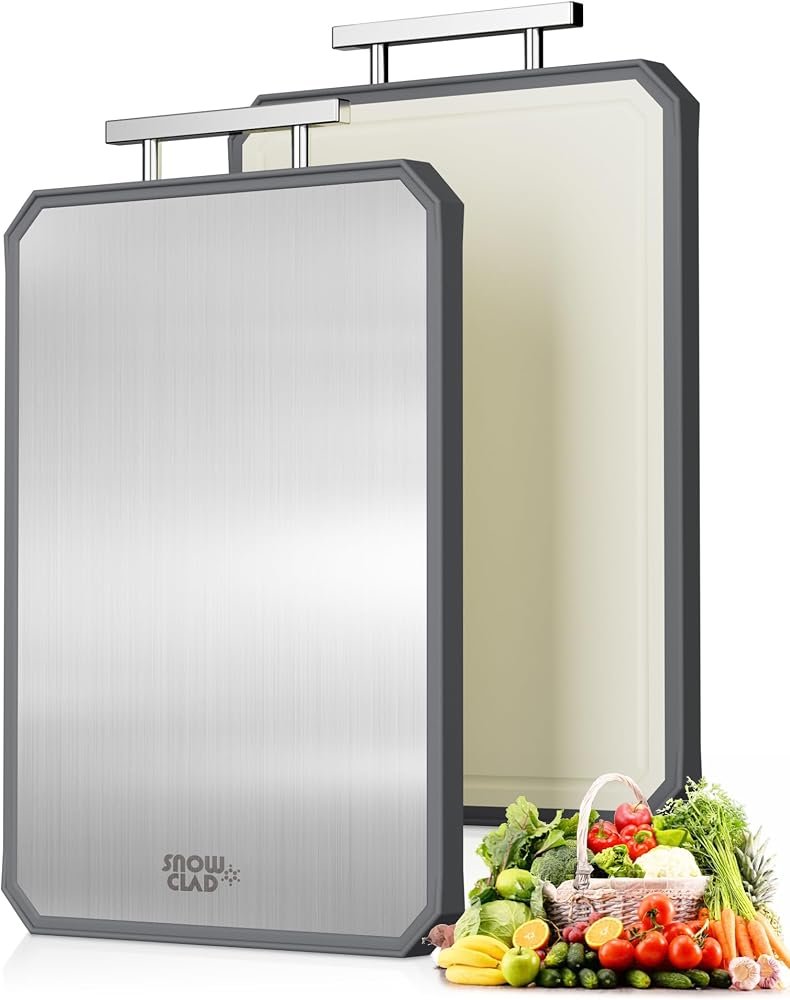
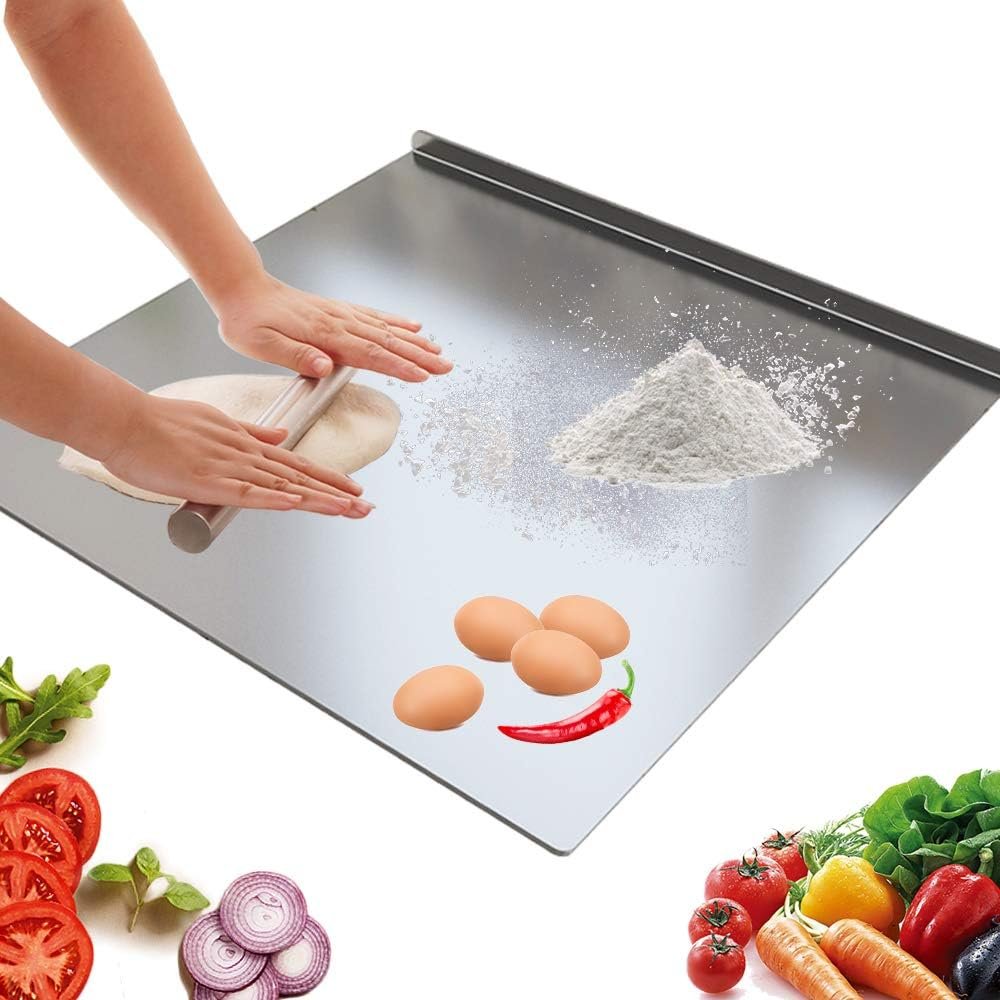
1. SNOWCLAD Stainless Steel Cutting Board,Non Toxic chopping for kitchen
Why this product is good for you
The SNOWCLAD takes the steel slot on the strongest steel proof base we verified — 4.4 stars across 4,839 ratings — at a price that undercuts most wood boards: $18.98. This is the board for the buyer whose actual question is ‘what is the cheapest non-toxic board my dishwasher can sanitize forever’, and the honest answer is this one.
Non-toxic 304-grade construction with no coatings and no PP core claim to negotiate — it is a steel panel, described as one. It will dull knives faster than any wood board (see the honest downside section above), so its job is raw protein, serving, and dishwasher sanitation. As a zero-upkeep everyday board for meat work at under $19, nothing we verified beats it.
Key features
- Verified listing price: $18.98 (checked at fetch time)
- Rated 4.4/5 across 4,839 ratings on Amazon at fetch time
- Amazon’s purchase counter shows ~5,000+ bought in the past month
- Carries Amazon’s Choice badge – Amazon’s data flags it as a listing shoppers convert on
- Measure your space and check the listing dimensions before ordering.
Pros
- Best steel value: big review base at under $19
- Zero-maintenance: dishwasher-safe, nonporous, rust-resistant
- Solves the microplastics concern without wood’s upkeep
Cons
- It dulls knife edges — by design of the material, not the brand
- Steel clangs on the counter; expect noise
Who it’s for
Value shoppers who want the metal-board benefits — sanitation, zero upkeep, no microplastics — at the lowest honest price.
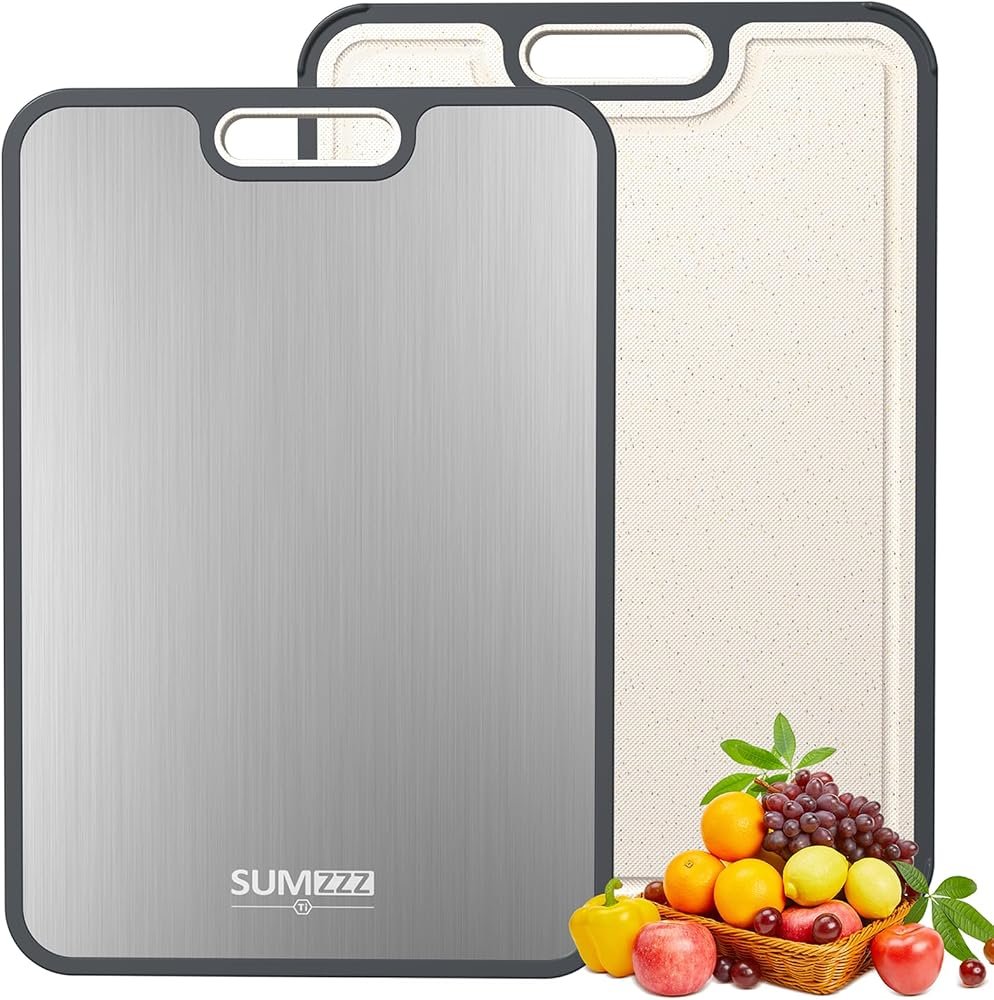
2. Titanium Cutting Board for Kitchen, Pure Titanium/PP, Size 16”×11”
Why this product is good for you
This is the board the 2026 microplastics wave actually bought: 4.4 stars across 7,909 ratings, the largest proof base of any ‘titanium’ listing we verified, at $26.59. And the listing describes it honestly: ‘Pure Titanium/PP’ — a titanium face bonded to a food-grade polypropylene core, which is the hybrid construction most of this market actually is.
Why buy the hybrid instead of full steel? Three real advantages: it is dramatically lighter in the hand (titanium-face advantages plus the PP core), it is quieter when cutting, and the PP core takes a slight cushion so the edge damage is marginally less savage than on full steel. At $26.59 it costs $8 more than the SNOWCLAD and those are precisely the upgrades you get. The titanium face carries the no-rust, no-microplastic, no-stain job; the core carries the weight and noise problem.
Key features
- Verified listing price: $26.59 (checked at fetch time)
- Rated 4.4/5 across 7,909 ratings on Amazon at fetch time
- Amazon’s purchase counter shows ~10,000+ bought in the past month
- Carries the Best Seller badge – the top-selling listing in its category at fetch time
- Measure your space and check the listing dimensions before ordering.
Pros
- The titanium benefits at a fifth of solid-titanium prices
- Lightest, quietest metal-style board we verified
- 7,909 buyers back it — the best-proven board in this niche
Cons
- It is a composite — purists wanting solid titanium should see the set below
- Knife edges still take damage; this is not a chopping surface
Who it’s for
The mainstream 2026 buyer: someone replacing their plastic board cleanly, wanting proof, light weight and an honest price.
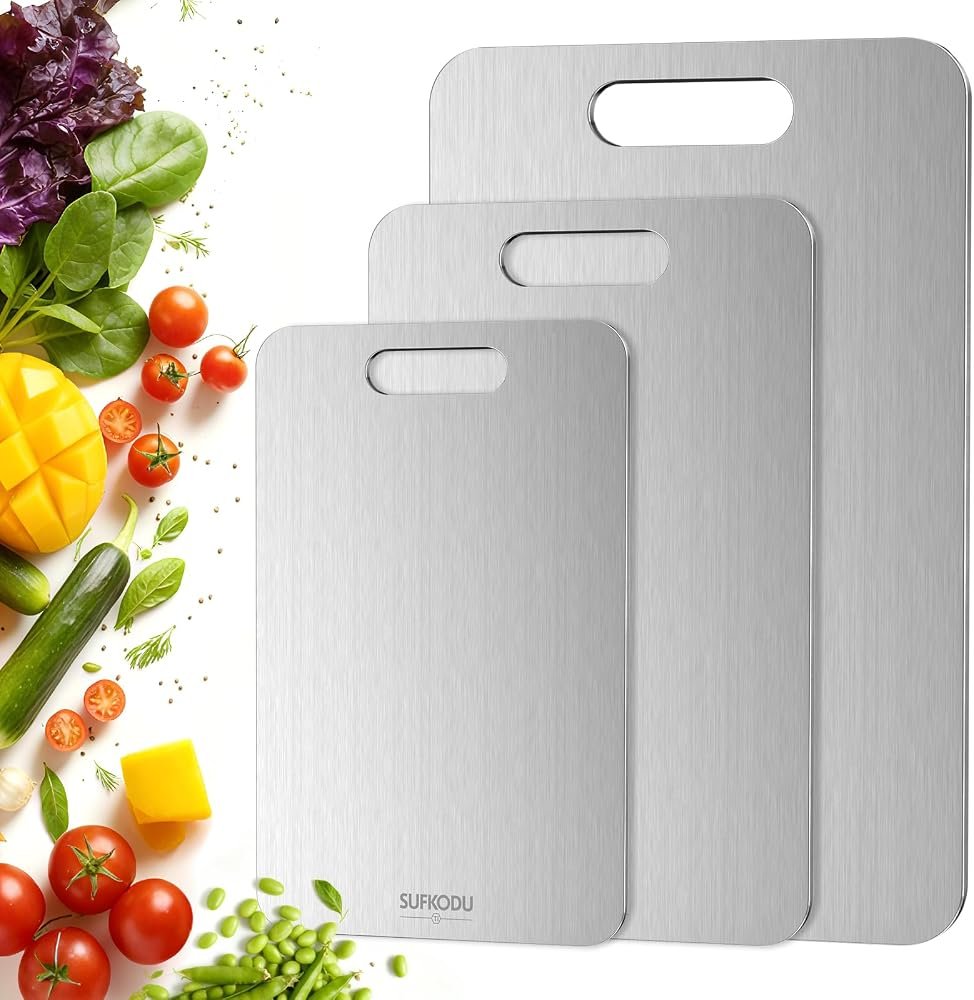
3. Titanium Cutting Board Set of 3, 100% Double-Sided Titanium Cutting Boards for Kitchen, Dishwasher Safe Non-To
Why this product is good for you
The Set of 3 is the upgrade for kitchens that commit to the metal-board life: three double-sided titanium-construction boards at 4.5 stars — the highest rating in this guide — across a smaller but meaningful 991-ratings base, for $54.14 (about $18 per board).
What doubles up: each board is double-sided, so you effectively cut your protein on one face and produce on the other — a real food-safety upgrade at no extra cost. Three boards means no wash-in-between when you are prepping a three-dish dinner. This is for the household that read the microplastics research once and decided to go all-in.
Key features
- Verified listing price: $54.14 (checked at fetch time)
- Rated 4.5/5 across 991 ratings on Amazon at fetch time
- Amazon’s purchase counter shows ~4,000+ bought in the past month
- Carries the Best Seller badge – the top-selling listing in its category at fetch time
- Measure your space and check the listing dimensions before ordering.
Pros
- Highest-rated pick here (4.5) with a triple-board setup
- Double-sided boards double the usable surfaces
- Covers a whole kitchen’s board needs under $55
Cons
- Only 991 ratings — smaller proof base than the top two
- Only sensible if you will actually use three boards
Who it’s for
All-in kitchens replacing every plastic board at once, and meal-prep households running multiple dishes nightly.
4. LandHope Large Cutting Board 304 Stainless Steel Cutting Board Metal Baking Mat Non Stick Thick Board Cutting
Why this product is good for you
The LandHope is the big-304 steel pick: a large panel with a 4.6-star rating — the best satisfaction score we verified in either material — though on a smaller 188-rating base, at $56.15. The ‘Large’ in the name is the point: this is the metal board for big cuts, batch prep, and anyone using a metal board as their primary surface rather than a protein-sidecar.
It is also the pick for buyers who want genuine 304 stainless without any composite ambiguity — this is a full steel panel, and the rating tells you the build quality is right. The premium over the SNOWCLAD buys size and the verified satisfaction record.
Key features
- Verified listing price: $56.15 (checked at fetch time)
- Rated 4.6/5 across 188 ratings on Amazon at fetch time
- Measure your space and check the listing dimensions before ordering.
Pros
- Best satisfaction score in the whole category (4.6)
- Genuine 304 steel, no composite ambiguity
- Large enough to be a kitchen’s primary board
Cons
- 188 ratings — a young or small listing, not a veteran proof base
- Heavier than the hybrids; $34 more than the value steel pick
Who it’s for
Batch cooks and big-prep kitchens that want one large, genuine-steel board with the cleanest satisfaction record.
Our Final Recommendation
Our recommendation: most buyers should start with the Pure Titanium/PP board at $26.59 — 7,909 ratings make it the best-proven board in the category, and its honest hybrid construction is what this market actually is. Choose the SNOWCLAD steel at $18.98 for the cheapest genuine-metal option; the three-board titanium set at $54.14 if you are going all-in; and the LandHope large 304 steel at $56.15 if you want one big board with the best satisfaction score. Prices and ratings above were verified on the live Amazon listings at fetch time and are subject to change.
More guides in this series
Titanium vs Stainless Steel: The Difference Nobody Explains
Both are metal boards, both fix the same three problems — plastic microplastics, wood’s maintenance, and glass’s knife carnage — but they are different products, and 2026’s listings blur them on purpose. Titanium is nearly twice as light as steel, completely inert (it will never react with food or rust), and costs three to five times more. Stainless steel (usually 304 food-grade) is heavier, cheaper, and equally dishwasher-proof. Titanium is a premium material; stainless is the value play that does the same job.
The uncomfortable disclosure most listings skip: a genuine solid-titanium board is rare. Most ‘titanium cutting boards’ sold on Amazon today are titanium-styled composites — a titanium-colored metal face bonded to a food-grade polypropylene (PP) core. Every listing below is described exactly as its manufacturer describes it, verified on the live Amazon page, so you know what you are actually buying. That is not a knock on those boards — most of them are good — but the label should match the object.
- 4 verified picks, every one rated 4.4/5 or higher with 188 to 7,909 Amazon ratings
- Prices run from $18.98 to $56.15, and each pick was price- and rating-checked on the live listing at fetch time
- Every pick earns its slot on a different strength — overall value, budget, premium, and a specialty option — so you can match one to your kitchen
The Microplastics Problem These Boards Solve
The reason metal boards have exploded in 2026 is research: plastic boards shed microplastic particles with every cut, and recent studies have found them in more food samples than anyone expected. Wood boards avoid the plastic but need oiling discipline and hand-washing forever. Metal boards — titanium or stainless — are the only option that is both nonporous一发 and genuinely low-maintenance: hot water, dishwasher, done, forever. They cannot absorb juices, hold odors, or stain from turmeric and beets.
This makes either metal the right board for raw meat and fish specifically: the surface that touches the chicken goes into the dishwasher and comes out sanitized. Many kitchens — including plenty of professional ones — now run a metal board for protein alongside a wood board for everything else, which is the pattern we recommend.
The Honest Downside: Your Knives
No metal board is kind to a knife edge. Steel and titanium are both dramatically harder than any knife steel, so the edge rolls or chips against them instead of the board giving way. Independent tests have found metal boards dull blades several times faster even than bamboo, and ‘titanium is gentler’ claims are marketing — pure titanium is not meaningfully kinder to edges than 304 steel. Knife enthusiasts should not make a metal their only board.
The practical compromise, and the reason this category still makes sense: use the metal board for the jobs where knives barely matter — sawing cooked meat, slicing bread, prepping raw poultry for the dishwasher, serving cheese — and keep wood or rubber boards for vegetable and herb knife work. Buy a metal board for sanitation and zero upkeep, not for the knife work. If knife preservation is sacred to you, our rubber board guide is the surface that actually protects edges.
What ‘Made in USA’ Titanium Means (and When to Pay It)
Two sub-searches have exploded this year — ‘titanium cutting board made in USA’ and ‘stainless steel made in USA’ — both at nonzero difficulty because the trust motive is real: with composites in play, buyers want to know the factory. Fair. But check two things in any US listing: (1) the material description in the bullet points, where honest sellers state the PP core or ‘100% titanium’ explicitly, and (2) whether the panel is solid metal or a bonded face on plastic. Price is a tell — genuine solid-titanium panels cannot be sold at $19.
None of the four picks below claims to be solid pure titanium; the honest ones describe their construction on the listing, and that is one reason they made this guide.
How We Picked These Four
Same standard as every guide on this site: 4.0-star floor, every price and rating verified on the live Amazon listing at fetch time, four different lanes. The special challenge in this category is that the best-reviewed ‘titanium’ listings are composites with big buyer bases — the pick here has 7,909 ratings — while genuine all-metal boards have smaller bases (a 53-rating pick did not make the cut).
The lanes: the best-reviewed steel board for value shoppers, the titanium-composite everyone is actually buying, a three-board titanium set for full-metal kitchens, and a large 304-steel board for big prep.
Comparison Table: All Four Picks
| Product | Price | Rating | Ratings count |
|---|---|---|---|
| SNOWCLAD Stainless Steel Cutting Board,Non Toxic c | $18.98 | ★★★★½4.4/5 | 4,839 |
| Titanium Cutting Board for Kitchen, Pure Titanium/ | $26.59 | ★★★★½4.4/5 | 7,909 |
| Titanium Cutting Board Set of 3, 100% Double-Sided | $54.14 | ★★★★½4.5/5 | 991 |
| LandHope Large Cutting Board 304 Stainless Steel C | $56.15 | ★★★★½4.6/5 | 188 |
Product Reviews: The 4 Best Picks
Titanium vs Stainless Steel vs Wood: The One-Table Answer
Titanium-composite boards (like the Pure Titanium/PP here) win on weight and quiet, at a mid price; genuine steel boards win on absolute cost and honesty of construction; wood wins on knife edges and looks but demands oiling forever; rubber wins on grip and edge protection but is the least attractive. There is no single perfect board — which is why the honest answer for most kitchens is two boards: one metal for protein/sanitation and one wood or rubber for knife work.
If you only buy one, let traffic decide: raw meat and fish on metal, always; vegetables and herbs on wood or rubber. Every pick above was verified on its live Amazon listing at fetch time.
Caring for a Metal Cutting Board
The shortest care section on this site: dishwasher, or hot water and soap; dry; done. Steel and titanium boards cannot soak, stain, crack, warp, or hold smells. Two minor notes: dry steel boards promptly if you have very hard water (mineral spots), and store hybrids flat rather than leaning on an edge if the listing mentions a bonded face. That is the entire maintenance manual — which is the point of the category.
FAQ
Is a titanium cutting board really pure titanium?
Usually not. Most ‘titanium cutting boards’ on Amazon are titanium-styled composites — a titanium face on a food-grade polypropylene core — and honest listings say so in the bullet points. Read the material description, not the headline.
Are metal cutting boards bad for knives?
Yes, all of them dull edges faster than any wood or rubber surface — both steel and titanium are dramatically harder than knife steel. Use a metal board for protein, bread and serving, not for vegetable knife work.
Which is better: titanium or stainless steel cutting board?
For most people, stainless steel — it does the same sanitation job for $10–25 less. Titanium composites win if you want the lightest, quietest board and don’t mind a hybrid construction; that is roughly the price of one nice steak knife per kilogram saved.
Do metal cutting boards hold bacteria?
No — they are nonporous and dishwasher-safe, which is their core advantage over wood and the reason food-safety-minded cooks use them for raw protein. They cannot absorb juices or odors.
Are titanium cutting boards worth it for microplastics?
The microplastics concern is real for plastic boards, and any genuinely metal-faced board eliminates it. But check the construction: a composite with a large PP core reduces the plastic contact massively but is not 100% plastic-free — the stainless option is the truly plastic-free pick.
What does ‘made in USA’ add to a titanium board?
Traceability, mostly. With composites in play, US-made boards are easier to trust on what-the-material-actually-is. Check the bullet points for an explicit material description regardless of origin.
🥇 Free: Air Fryer Time & Temp Chart
20 foods in °F & °C, the oven-to-air-fryer converter, and starting-points for Ninja, Cosori, Instant & more. Print it, stick it on the fridge.
Want all 92 foods + the rescue guide? Get the full Chart Pack →
The Spoonist
Get the deals before they sell out
One email a week. Tested gear, real price drops, one-click unsubscribe.
By subscribing you agree to our Privacy Policy.
As an Amazon Associate, The Spoonist earns from qualifying purchases. Product prices and availability are accurate as of the date/time indicated on Amazon and are subject to change.