
Why Your Cutting Board Matters More Than Your Knives
Every cut you make lands on the board first, and the board decides what happens to both the food and the knife. A glass or marble board looks elegant and quietly destroys edge geometry with every stroke — it is harder than the steel itself. A soft, forgiving surface lets the edge bite, stop and release cleanly, which is why professional kitchens run on plastic and wood, not stone.
Hygiene is the second factor. Raw chicken on a scarred wooden board is a food-safety problem; on a non-porous plastic or steel board you can sanitize it in the dishwasher. Wood wins for bread, produce and serving; plastic wins for raw proteins; the newer titanium and stainless boards claim both worlds. This guide covers one of each so you can match the board to the job instead of buying three boards that all do the same thing.
As an Amazon Associate we earn from qualifying purchases. Prices and availability change — the links below go to Amazon.
Quick picks — all four
1. GORILLA GRIP Cutting Board Set of 3, Slip Resistant and Nonporous, Black

Why this product is good for you
This is the board most kitchens should start with, and the numbers explain why: 52,616 ratings at 4.6 stars is one of the largest verified proof bases in the entire kitchen category. The three-piece set gives you a dedicated board for raw proteins, one for produce, and one for serving — the separation that food-safety guides keep asking for.
The slip-resistant edges matter more than the marketing suggests. A board that slides while you slice is the most common cause of knife accidents at home, and the non-slip corners on this set hold firm on wet counters. At $18.99 for three boards, the cost per board is lower than most single boards on shelf.
Key features
- Verified listing price: $18.99 (checked at fetch time)
- Rated 4.6/5 across 52,616 ratings on Amazon at fetch time
- Amazon’s purchase counter shows ~8,000+ bought in the past month
- Check the listed dimensions against your sink and counter space — boards photograph larger than they measure.
Pros
- 52,616 ratings at 4.6/5 — enormous, sustained buyer approval
- Three boards for $18.99 — cheapest per-board cost in the guide
- Dishwasher-safe and gentlest surface here for knife edges
Cons
- Deep knife scars appear over years and are not repairable
- Not the board for serving guests — it reads as utilitarian
Who it’s for
Families and everyday cooks who want the food-safety separation of multiple boards without spending real money, and anyone who puts boards in the dishwasher.
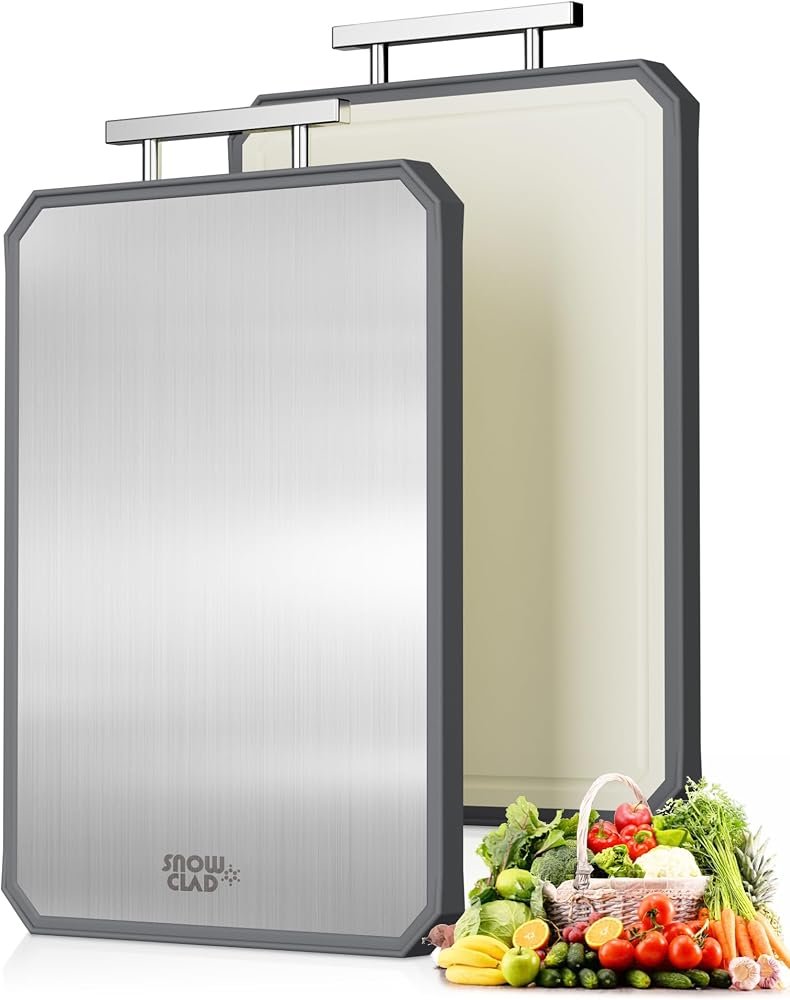
2. SNOWCLAD Stainless Steel Cutting Board,Non Toxic chopping for kitchen

Why this product is good for you
Snowclad is the affordable entry into the non-porous steel category: 4,787 ratings at 4.5 stars on a board that will never absorb a garlic odor, never stain from beet juice, and never warp in a dishwasher. For raw protein work it is the most hygienic surface in this guide.
Steel is harder on knife edges than plastic — plan on slightly more frequent honing if this becomes your daily driver. Buyers accept that trade for the zero-porosity hygiene and the modern look at a $19.99 price that undercuts every wood board its size.
Key features
- Verified listing price: $19.99 (checked at fetch time)
- Rated 4.5/5 across 4,787 ratings on Amazon at fetch time
- Amazon’s purchase counter shows ~7,000+ bought in the past month
- Check the listed dimensions against your sink and counter space — boards photograph larger than they measure.
Pros
- 4,787 ratings at 4.5/5 with a $19.99 entry price
- Most hygienic surface here — nothing absorbs, nothing stains
- Oven-safe to rest hot pans on directly
Cons
- Harder on knife edges than plastic or wood
- Louder when chopping; metal-on-metal clatter with some knives
Who it’s for
Hygiene-first buyers who prep a lot of raw meat and want a board that sanitizes completely in the dishwasher.
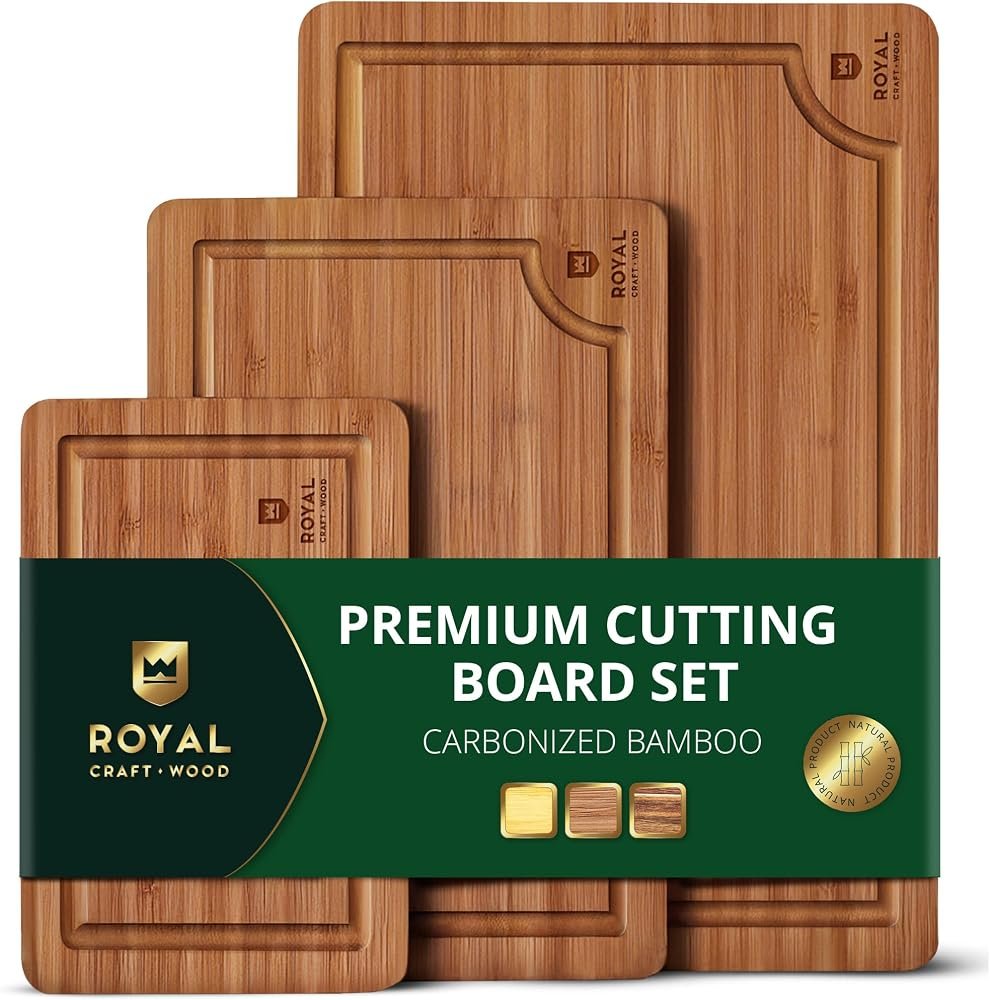
3. ROYAL CRAFT WOOD Wooden Cutting Boards for Kitchen Appliances – Non Toxic Bamboo

Why this product is good for you
Bamboo earns its slot with 54,165 ratings at 4.5 stars — the single largest proof base in this guide, at the premium end of its category. Bamboo is technically a grass, which makes it harder than most cutting-board woods while staying gentle on knife edges.
The Royal Craft Wood set is deep-carbonized for water resistance, arrives with built-in side handles and juice grooves, and looks good enough to leave on the counter serving cheese. At $39.97 it is the board you buy once and keep on display.
Key features
- Verified listing price: $39.97 (checked at fetch time)
- Rated 4.5/5 across 54,165 ratings on Amazon at fetch time
- Check the listed dimensions against your sink and counter space — boards photograph larger than they measure.
Pros
- 54,165 ratings at 4.5/5 — the biggest proof base here
- Gentle on knife edges and naturally bacteria-resistant surface
- Serves double duty as a charcuterie or cheese board
Cons
- Hand-wash only — it can never see a dishwasher
- Needs monthly mineral oil to stay sealed
Who it’s for
Cooks who want one beautiful board for produce, bread and serving, and accept hand-washing in exchange for knife-friendly wood.
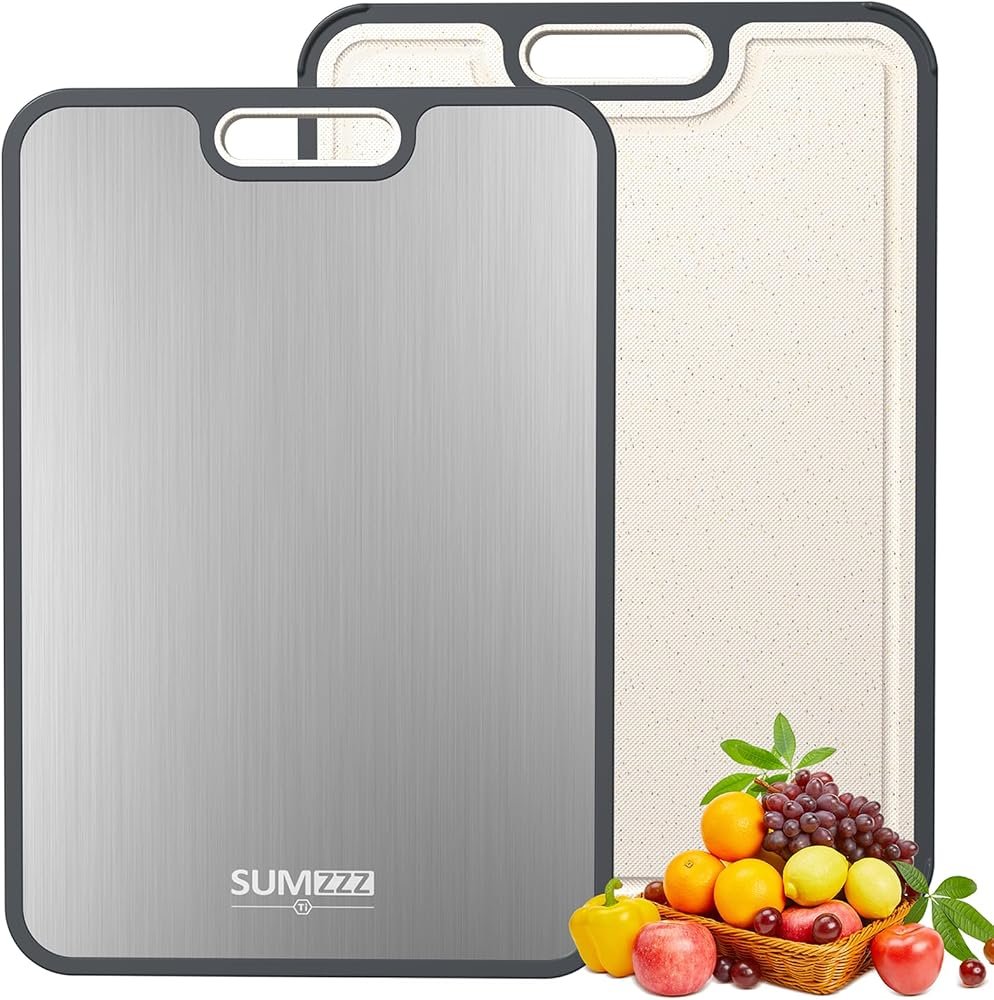
4. Titanium Cutting Board for Kitchen, Pure Titanium/PP, Size 16”×11”

Why this product is good for you
Titanium is the newest material in the category, and this listing’s Best Seller badge plus 7,836 ratings at 4.4 stars show the market is buying it. Pure titanium on one side handles raw proteins with zero porosity; flip to the polypropylene side for produce and gentler edge treatment.
It solves wood’s maintenance problem — no oiling, no hand-wash — while keeping the double-sided flexibility. At $27.99 it costs less than most solid-wood boards while outlasting all of them.
Key features
- Verified listing price: $27.99 (checked at fetch time)
- Rated 4.4/5 across 7,836 ratings on Amazon at fetch time
- Amazon’s purchase counter shows ~10,000+ bought in the past month
- Carries the Best Seller badge – the top-selling listing in its category at fetch time
- Check the listed dimensions against your sink and counter space — boards photograph larger than they measure.
Pros
- 7,836 ratings at 4.4/5 with Best Seller badge
- Zero-porosity hygiene of steel with a plastic face for edges
- $27.99 undercuts most solid-wood boards
Cons
- Newest material here — the smallest review base in this guide
- Sizing runs compact; check dimensions for large roasts
Who it’s for
Buyers who want the wood-style flexibility with steel hygiene and zero maintenance, at a mid-tier price.
Our Final Recommendation
Our recommendation: start with the Gorilla Grip three-pack at $18.99 — the 52,616-rating proof base and dishwasher convenience make it the right first board for most kitchens. Add the Snowclad steel board at $19.99 if raw-meat hygiene is your priority, and the Royal Craft bamboo at $39.97 if you want one board beautiful enough to serve on. The titanium board is the no-maintenance wildcard for buyers who hate hand-washing.
Prices and ratings above were verified on the live Amazon listings at fetch time and are subject to change.
More guides in this series
Best Acacia Wood Cutting Board
- 4 verified picks, every one rated 4.4/5 or higher with 4,787 to 54,165 Amazon ratings
- Prices run from $18.99 to $39.97, and each pick was price- and rating-checked on the live listing at fetch time
- Every pick earns its slot on a different strength — overall value, budget, premium, and a specialty option — so you can match one to your kitchen
Plastic vs Steel vs Wood vs Titanium
Plastic (polypropylene) boards are the workhorse: dishwasher-safe, gentlest on edges, cheapest to replace, and they double as serving trays. Their weakness is deep knife scars over years of use — at that point the board should be replaced, which is why the three-piece Gorilla Grip set is priced like one board elsewhere.
Stainless and titanium boards are the new category: completely non-porous, dishwasher-safe, and immune to the odor and staining that plastic absorbs. They are harder on knife edges than plastic but far kinder than glass. Wood and bamboo remain the classic choice — gentle on edges and naturally bacteria-resistant, but they can never see a dishwasher and need monthly oiling. The titanium pick below splits the difference for buyers who want wood-style looks with zero upkeep.
How We Picked These Four
Every board here carries a 4.4-star listing rating or higher and at least 4,700 Amazon reviews — the weakest proof base in this guide is 7,836 ratings and the strongest is 54,165. We verified prices, ratings and images on the live Amazon listings at fetch time, and we capped the set at four different materials and four different brands so you get a real decision, not four versions of the same board.
Two near-duplicate titanium listings tied on score, so we kept one and replaced the second with the bamboo board — you should not have to choose between two listings from the same mold.
Comparison Table: All Four Picks
| Product | Price | Rating | Ratings count |
|---|---|---|---|
| GORILLA GRIP Cutting Board Set of 3, Slip Resistan | $18.99 | ★★★★½4.6/5 | 52,616 |
| SNOWCLAD Stainless Steel Cutting Board,Non Toxic c | $19.99 | ★★★★½4.5/5 | 4,787 |
| ROYAL CRAFT WOOD Wooden Cutting Boards for Kitchen | $39.97 | ★★★★½4.5/5 | 54,165 |
| Titanium Cutting Board for Kitchen, Pure Titanium/ | $27.99 | ★★★★½4.4/5 | 7,836 |
Product Reviews: The 4 Best Picks
How to Care for a Cutting Board
Whichever board you pick, two habits decide its lifespan. First, hand-wash plastic and steel immediately after raw protein — the dishwasher finishes the job but the rinse should happen before the juice dries. Second, dry boards on edge, not flat: trapped moisture is what warps wood and opens seams. Bamboo needs a coat of food-safe mineral oil monthly; the steel and titanium boards need nothing at all.
Signs It Is Time to Replace a Board
Plastic boards are consumables, not heirlooms: when knife scars become deep enough to catch a fingernail, they trap bacteria where washing cannot reach, and the board should be retired — the whole point of a $18.99 three-pack is that replacing one is trivial. Wood boards that crack along a seam or take on persistent odors are done as prep surfaces, though they can be demoted to serving duty.
FAQ
Which cutting board is most hygienic?
Fully non-porous boards — stainless steel and titanium — are the most hygienic because nothing absorbs into the surface and both sanitize in the dishwasher. Plastic is nearly as hygienic while it is new but must be replaced once deep knife scars form, since scarred grooves trap bacteria.
Do cutting boards really dull knives?
The board surface matters more than the knife. Glass and marble boards destroy edges quickly because they are harder than the steel. Plastic, wood and bamboo are the kindest; stainless and titanium sit in between — expect slightly more frequent honing if you use steel daily.
Can wooden cutting boards go in the dishwasher?
No. Soaking and heat will warp and crack wood and bamboo boards; they should be hand-washed, dried on edge, and oiled monthly with food-safe mineral oil.
Is bamboo better than wood for cutting boards?
Bamboo is harder than most cutting-board woods, which makes it more water-resistant but slightly harder on edges. For knife-friendliness wood wins; for low upkeep and looks, bamboo holds up better over years.
How often should I replace a plastic cutting board?
When knife scars become deep enough to catch a fingernail — typically every one to three years in a busy kitchen. Scarred plastic traps bacteria in grooves that washing cannot reach, which is why multi-packs like the Gorilla Grip set are the economical choice.
The Spoonist
Get the deals before they sell out
One email a week. Tested gear, real price drops, one-click unsubscribe.
By subscribing you agree to our Privacy Policy.
As an Amazon Associate, The Spoonist earns from qualifying purchases. Product prices and availability are accurate as of the date/time indicated on Amazon and are subject to change.
🥇 Free: Air Fryer Time & Temp Chart
20 foods in °F & °C, the oven-to-air-fryer converter, and starting-points for Ninja, Cosori, Instant & more. Print it, stick it on the fridge.
Want all 92 foods + the rescue guide? Get the full Chart Pack →