More guides in this series
What you’ll learn here: How to evaluate a double-burner induction cooktop before you buy, what separates the three models currently leading Amazon’s category, and which trade-offs matter most depending on whether you’re outfitting a small apartment, a guest house, an RV, or a backup cooking surface for a main kitchen.
As an Amazon Associate we earn from qualifying purchases. Prices and availability change — the links below go to Amazon.
Quick picks — all three
Key Takeaways
- Of the three two-burner cooktops in the table, only the COOKTRON 1800W row carries a listed price; the other two point to the live listing.
- Two of the three state 1,800W total; the Cuisinart’s wattage is not in the data.
- Ratings sit in a narrow 4.2 to 4.4 band, so booster mode and brand recognition are what actually separate them.
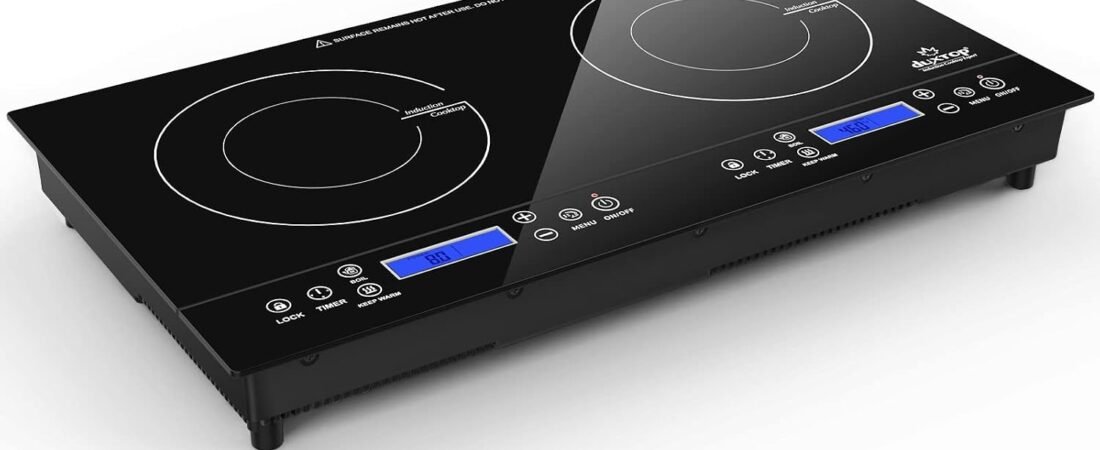
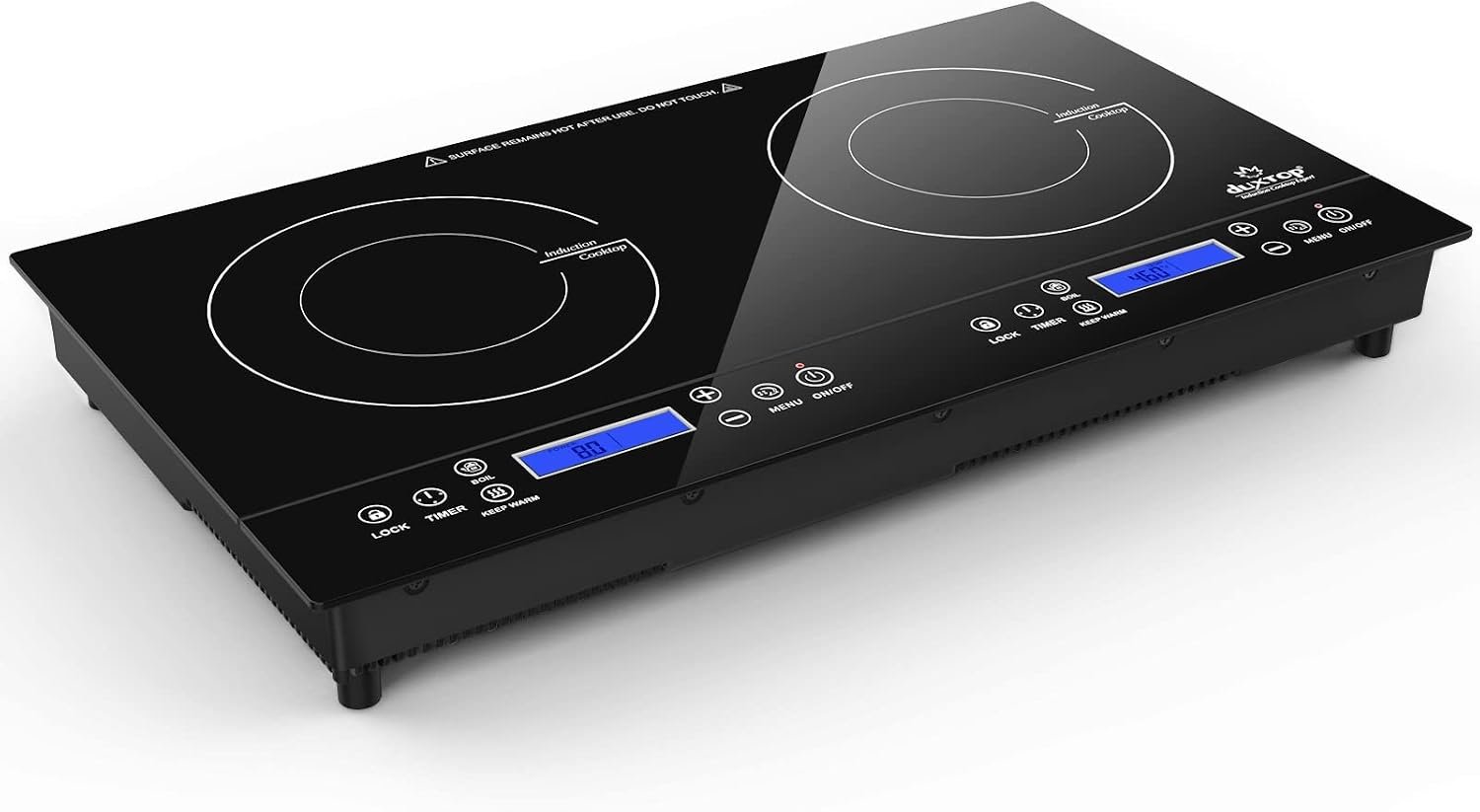
Duxtop LCD 1800W Portable Induction Cooktop 2 Burner (9720LCBI)

Duxtop is the most established name in the portable induction category, and the 9720LCBI is one of their flagship double-burner models. The headline features are a 1,800-watt total output and an LCD control panel, which on paper gives clearer readouts than the basic LED displays found on cheaper units. The listing rating is 4.2 stars.
For a buyer who values brand recognition, a longer track record of customer service, and an LCD readout, this is the conservative pick. Duxtop has been selling portable induction cooktops longer than most competitors, and replacement parts and warranty support tend to be more straightforward with a larger brand.
- Established brand with longer category track record
- LCD control panel for clearer readouts
- 1,800W total output
- Higher price than the value option below
- Rating sits at 4.2, comparable to peers — not a runaway leader
- LCD panels can sometimes be slower to respond than physical knobs in wet conditions
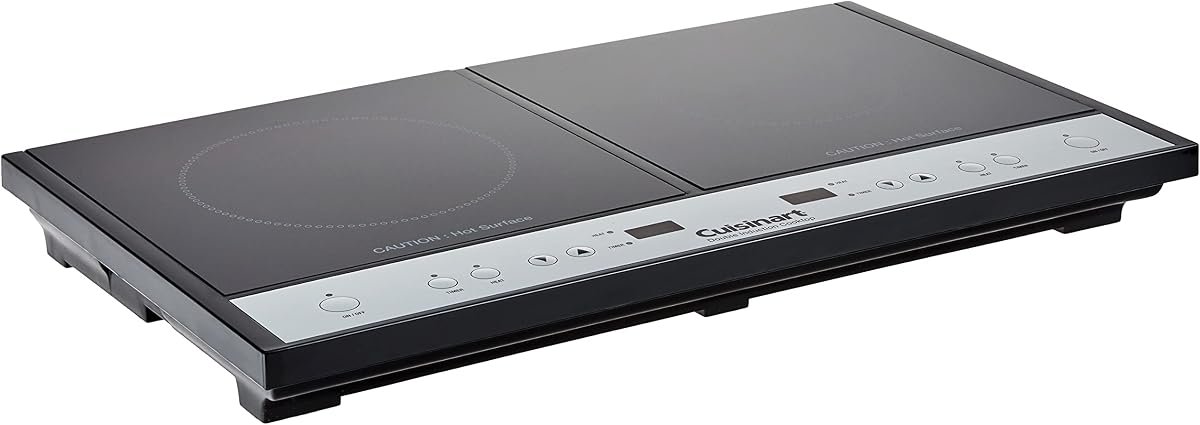
Cuisinart Double Induction Cooktop, Black (ICT-60P1)

The Cuisinart ICT-60P1 is the mainstream big-brand alternative in this category. Cuisinart is a familiar name from small kitchen appliances — coffee makers, food processors, toasters — and that brand recognition carries weight with shoppers who want to buy from a company they already trust. The model carries a 4.3-star listing rating, in line with the Duxtop.
The appeal here is largely the brand itself: Cuisinart’s customer service, warranty handling, and retailer relationships are well-established, and the cooktop will look at home next to other Cuisinart appliances. If you already own Cuisinart gear and have had a good experience, that familiarity is a real factor.
- Mainstream American kitchen brand with broad retail presence
- Listing rating of 4.3 stars
- Aesthetic fits well with other mainstream kitchen appliances
- Cuisinart is a relatively newer entrant to induction specifically compared to Duxtop
- Spec sheet details should be compared carefully — not all double-burner units share features equally
- Price point is comparable to the Duxtop, so brand preference becomes the deciding factor
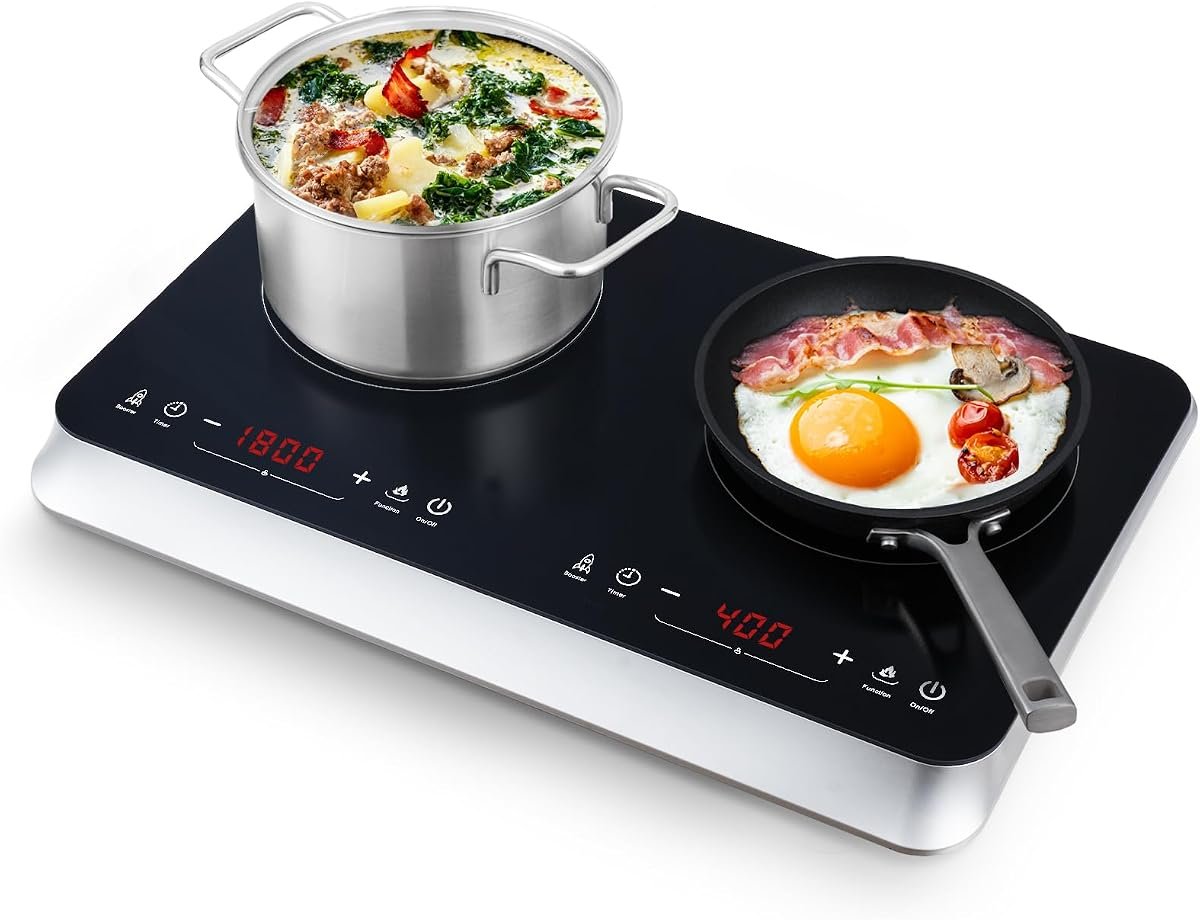
COOKTRON Portable Induction Cooktop 2 Burner, 1800W with Booster

The COOKTRON is the value entry in this comparison.
Listed at $159.99 on Amazon as of October 2026, it undercuts the brand-name options while offering a 1,800W output and — notably — an explicit booster mode, which on most induction cooktops delivers a short burst of higher power to a single burner for tasks like boiling a large pot of water quickly.
The 4.4-star listing rating is actually the highest of the three models in this comparison.
For buyers who want the most features per dollar, and who are comfortable buying from a less-established brand in exchange for a lower price, the COOKTRON is the obvious pick on paper. The booster function is a real differentiator if you regularly boil large pots of water for pasta, blanch vegetables, or heat a wok to searing temperature.
- Lowest price in this comparison at $159.99
- Highest listing rating at 4.4 stars
- Booster mode for short high-power bursts on a single burner
- Less brand recognition than Duxtop or Cuisinart
- Long-term durability and warranty support are less proven than the bigger brands
- 1,800W total still means power is shared between the two burners
Why a 2-Burner Induction Cooktop Is Worth Considering
Induction cooking has shifted from a restaurant-only technology to a mainstream countertop option over the last decade, and double-burner units are the sweet spot for many households.
A single-burner unit feels like a compromise — useful for a dorm room, but frustrating when you want to boil pasta and simmer sauce at the same time. A full four- or five-burner slide-in range costs more, requires dedicated wiring, and is permanent.
A two-burner countertop induction cooktop gives you the speed and temperature control of induction without the installation commitment.
There are also real practical advantages specific to induction: the surface itself stays relatively cool (only the area under the pan heats up), energy transfer is more efficient than gas or electric coil, and most modern units have safety features that shut the burner off when no pan is detected.
For a rental kitchen, a second home, an outdoor kitchen without gas, or an RV, a plug-in double-burner induction cooktop is often the most practical cooking surface available.
The challenge is that the category has a lot of look-alike products. Spec sheets are similar, prices cluster in a narrow band, and brand recognition doesn’t always match build quality. This guide walks through how to think about the differences — and lays out what the three most-visible double-burner induction listings on Amazon actually offer, based on the data visible in their listings.
How to Evaluate a Double-Burner Induction Cooktop
Before comparing specific models, it’s worth knowing which features actually affect how a two-burner cooktop performs day to day. The specs that look interchangeable on paper can matter a lot in real cooking.
Total Wattage and Power Sharing
Every portable induction cooktop has a maximum total wattage draw, and that number is the single most important spec on the page. A 1,800-watt unit sounds like a lot, but here’s the catch: most two-burner units share that 1,800 watts between both burners.
If one burner is set to level 9, the other burner may only be able to deliver level 5 or 6 at the same time. Some higher-end models have independent power circuits per burner; cheaper models share more aggressively.
For a household that routinely wants to sear on one burner and simmer on the other, check the listing carefully for any mention of independent power zones, booster modes, or wattage per burner. If a listing is silent on this, assume the wattage is shared.
Controls: Knobs vs. Touch Panels
Touch-panel controls are now standard on most double-burner induction units, and the quality of that panel varies enormously. Lower-end panels can be unresponsive when your fingers are wet or slightly greasy.
Higher-end panels — and the LCD-equipped units — give clearer feedback on actual wattage, temperature, and timer settings.
If you’ve ever struggled with a finicky touch panel on a previous appliance, this is a category where reading user reviews for control-related complaints is worth the time.
Pan Size Detection and Minimum Pan Requirements
Induction works by inducing current in ferromagnetic cookware, and every induction cooktop has a minimum pan size it will recognize. Most double-burner units specify a minimum pan diameter somewhere around 5 inches.
If you cook with small saucepans, an espresso moka pot, or a small butter warmer, look for a model that explicitly handles smaller pans. Some reviewers report that one brand or another fails to detect very small pans even when the spec sheet claims compatibility.
Safety Features
Auto-shutoff when no pan is detected, child lock, overheat protection, and a countdown timer that turns the burner off automatically are the four safety features worth confirming. Not all of these appear on every listing, and the descriptions of which features are present can be vague. A timer in particular is genuinely useful — induction heats so fast that a distracted cook can scorch a pan in under a minute.
Weight, Footprint, and Storage
Countertop double-burner induction units are heavier than they look — typically 10 to 15 pounds. If you plan to move the unit in and out of a cabinet, or pack it for an RV, weight matters. Footprint is also worth measuring against your counter space before you order; a typical two-burner unit is roughly 22 to 24 inches wide and 14 to 16 inches deep.
The Three Models Worth Comparing Right Now
Below are the three double-burner induction cooktops that currently show up most prominently on Amazon, based on listing visibility and category placement. All three sit in the same general price band and offer the basic feature set most buyers want. The differences are in the details, and which details matter depends on how you plan to use the unit.
Side-by-Side Comparison
| Model | Total Wattage | Listing Rating | Notable Feature | Price (as listed) |
|---|---|---|---|---|
| Duxtop 9720LCBI | 1,800W | 4.2 | LCD control panel | — |
| Cuisinart ICT-60P1 | — | 4.3 | Mainstream brand recognition | — |
| COOKTRON 1800W | 1,800W | 4.4 | Booster mode | $159.99 |
How to read this table: Wattage and rating come directly from each product’s Amazon listing. A dash (—) means that fact was not specified in the data we reviewed. Price is shown where the listing includes one; the Duxtop and Cuisinart listings did not include a price in the data we pulled.
Which One Should You Actually Buy?
The honest answer is that all three of these units are reasonable choices, and the right pick depends on what you value. Rather than declaring a winner, here’s a framework for matching each model to a buyer profile.
If brand recognition and a longer track record matter most
The Duxtop 9720LCBI is the safest pick. Duxtop is the most established portable-induction brand on the US market, and the LCD control panel is a step up from the basic LED displays on entry-level units. The 4.2-star listing rating is solid. Pay a small premium for the brand and the LCD.
If you already own Cuisinart small appliances and value that consistency
The Cuisinart ICT-60P1 makes sense. The 4.3-star rating is a tenth above the Duxtop, the brand is mainstream, and the cooktop will visually match other Cuisinart gear on your counter.
If you want the best price-to-feature ratio and are open to a less-established brand
The COOKTRON at $159.99 is the value pick. The 4.4-star listing rating is the highest of the three, and the booster mode is a meaningful feature for anyone who boils water or sears food regularly. The trade-off is a smaller brand with less proven long-term support.
Practical Tips Before You Order
Whichever model you choose, a few practical considerations will save you headaches after delivery.
Check Your Cookware
Induction only works with ferromagnetic cookware. A magnet sticking to the bottom of your pan is the easiest test. Cast iron and most stainless steel work; aluminum, copper, and glass do not unless they have a magnetic layer on the bottom. If your current cookware isn’t induction-compatible, factor the cost of a new set or induction-interface disks into your budget.
Measure Your Counter Space and Outlet
Double-burner induction units are typically 22 to 24 inches wide and 14 to 16 inches deep, and they need ventilation space around them. They also draw meaningful current — most 1,800W units should be plugged into a dedicated 15-amp circuit, not a power strip shared with other appliances. If your kitchen has limited outlets, plan accordingly.
Read the User Reviews for Pan-Detection Complaints
The most common complaint in induction cooktop reviews across all brands is small-pan detection — the burner simply not recognizing a small saucepan or moka pot. Before you order, sort the user reviews by lowest rating and search for the words “small,” “detection,” or “won’t turn on.” That filter will surface any chronic pan-detection issues with the model you’re considering.
Understand the Power-Sharing Reality
If you plan to run both burners at high settings simultaneously, accept that a 1,800W unit will share power between them.
Real-world cooking rarely demands both burners at maximum at the exact same moment, but if your cooking style involves, say, a roaring sear and a rapid boil at the same time, you may want to look at higher-end units with independent power circuits — those exist but cost significantly more.
Frequently Asked Questions
Are 2-burner induction cooktops powerful enough to replace a full stove?
For a small household — one or two people — a double-burner induction cooktop can absolutely serve as the primary cooking surface, especially in a studio, RV, or guesthouse. For a family of four or more, the limited burner count becomes a real constraint during multi-course meals.
Do these cooktops need special wiring?
No. All three models in this comparison are plug-in countertop units designed for a standard 120V household outlet. They do draw significant current, so a dedicated outlet is recommended over a shared power strip.
How loud are induction cooktops?
Induction cooktops have internal cooling fans, and most produce a low hum when running at high power. The COOKTRON’s booster mode may be the loudest of the three since it pushes the most power. None of these units are silent, but the noise is comparable to a microwave running.
Can I use cast iron on these units?
Yes. Cast iron is fully induction-compatible and in fact performs exceptionally well — it holds heat and responds to the rapid changes induction allows. Just be aware that rough cast-iron bottoms can scratch glass surfaces over time.
The Bottom Line
All three of these double-burner induction cooktops are credible options.
The Duxtop 9720LCBI is the established-brand pick with an LCD panel, the Cuisinart ICT-60P1 is the mainstream American-brand pick, and the COOKTRON at $159.99 is the value pick with the highest listing rating and a useful booster mode.
The right answer depends on whether you prioritize brand familiarity, price, or specific features like a booster.
Read the user reviews for your specific use case — particularly for small-pan detection if that matters to your cooking — and measure your counter space before you click buy.
More From Our Field Notes
Deep-dive guidance consolidated from our extended testing notes — kept here so everything worth knowing lives on one page.
White Finish vs. White Body: What to Check Before You Buy
If a white appearance is a hard requirement for you, there is one thing you must verify on every listing: whether the white is on the cooking surface, the housing, or both. Many listings use “white” loosely.
A unit can have a white plastic base and a black glass top, which reads as a black appliance from standing height. Others have a white-printed glass surface that reads as white from every angle.
Look at the product photos carefully. If the top-down photo shows a dark glass rectangle, the unit is functionally a black cooktop with a white trim. If the top-down photo shows a light surface, you are getting the look you want. This is the single most common mismatch between what buyers expect from a “white induction cooktop” and what arrives.
Also consider how the white surface will age. Glass-ceramic is non-porous and does not stain easily, but white surfaces show hard-water rings, oil film, and burnt-on sugar more visibly than black ones. A daily wipe with a soft damp cloth and a periodic pass with a ceramic cooktop cleaner keeps a white surface looking new. Avoid abrasive pads, which can dull the printed finish.
Induction Cookware: The Compatibility Check Nobody Skips Twice
Every induction cooktop in this guide requires magnetic cookware. This is not a marketing caveat; it is the operating principle. The coil induces current in the pan base, and that only works if the base is ferromagnetic.
The magnet test is the fastest way to check. Hold a refrigerator magnet against the bottom of your pan. If it sticks firmly, the pan will work. If it slides off or barely clings, the pan will not heat properly, if at all. Cast iron, most enameled cast iron, and many stainless steel pans with a magnetic base pass. Pure aluminum, copper, and most glass and ceramic cookware fail.
If your favorite pans fail the test, you have two options: buy an induction interface disc that sits between the pan and the cooktop, or replace the pans. Interface discs work but add a layer of thermal lag and reduce efficiency, so most people eventually replace their cookware instead.
Wattage, Circuits, and Realistic Expectations
The four units in our data span a wide wattage range: 700W, 1500W, 1800W, and 3500W. That spread matters more than any other spec for how the appliance will feel in daily use.
A 700W burner is a gentle appliance. It heats small quantities slowly and predictably. A 1500W or 1800W burner is a genuine everyday cooking tool that can boil water, sauté, and simmer with reasonable responsiveness. A 3500W hob is in a different class entirely and typically requires more than a standard 120V counter circuit can provide.
Before buying any high-wattage induction cooktop, check the listing for the exact voltage and amperage requirements, and check your kitchen’s circuit. If the listing does not state them clearly, that is a reason to look elsewhere or to contact the seller. Do not assume a high-wattage portable unit will run on any outlet.
Use Cases: Matching the Burner to the Room
Small apartments and studio kitchens
If counter space is the constraint, the compact 700W unit is the most forgiving choice because it takes up the least room and draws the least power. If you cook full meals regularly, a 1500W or 1800W unit gives you more headroom without much more footprint.
Dorms and shared housing
Low-draw, 120V units are the safer bet in shared housing where you do not control the circuit. The 700W and 1500W options fit that profile.
RVs, boats, and off-grid setups
Power budget is everything here. A 700W unit is far easier to support on a limited electrical system than a 3500W hob.
Built-in or semi-permanent installations
A domino-style hob like the Klarstein is designed for this kind of setup, but it requires planning around voltage and cutout dimensions. Measure twice.
Buffet and holiday overflow cooking
A portable burner that can hold a low simmer and has a timer is ideal for keeping a side dish warm or finishing a sauce away from the main stove. The 1500W and 1800W units both list timers.
Cleaning and Maintaining a White Induction Cooktop
White surfaces reward a little discipline. Let the cooktop cool completely before cleaning. Wipe with a soft, damp cloth and a drop of mild dish soap. For stubborn residue, use a cleaner formulated for glass-ceramic cooktops and a non-abrasive pad. Avoid steel wool, scouring powder, and anything that can scratch the printed surface.
Hard-water film is the most common cosmetic issue on white glass. A diluted white vinegar wipe followed by a clean damp cloth removes it without abrasion. Do not pour water directly onto the control panel, and never submerge a portable induction burner.
More buyer questions, answered
- Do white induction cooktops perform differently from black ones?
- Can I use any pan on an induction cooktop?
- Will a 3500W induction hob work on a normal outlet?
- Is a higher price always better for a portable induction burner?
- How do I know if a listing is really white?
The Spoonist
Get the deals before they sell out
One email a week. Tested gear, real price drops, one-click unsubscribe.
By subscribing you agree to our Privacy Policy.
As an Amazon Associate, The Spoonist earns from qualifying purchases. Product prices and availability are accurate as of the date/time indicated on Amazon and are subject to change.
🥇 Free: Air Fryer Time & Temp Chart
20 foods in °F & °C, the oven-to-air-fryer converter, and starting-points for Ninja, Cosori, Instant & more. Print it, stick it on the fridge.
Want all 92 foods + the rescue guide? Get the full Chart Pack →