
More guides in this series
If you are new to baking with a stand mixer, the right first machine is the one that fits your counter, your budget, and the recipes you actually plan to make. This guide walks through three popular options across the beginner price spectrum and explains what to weigh before you add one to your cart. Three questions settle which best stand mixer for beginners is yours: bowl capacity, counter depth, and how often you bake.
As an Amazon Associate we earn from qualifying purchases. Prices and availability change — the links below go to Amazon.
Quick picks — all three
Key Takeaways
- Three beginner mixers, $62.95 to $398.00: 4 qt with 6 speeds, 5.5 qt with 12 speeds, and the 5 qt KitchenAid Artisan.
- Listing ratings barely move (4.3 to 4.4), so bowl size, speed count and price decide it, not the scores.
- The KitchenAid row does not state a speed count in the product data, so check the listing before paying the premium.
The three stand mixers worth comparing for beginners
These three models cover the beginner price ladder from a budget combo unit to the most-recognized name in the category. They are not the only options on the market, but they represent the three most common ways a first-time buyer tends to shop: spend the least, spend a moderate amount, or buy the brand you have heard of most.
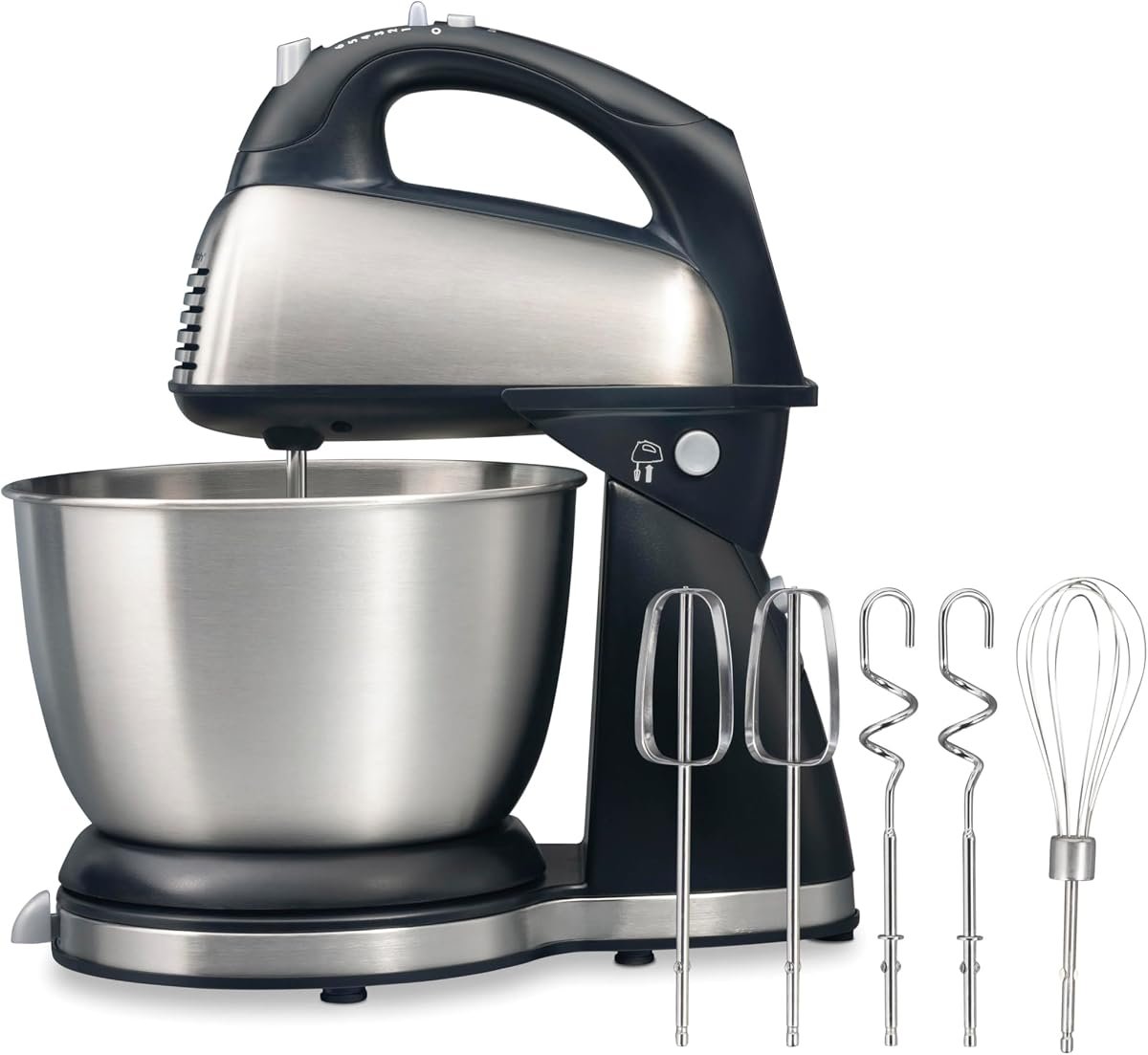
Hamilton Beach Classic Stand and Hand Mixer (4 Quarts, 6 Speeds)

The Hamilton Beach Classic is the lowest-priced of the three options and the simplest entry point if you are not sure how often you will reach for a stand mixer. The 4-quart bowl is enough for most beginner recipes, and the 6-speed range with a QuickBurst button gives you a basic level of control without a learning curve. Because it doubles as a hand mixer, you can also detach the motor body for smaller jobs where a full stand setup is overkill.
The honest upside here is price and flexibility. The honest trade-off is that this is a lighter, simpler machine than the other two on this list. If you plan to knead stiff bread doughs weekly, you may find yourself wishing for a heavier bowl-lift or tilt-head design with a larger capacity. For someone baking cookies, cakes, and the occasional loaf, though, this is a low-risk way to find out whether a stand mixer belongs in your kitchen at all.
- Lowest price of the three options listed here
- Doubles as a hand mixer for small jobs
- Simple 6-speed layout is easy to learn
- Smallest bowl of the three at 4 quarts
- Lighter build than the mid-range and premium options
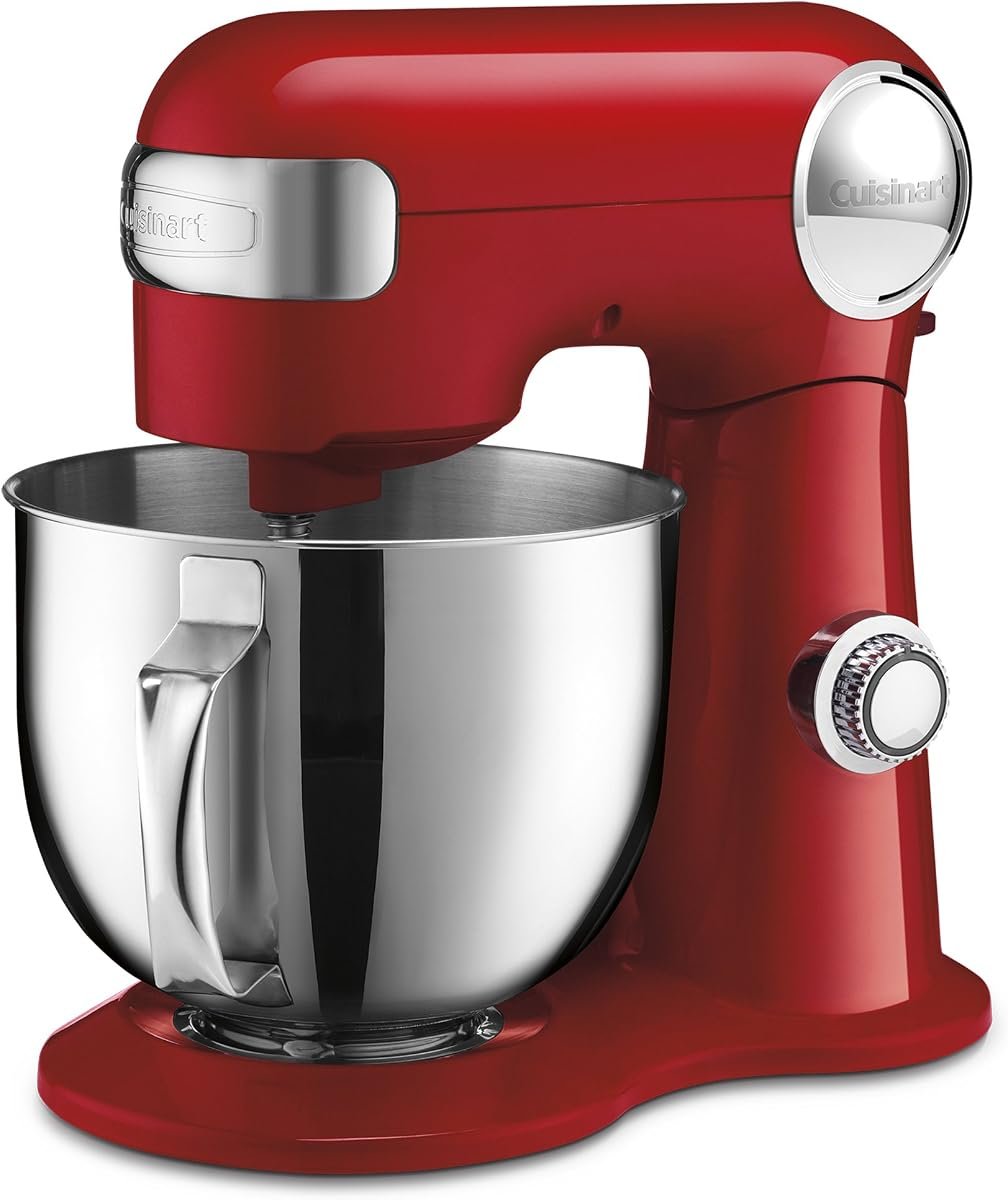
Cuisinart Stand Mixer (12 Speed, 5.5-Quart Stainless Steel Bowl)

The Cuisinart sits in the middle of the price range and brings two meaningful upgrades over a budget model: a 5.5-quart stainless steel bowl and a 12-speed control range. The bowl size is the largest of the three, which means more room for double batches, family-sized loaves, or recipes that need extra space for ingredients to incorporate. Twelve speeds, paired with the included chef’s whisk, dough hook, and flat mixing paddle, give you noticeably more control over how a dough or batter comes together.
This is the model for a beginner who has already decided that baking is going to be a regular habit, not a one-time experiment. It costs more than the Hamilton Beach option, but it also asks less of you to grow into it. If you can see yourself making bread, layered cakes, and cookie batches within the first year, the extra capacity tends to pay for itself in fewer split-batch moments.
- Largest bowl of the three at 5.5 quarts
- 12-speed range for finer control over mixing
- Includes chef’s whisk, dough hook, and flat mixing paddle
- Mid-range price; not the cheapest option
- Takes up more counter space than the budget model
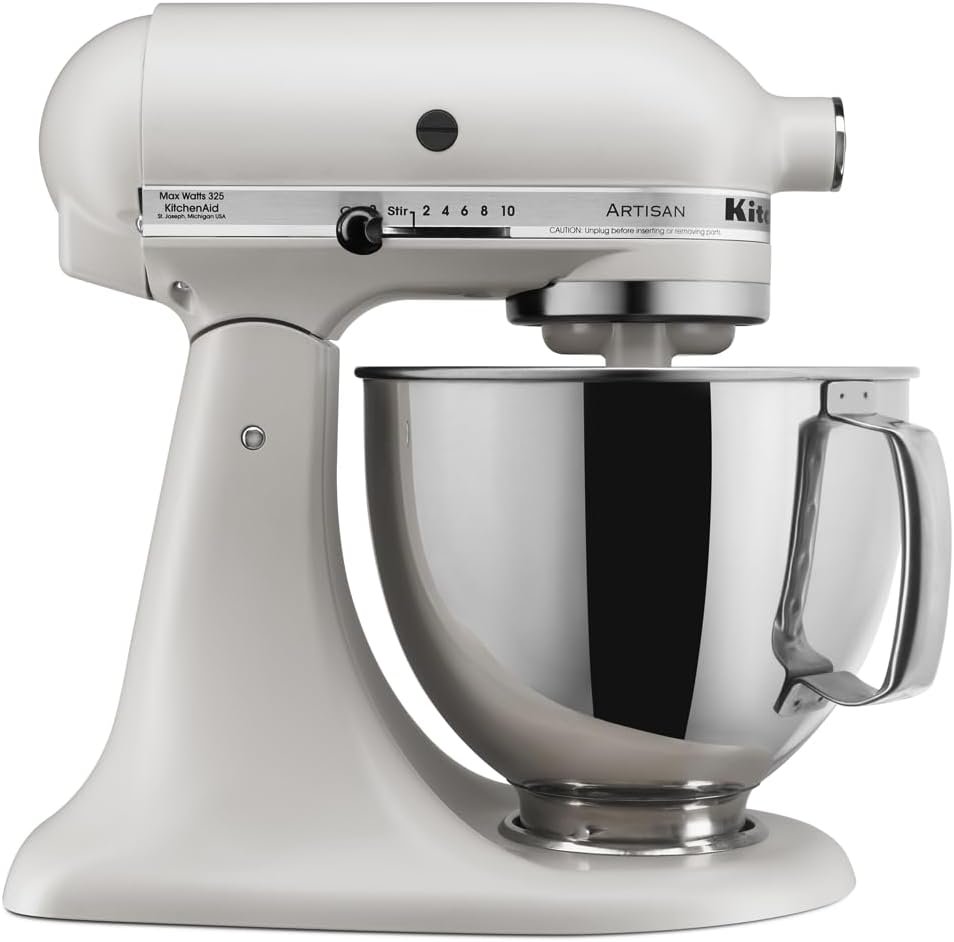
KitchenAid Artisan 5-Qt Tilt-Head Stand Mixer (KSM150PS)

The KitchenAid Artisan is the most recognized name on this list and the highest-priced of the three. The 5-quart tilt-head design, paired with the included pouring shield, has become the reference image many people picture when they think of a stand mixer. For a beginner, the appeal is partly aesthetic and brand-driven, and partly practical: tilt-head access makes it easy to add ingredients or swap attachments, and the pouring shield helps keep flour from dusting the counter when you start a dough.
It is worth being honest about what the Artisan does and does not give you over the Cuisinart. On capacity, the Artisan’s 5-quart bowl is smaller than the Cuisinart’s 5.5-quart. On listed price, the Artisan is the most expensive option here by a wide margin. Where it tends to win is in long-term ecosystem, the breadth of available attachments, and the simple fact that many home bakers already trust the brand. If brand trust and a wide attachment ecosystem matter to you, the Artisan is a reasonable place to land. If raw capacity-to-dollar value is the priority, the Cuisinart looks stronger on paper.
- Most-recognized stand-mixer brand in the category
- Tilt-head access makes adding ingredients and swapping tools easy
- Includes a pouring shield to contain flour dust
- Highest listed price of the three options
- 5-quart bowl is smaller than the Cuisinart option
What a beginner actually needs from a stand mixer
Stand mixers look similar in product photos, but the differences between an entry-level model and a step-up unit show up fast once you start baking. Before you compare prices or star ratings, it helps to be honest about three things: how often you will use the machine, how much dough or batter you want to make in one batch, and how much counter space you can spare.
For most beginners, that means looking at bowl size, the number of speed settings, and what attachments are included. You do not need to be an expert on motor wattage or gearbox materials to make a good call. You just need a clear sense of what you will ask the mixer to do on a Saturday morning.
A helpful way to frame the decision is this: a stand mixer is a tool, not a trophy. The best one for a beginner is the one you will actually pull off the shelf, plug in, and use — not the one that sits in a box because it felt too fancy to risk.
How to think about capacity, speed, and build
Capacity is usually the first spec shoppers notice. A 4-quart bowl is plenty for a single cake or a small loaf of bread, while a 5- or 5.5-quart bowl gives you more headroom for double recipes, bigger batches of cookies, or bread doughs that rise as they mix. Beginners who mostly bake for one or two people often do well with a smaller bowl. Beginners who plan to bake for a family or to portion and freeze dough will appreciate the extra room.
Speed settings matter less than capacity for most beginners, but they do change how the mixer feels in use. More speeds give you finer control when you start a heavy dough at low speed to keep flour from flying out of the bowl, then ramp up to incorporate ingredients. Fewer speeds can still get the job done; you just have less fine-tuning along the way.
Build quality is harder to judge from a listing alone. Heavier mixers tend to stay put on the counter, which matters when you are mixing thick dough at higher speeds. Lighter mixers are easier to lift and store, but they can walk across the counter if the dough is heavy. The trade-off is real, and there is no single right answer.
Side-by-side look at the three options
Before you decide, it can help to see the three options lined up. The table below pulls only the listed facts from each product’s Amazon listing. Because every model on this list is a real listing with a real price, a side-by-side comparison is fair to share.
| Model | Bowl size | Speeds | Listed price | Listing rating |
|---|---|---|---|---|
| Hamilton Beach Classic Stand and Hand Mixer | 4 qt | 6 | $62.95 | 4.4 |
| Cuisinart Stand Mixer | 5.5 qt | 12 | $228.07 | 4.3 |
| KitchenAid Artisan 5-Qt Tilt-Head (KSM150PS) | 5 qt | Not listed in product data | $398.00 | 4.3 |
Tip: when you open any of the Amazon listings, double-check the current price, the bowl-lift versus tilt-head style, and the wattage. Those three details tend to swing the buying decision more than the speed count does for a beginner.
How to read star ratings at this level
All three options on this list sit in a tight band of 4.3 to 4.4 stars on their Amazon listings. That is worth pausing on. When ratings are that close, the difference between, say, 4.3 and 4.4 is not usually the deciding factor. What matters more is the shape of the reviews behind those averages: are most complaints about a specific part failing, or about something cosmetic, or about user error on first use? The Spoonist does not run its own hands-on tests, so we treat the listing rating as a starting point rather than a verdict, and we recommend you do the same.
For a beginner, a useful way to use the rating is to set a floor for yourself. If a model you are considering has a listing rating noticeably lower than the rest of the category, that is a signal to slow down and read the most recent negative reviews before you commit. If everything you are considering is sitting in the 4.3-to-4.4 range, your decision is more likely to come down to price, capacity, and brand trust than to a small star-rating gap.
What to look for once you open the Amazon listing
Even within the three models above, the listing itself will tell you more than the summary on a buying guide can. Once you click through, here are the details worth verifying on the product page before you buy:
- Wattage: the listed wattage is a rough proxy for how the mixer will handle stiff dough. None of the three listings above include a wattage in the summary data, so check the product page for the exact number on the model you are considering.
- Included attachments: confirm whether the price covers the paddle, whisk, and dough hook, and whether a pouring shield is included or sold separately.
- Bowl material: stainless steel and coated metal each have their own trade-offs around weight, noise, and how easy they are to clean. The Cuisinart listing specifies a stainless steel bowl; check the others on their respective product pages.
- Dimensions and weight: if your counter space is tight, the actual width, height, and weight of the unit will matter more than the bowl capacity number.
- Warranty terms: the warranty length and what it covers vary across brands, and the listing is the right place to confirm this rather than guess.
None of these details are filler. Beginners who get them right the first time tend to be the ones who keep using their mixer for years.
Common beginner mistakes to avoid
A few patterns come up over and over with first-time stand-mixer buyers. None of them are dealbreakers, but they are worth naming:
Buying the biggest bowl you can afford. A 5.5-quart bowl sounds generous, but if you mostly bake single-batch cookies or a small loaf, you will end up over-mixing smaller recipes to chase the bowl’s edges. Match the bowl to your actual recipes, not your imagined future ones.
Skipping the brand-loyalty conversation. Some beginners feel they should be brand-agnostic. In practice, attachment ecosystems and resale value both lean on brand, and that is a legitimate factor in a purchase this size.
Ignoring counter space. A stand mixer that lives on the counter is a stand mixer you will use. A stand mixer that lives in a closet is a stand mixer you will not. Be honest about where yours will live before you buy.
Treating the listing rating as a verdict. As noted above, a 4.3 versus 4.4 gap at this level is rarely the real story. Read the recent reviews, especially the one- and two-star ones, and decide for yourself what matters.
Which of these three should a beginner actually buy?
There is no single right answer, but there is a clean way to choose between these three.
If you want to spend the least and test the waters, the Hamilton Beach Classic at $62.95 is the lowest-cost way to find out whether a stand mixer belongs in your kitchen. It is not the heaviest or largest, and that is the point.
If you already know you will bake often and want room to grow, the Cuisinart at $228.07 offers the largest bowl of the three and the most speed steps, which makes it the strongest value pick on raw specs.
If brand trust and a wide attachment ecosystem matter most, the KitchenAid Artisan at $398.00 is the most expensive of the three but also the most recognized, and that has real value if you plan to use the mixer as a long-term kitchen center.
Frequently asked questions
How much bowl capacity does a beginner actually need?
For a beginner baking for one or two people, a 4- to 5-quart bowl covers most recipes. If you plan to bake for a family or to do double batches, a 5- to 5.5-quart bowl is more forgiving. Among the three models above, the 5.5-quart Cuisinart offers the most headroom, while the 4-quart Hamilton Beach is the most compact.
Is a tilt-head or bowl-lift design better for a beginner?
Both work. Tilt-head designs are easier to access when you want to add ingredients or change tools, while bowl-lift designs tend to be sturdier with very heavy doughs. Among the three options above, only the KitchenAid Artisan is described as tilt-head in the product data; check the listing for each model to confirm the style before you buy.
Do I need a stand mixer if I already own a hand mixer?
Not necessarily. Hand mixers handle most cake and cookie batters well. A stand mixer earns its place when you start making bread dough, large batches, or recipes that need long, hands-free mixing. If you are unsure, the Hamilton Beach option above doubles as both, which is one way to delay that decision.
How important is the number of speed settings?
For most beginners, it matters less than capacity or build quality. More speeds give you finer control, but the recipes in a typical beginner baking book do not require them. If finer control matters to you, the 12-speed Cuisinart is the most flexible of the three; if you would rather keep things simple, the 6-speed Hamilton Beach will get the job done.
The Spoonist
Get the deals before they sell out
One email a week. Tested gear, real price drops, one-click unsubscribe.
By subscribing you agree to our Privacy Policy.
As an Amazon Associate, The Spoonist earns from qualifying purchases. Product prices and availability are accurate as of the date/time indicated on Amazon and are subject to change.
🥇 Free: Air Fryer Time & Temp Chart
20 foods in °F & °C, the oven-to-air-fryer converter, and starting-points for Ninja, Cosori, Instant & more. Print it, stick it on the fridge.
Want all 92 foods + the rescue guide? Get the full Chart Pack →