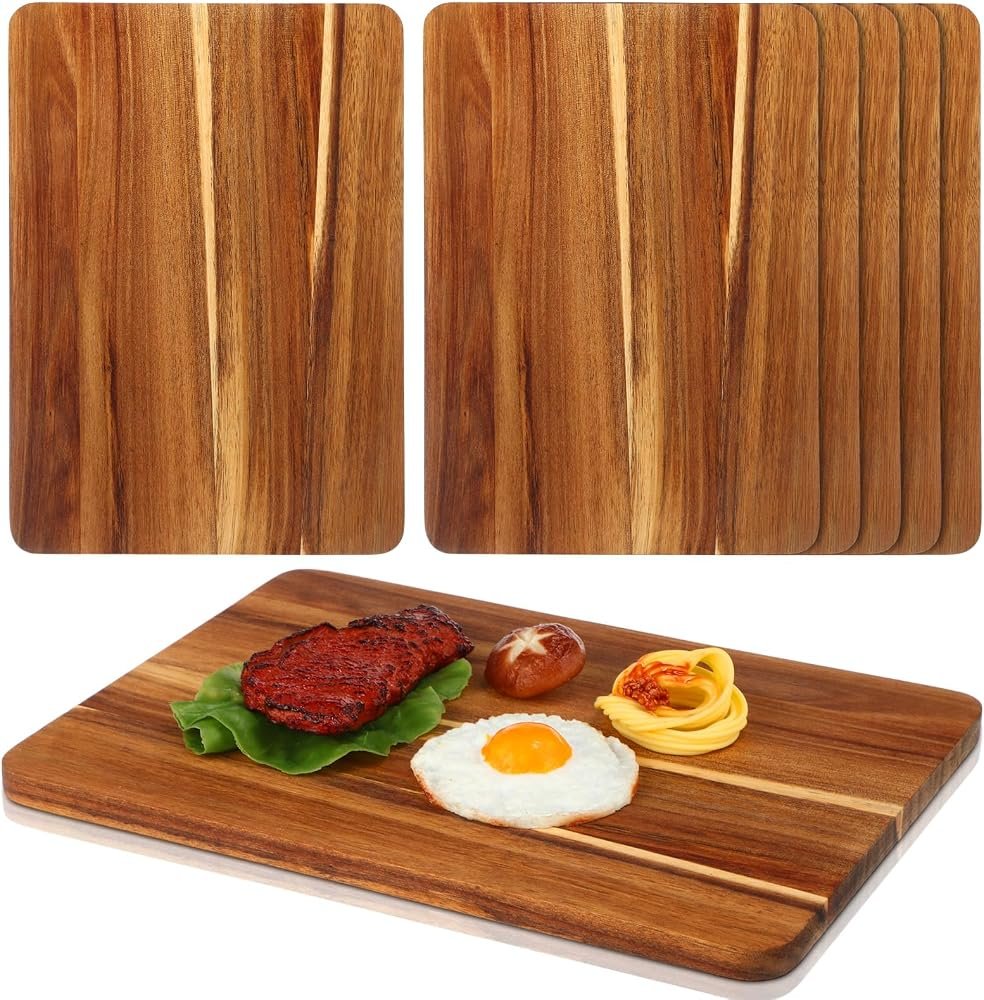
The best acacia wood cutting board for most people is the Deer & Oak 3-board set with stand ($46.99, 4.2★, 283 ratings). Need the biggest prep surface? The Ironwood Gourmet 14×20 station is $74.99 with 4.1★ from 3,116 ratings — the most-reviewed pick here. Grabbing multiple boards? The Roshtia 6-pack covers a whole kitchen for $134.40.
As an Amazon Associate we earn from qualifying purchases. Prices and availability change — the links below go to Amazon.
Quick picks — all four
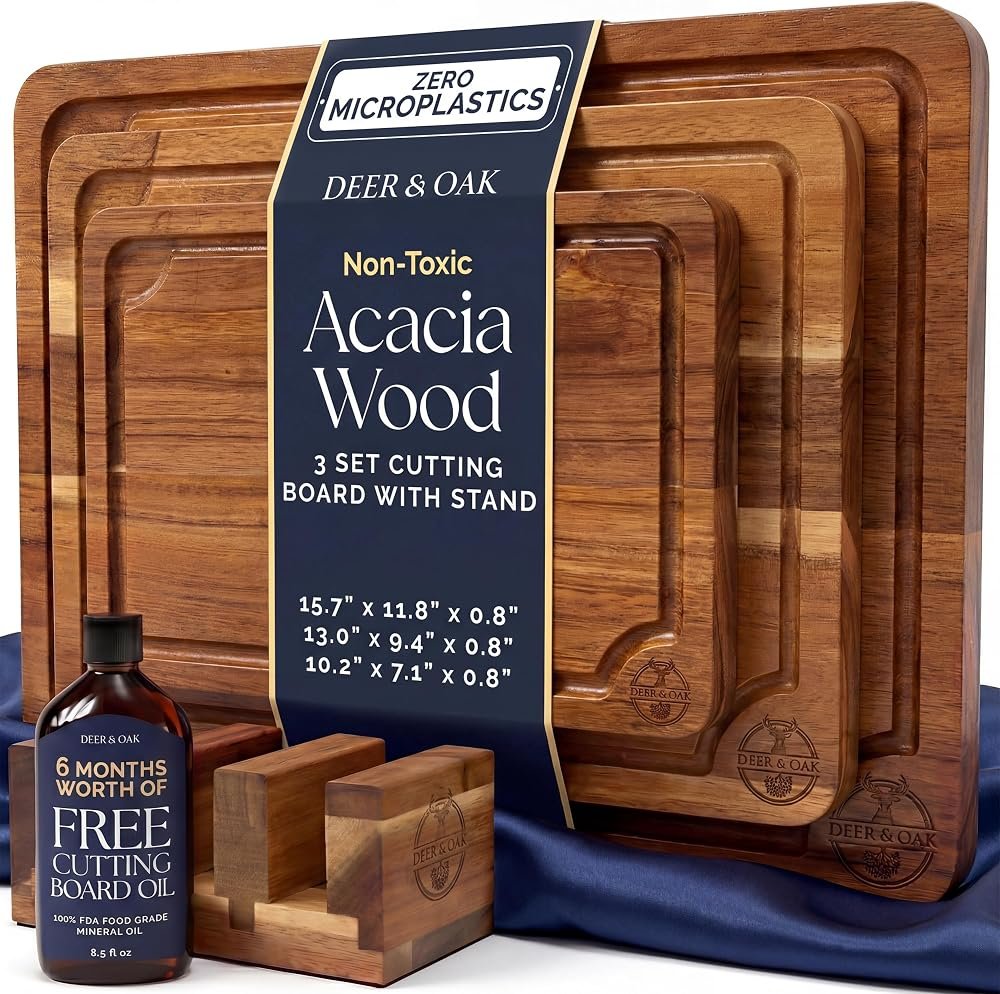
1. Deer & Oak Non Toxic 3-Piece Acacia Cutting Board Set with Stand
Why this product is good for you
The Deer & Oak set solves the problem every multi-board kitchen has — where do the boards live? — with a matching display stand, and does it in genuinely non-toxic acacia at 4.2 stars across 283 ratings. Three boards in graduated sizes means raw protein, produce and serving each get their own surface, which is the food-safety habit every kitchen guide recommends and almost nobody follows because it means buying three boards.
At $46.99 for the three-board set plus the stand, the math beats buying even one premium single board, and the acacia construction puts it in a different durability class than the plastic sets most guides recommend. This is the pick for the kitchen that wants the full setup once, correctly, without a $150 spend.
Key features
- Verified listing price: $46.99 (checked at fetch time)
- Rated 4.2/5 across 283 ratings on Amazon at fetch time
- Amazon’s purchase counter shows ~1,000+ bought in the past month
- Measure your space and check the listing dimensions before ordering.
Pros
- Three boards plus stand for $46.99 — the cheapest complete setup here
- 4.2 stars across 283 verified ratings
- Solves food-safety separation without three separate purchases
Cons
- Smallest boards in the set are compact — check dimensions before buying
- Hand-wash and occasional oiling, like every wood board
Who it’s for
Kitchens setting up properly for the first time, gift buyers, and anyone who wants the protein/produce/serving separation food-safety guides keep recommending.
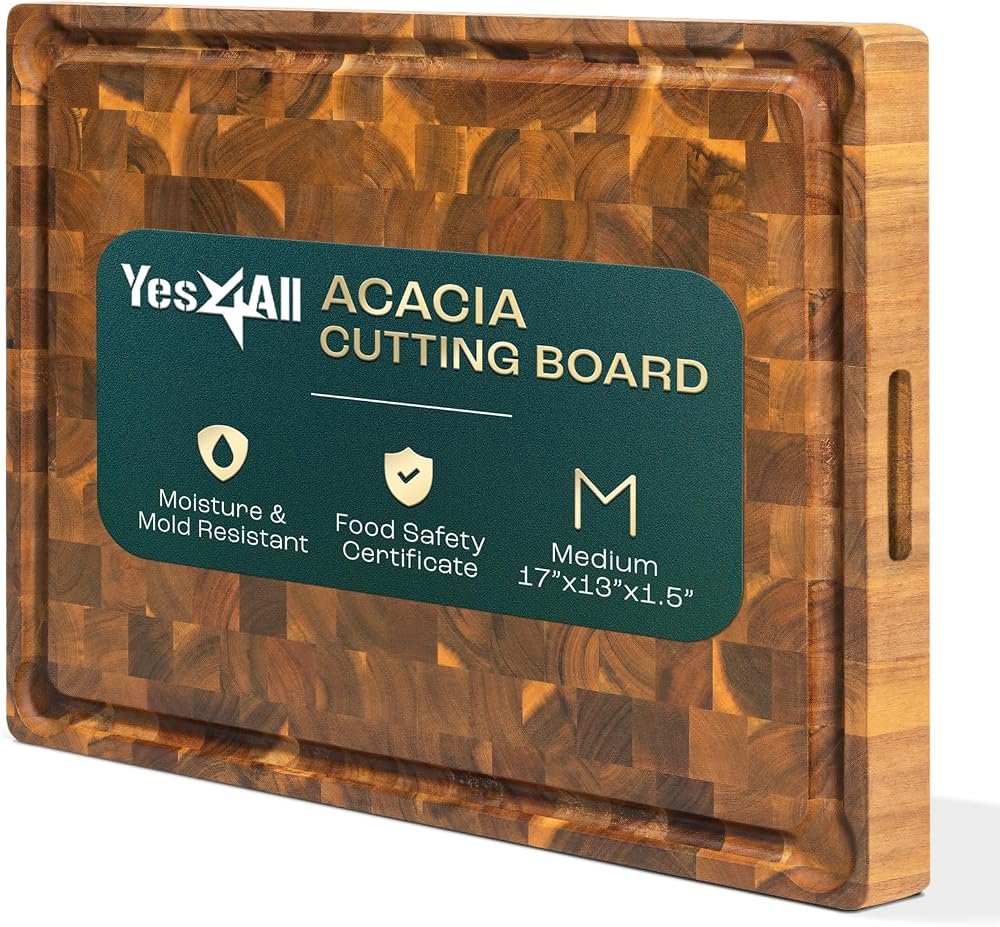
2. Yes4All Medium Acacia Cutting Board, End Grain Cutting Board 17″x 13″x 1.5″
Why this product is good for you
At $33.66, the Yes4All is the cheapest genuine end-grain acacia board we found — and end grain is the construction knife lovers argue for, because the blades slide between the wood fibers instead of slicing through them. The 17 x 13 x 1.5-inch slab is a serious daily workhorse with real mass under it; it will not skate around the counter mid-slice.
The 4.0-star rating across 96 ratings is the smallest proof base in this guide, which is why it takes the budget slot rather than the top one — but the price-to-construction ratio is unmatched. If you have been curious whether end grain justifies its premium, this is the lowest-risk way to find out.
Key features
- Verified listing price: $33.66 (checked at fetch time)
- Rated 4.0/5 across 96 ratings on Amazon at fetch time
- Measure your space and check the listing dimensions before ordering.
Pros
- End-grain construction at a mid-range price — $33.66
- Large 17×13 work surface with genuine heft
- Gentlest construction here for knife edges
Cons
- 96-rating proof base is the smallest in this guide
- At 1.5 inches thick it is heavy — plan a storage spot
Who it’s for
First-time end-grain buyers and value hunters who want the knife-friendly construction without the $75+ entry fee.
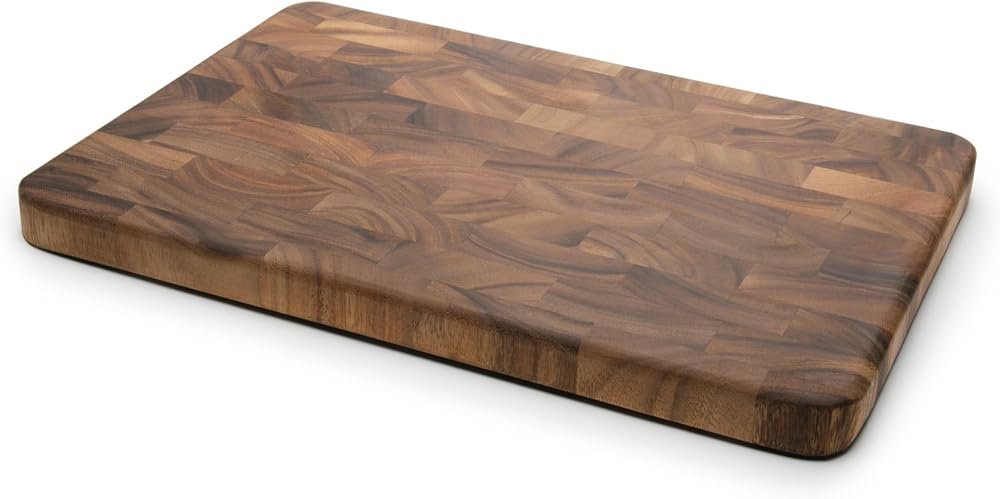
3. Ironwood Gourmet Large End Grain Prep Station Acacia Wood Cutting Board, 14 x 20-Inch, Brown
Why this product is good for you
The Ironwood Gourmet prep station is the veteran of this guide — 3,116 ratings at 4.1 stars is the largest verified proof base of any acacia board we found, and it has held that position for years for a reason. The 14 x 20-inch end-grain surface is genuinely pro-sized: wide enough to break down a whole chicken with room for the trim work on the same board.
The prep-station layout is the differentiator — a deep juice groove on one long edge catches roast drippings and fruit juice, and the end-grain face shrugs off years of daily knife work that would bury an edge-grain board in scars. At $74.99 it is the most expensive pick here, and the only one whose review base approaches the thousands. This is the buy-it-once board.
Key features
- Verified listing price: $74.99 (checked at fetch time)
- Rated 4.1/5 across 3,116 ratings on Amazon at fetch time
- Measure your space and check the listing dimensions before ordering.
Pros
- Biggest verified review base in the acacia category — 3,116 ratings
- Genuinely pro-sized surface for whole-bird and large-cut work
- End-grain face stays smoother far longer than edge grain
Cons
- $74.99 is the steepest price here
- At 14×20 it needs a dedicated storage spot and two hands to move
Who it’s for
Serious home cooks, big-batch meal preppers, and anyone carving roasts or whole birds who wants one board that outlasts a decade.
4. Roshtia 6 Pcs Wooden Cutting Boards 14×10” Acacia Chopping Board, Classic
Why this product is good for you
The Roshtia six-pack is the specialist pick: six 14 x 10-inch acacia boards at 4.3 stars, built for kitchens that go through boards fast — meal preppers who portion a week of food on Sunday, families that separate raw/cooked rigorously, or anyone running a small catering operation. At $134.40 it is the highest ticket here, but it comes to about $22 per board.
A 4.3-star average across 80 ratings is actually the highest rating in this guide — the buyers are fewer but happier. Two honest notes: this is a volume purchase, so only buy it if you will genuinely use the boards, and the 14×10 size is cutting-board compact rather than counter-display large.
Key features
- Verified listing price: $134.40 (checked at fetch time)
- Rated 4.3/5 across 80 ratings on Amazon at fetch time
- Measure your space and check the listing dimensions before ordering.
Pros
- About $22 per board for genuine acacia
- 4.3/5 — the strongest buyer satisfaction here
- Perfect for meal-prep batching and raw/cooked separation
Cons
- $134.40 up front — only sensible if you need the volume
- 80-rating proof base is small
Who it’s for
Meal preppers, large households, and small food businesses that need multiple boards and go through them weekly.
Our Final Recommendation
Our recommendation: most kitchens should start with the Deer & Oak three-board set at $46.99 — the stand, the separation and the 4.2-star average make it the complete buy. Add the Ironwood Gourmet prep station at $74.99 if you carve roasts or batch-cook; start with the Yes4All at $33.66 if you want to try end grain cheaply; and pick the Roshtia six-pack at $134.40 only if you genuinely need the volume. Prices and ratings above were verified on the live Amazon listings at fetch time and are subject to change.
More guides in this series
Why Acacia Became the Cutting Board Wood
Acacia has quietly taken over the cutting board aisle, and the reason is physics, not marketing. It is a genuinely hard wood — harder than the maple and walnut most classic boards use — yet its tight, interlocked grain still treats knife edges far better than glass, stone or steel ever will. That combination is rare: boards hard enough to resist knife scars usually punish the knife, and boards kind to knives usually scar deeply. Acacia splits the difference.
The second advantage is water. Acacia’s natural oils make it one of the most water-repellent hardwoods used in kitchens, which matters because water — not knife damage — is what ruins a wood board. It resists the warping and seam-splitting that end cheaper boards within a year, and its dramatic two-tone grain (chocolate heartwood against golden sapwood) means most acacia boards double as serving pieces. Every pick below was chosen from that standpoint: hard, water-resistant, and good enough to leave on the counter.
- 4 verified picks, every one rated 4.0/5 or higher with 80 to 3,116 Amazon ratings
- Prices run from $33.66 to $134.40, and each pick was price- and rating-checked on the live listing at fetch time
- Every pick earns its slot on a different strength — overall value, budget, premium, and a specialty option — so you can match one to your kitchen
Is Acacia Wood Good for Cutting Boards?
Yes — with two honest caveats. On the plus side: acacia is dense enough to resist deep knife grooves (where bacteria hide), naturally water-repellent, and priced well below comparable end-grain maple boards. It is also one of the more sustainable hardwoods — acacia trees grow fast enough that plantations replace them in years, not decades. For a daily-use board that still looks premium, it is arguably the best value in the wood category.
The caveats: acacia is heavier than maple or walnut, so a 17-inch board is a two-handed affair for some cooks — worth checking before you buy if you have small hands or a weak counter edge. And like all wood boards it is hand-wash only: no dishwasher, and a coat of food-safe mineral oil every month or two to keep the grain sealed. If you want a zero-maintenance board, see our steel and titanium comparison instead; if you want the best wood for the money, acacia is it.
How We Picked These Four
We pulled every acacia board listing with meaningful buyer feedback and applied our rating floor: nothing below 4.0 stars made the guide, and every pick’s price and rating were verified on the live Amazon listings at fetch time. The proof bases here range from 96 ratings on the budget end-grain pick to 3,116 ratings on the Ironwood prep station — the largest verified review base of any acacia board we found.
We also kept the four picks in genuinely different lanes: a three-board set with display stand for most kitchens, a budget end-grain slab, a pro-sized prep station, and a six-pack for serious meal preppers. No two picks overlap — you should be choosing a use-case, not a clone.
Acacia vs Bamboo vs Maple
Bamboo (technically a grass) is the cheapest and lightest option and resists water well, but its hardness punishes knife edges more than acacia does, and cheap bamboo boards delaminate within a couple of years. Maple is the professional classic — slightly softer, lighter in weight, kinder to edges, and the traditional choice for end-grain boards — but it demands more diligent oiling than acacia and usually costs more at the same quality.
The practical summary: buy acacia for the best balance of hardness, water resistance and price; buy maple if knife-edge kindness is your obsession and you enjoy board maintenance; buy bamboo only as a disposable workhorse. If you are weighing grain orientation rather than wood species, our end grain vs edge grain guide covers that decision in depth — it matters as much as the wood itself.
Comparison Table: All Four Picks
| Product | Price | Rating | Ratings count |
|---|---|---|---|
| Deer & Oak Non Toxic 3-Piece Acacia Cutting Board | $46.99 | ★★★★4.2/5 | 283 |
| Yes4All Medium Acacia Cutting Board, End Grain Cut | $33.66 | ★★★★4.0/5 | 96 |
| Ironwood Gourmet Large End Grain Prep Station Acac | $74.99 | ★★★★4.1/5 | 3,116 |
| Roshtia 6 Pcs Wooden Cutting Boards 14×10” Acacia | $134.40 | ★★★★½4.3/5 | 80 |
Product Reviews: The 4 Best Picks
How to Care for an Acacia Cutting Board
Acacia’s water resistance buys you forgiveness, not exemption. Hand-wash with mild soap and dry it on edge within minutes — standing water is the only thing that reliably beats this wood. Once a month (or whenever the surface looks pale and dry), wipe on food-safe mineral oil, let it soak in overnight, and buff off the excess. Five minutes of oiling a month is the entire maintenance budget for a board that should outlast a decade.
Never put acacia in the dishwasher, never soak it in the sink, and never leave it flat on a wet counter. Those three habits are the cause of nearly every cracked or warped wooden board we have seen.
When to Replace a Wooden Cutting Board
Wood boards are the opposite of plastic: they do not wear out on a schedule, and small knife scars actually bother nobody — the fibers close around them. Replace an acacia board when it cracks along a seam, takes on a smell that survives washing, or develops a warp that rocks on the counter. A well-cared-for board should need replacing for aesthetics long before it fails for function — which is why our overall pick is the set: one board for raw meat, one for everything else, and a third for serving.
FAQ
Is acacia wood good for cutting boards?
Yes — acacia is hard enough to resist deep knife grooves, naturally water-repellent, and priced below comparable end-grain maple. It is heavier than maple and needs monthly oiling, but for a daily-use board that also looks premium it is one of the best values in the wood category.
Does acacia dull knives faster than other wood?
No. Acacia is harder than maple or walnut, but it is still far kinder to edges than glass, stone or steel boards — the fibers let the blade slip between them. Expect normal honing frequency, not the edge damage you get from hard-surface boards.
Can acacia cutting boards go in the dishwasher?
No. Heat and standing water warp and crack the fibers. Hand-wash with mild soap, dry on edge, and oil monthly with food-safe mineral oil — five minutes a month is the whole maintenance routine.
Is end grain really better than edge grain?
End grain is gentler on knife edges and self-heals from cuts, which is why it is the premium construction — but it costs more and needs the same oiling. The budget pick in this guide, the Yes4All, is the cheapest genuine end-grain acacia board we found if you want to try it.
Acacia or bamboo — which should I buy?
Acacia for a board you will keep: it is kinder to knife edges and far more durable. Bamboo for a cheap workhorse you will replace in a few years: it is lighter and cheaper but harder on blades and prone to delamination.
🥇 Free: Air Fryer Time & Temp Chart
20 foods in °F & °C, the oven-to-air-fryer converter, and starting-points for Ninja, Cosori, Instant & more. Print it, stick it on the fridge.
Want all 92 foods + the rescue guide? Get the full Chart Pack →
The Spoonist
Get the deals before they sell out
One email a week. Tested gear, real price drops, one-click unsubscribe.
By subscribing you agree to our Privacy Policy.
As an Amazon Associate, The Spoonist earns from qualifying purchases. Product prices and availability are accurate as of the date/time indicated on Amazon and are subject to change.