
How to Find the Best Bread Maker for a Small Kitchen
A bread maker is one of those appliances that either earns its counter space or becomes a very expensive breadbox. In a small kitchen, that calculation gets harsher. Every inch of counter is contested, every cabinet is already full, and a machine that is awkward to store will stop getting used within a month. The good news is that the category has quietly split into two camps: full-size machines that bake big loaves but demand real estate, and genuinely compact machines built for one- or two-person households. Knowing which camp you belong in is the single most important decision you will make. Size first, then programs: that order is how a best bread maker for small kitchen earns its spot.
As an Amazon Associate we earn from qualifying purchases. Prices and availability change — the links below go to Amazon.
Quick picks — all three
More guides in this series
- Best Bread Maker for a Small Kitchen: How to Choose Without Wasting Counter Space
- Best Kitchen Faucet for a Small Sink: A Practical Buying Guide
- Best Kitchen Cart for Small Kitchens: How to Choose the Right One
- Must-Have Kitchen Gadgets for Beginners (2026 Guide)
- Best Kitchen Tools for Busy Moms (2026): Time-Savers
This guide is not a lab test. The Spoonist does not test products, and we will not pretend otherwise. What we can do is walk you through the three models in our current product data, explain exactly what each one is built for, and give you a framework for reading any bread maker listing critically — including the specs that matter most when space is tight. Prices and ratings below come straight from Amazon listings and are noted as such.
Key Takeaways
- Loaf capacity is the biggest driver of physical size. A 1-pound machine is dramatically smaller than a 2-pound machine.
- Vertical loaf pans save counter depth; horizontal pans produce more conventional slices but take up more room.
- Measure your cabinet clearance before you buy — height is the spec that gets overlooked most often.
- Features like fruit-and-nut dispensers and delay timers add convenience but also add bulk.
- For a one- or two-person kitchen, a compact 1-pound machine often beats a bigger, cheaper unit you resent storing.
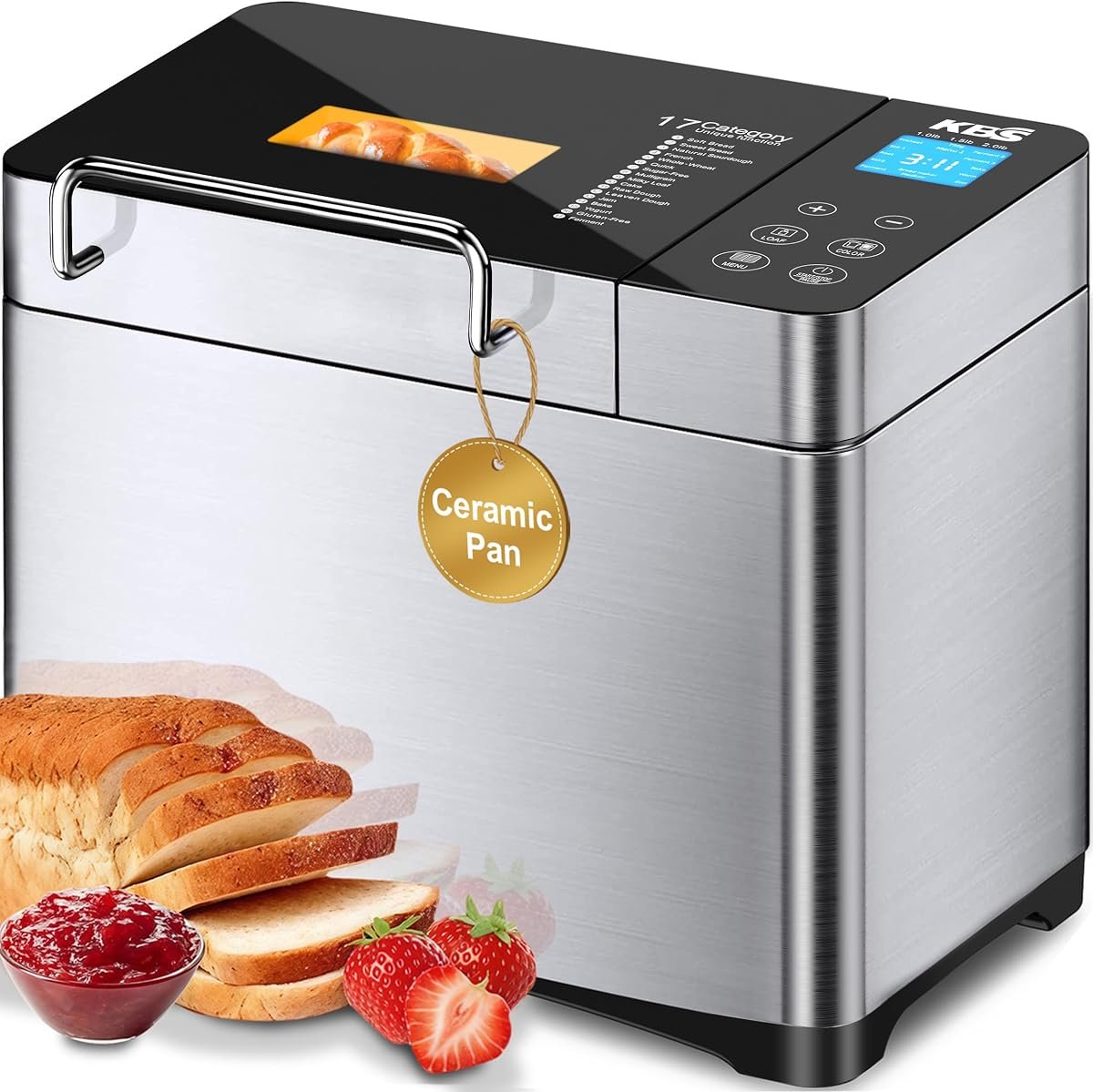
KBS Pro 710W 2.2LB Bread Maker (Stainless Steel, 17-in-1)

The KBS Pro 710W 2.2LB Bread Maker (Stainless Steel, 17-in-1) is the value play in this group and the largest loaf capacity of the three. It is a 710-watt machine with a 2.2-pound capacity and a stainless steel body, and it carries seventeen programmable settings. As of the Amazon search results captured on 2026-10-17, it was listed at $139.98 with a 4.4-star listing rating.
For a small kitchen, the appeal here is straightforward: you get the most bread per dollar of the three, and the stainless steel body is easier to wipe down than a textured plastic housing. The 2.2-pound capacity means you can bake a full-size loaf, which is useful if you are feeding more than two people or if you like to bake once and eat for several days.
The trade-off is size. A machine that bakes a 2.2-pound loaf is not a compact appliance, and seventeen programs mean a busier control panel. If your counter space is genuinely limited, this is the model most likely to end up in a closet. But if you have a spot for it — or you are willing to store it and haul it out on baking days — it delivers a lot of capability for the price.
Pros
- Largest loaf capacity in this comparison at 2.2 lb
- Lowest listed price of the three at $139.98
- Stainless steel body is easy to clean
- Seventeen programmable settings cover a wide range of breads and doughs
Cons
- Full-size footprint is the hardest to fit in a small kitchen
- Busy control panel if you only ever use basic cycles
- 2.2 lb is more bread than a one- or two-person household needs
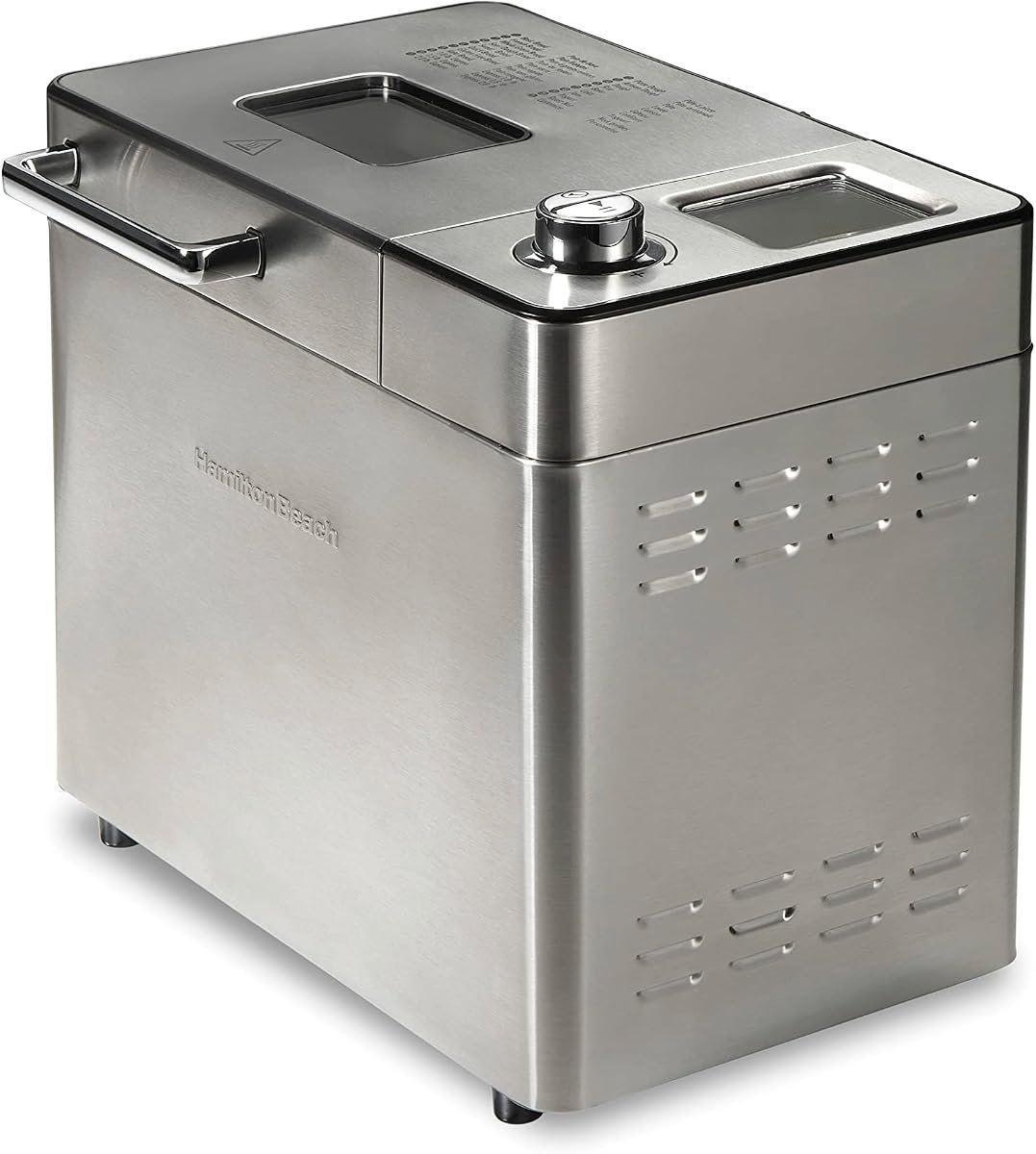
Hamilton Beach Premium Dough & Bread Maker Machine (2lb, Auto Fruit & Nut Dispenser)

The Hamilton Beach Premium Dough & Bread Maker Machine (2lb, Auto Fruit & Nut Dispenser) is the middle option in both price and capacity. It bakes a 2-pound loaf and includes a delay start plus an automatic fruit and nut dispenser. As of the Amazon search results captured on 2026-08-31, it was listed at $177.45 with a 4.5-star listing rating — the highest rating in this group.
The auto dispenser is the headline feature, and it is genuinely useful rather than decorative. If you bake raisin bread, seeded loaves, or anything with add-ins, the dispenser drops them in at the right point in the cycle so they do not get pulverized during kneading. Doing that by hand means standing by the machine at the right moment, which defeats the purpose of a bread maker for many people.
The delay start is the other feature worth calling out. It lets you load the machine the night before and wake up to bread, which is one of the genuinely magical things a bread maker can do. In a small kitchen, though, the same size caveat applies: a 2-pound machine is not small. The dispenser mechanism also adds a component that needs occasional cleaning, so factor that into your routine.
Pros
- Highest listing rating in this comparison at 4.5
- Automatic fruit and nut dispenser handles add-ins without babysitting
- Delay start supports overnight baking
- 2 lb capacity is a good middle ground for small families
Cons
- Mid-to-high price at $177.45
- Still a full-size machine, so counter space remains a constraint
- Dispenser adds a part to clean and maintain
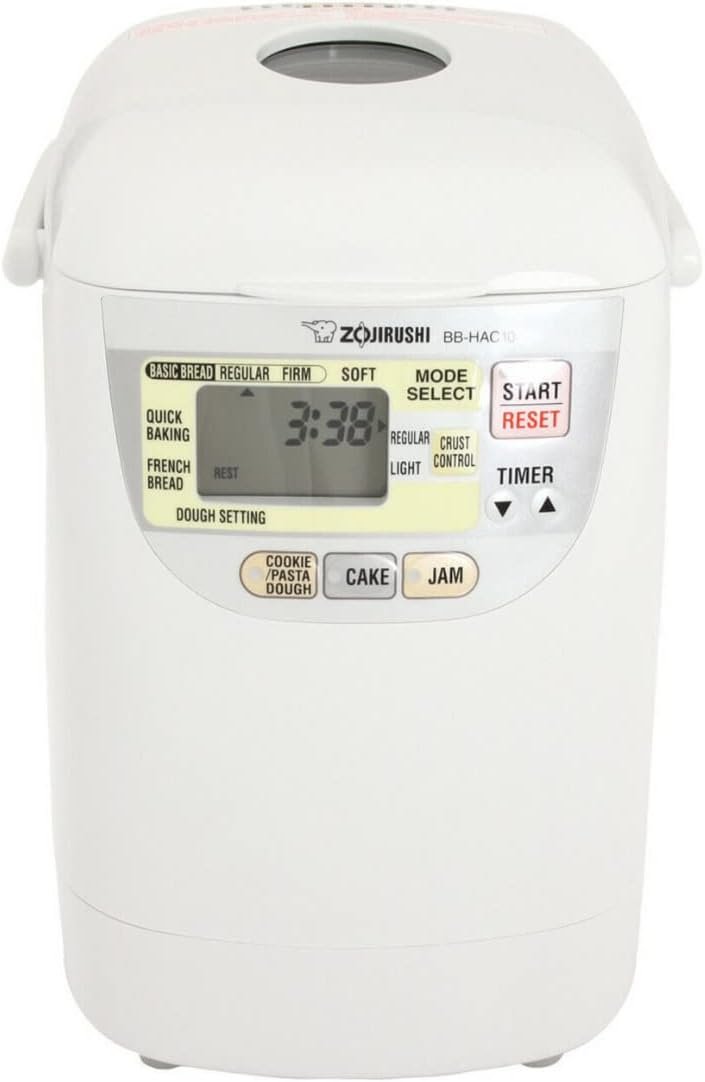
Zojirushi BB-HAC10 Home Bakery Mini Breadmaker (1 Lb, White)

The Zojirushi BB-HAC10 Home Bakery Mini Breadmaker (1 Lb, White) is the compact specialist of the group and the one most directly aimed at small kitchens. It bakes 1-pound loaves, making it the most compact option here, and it comes from the most recognized bread-maker brand in the category. As of the Amazon search results captured on 2026-10-17, it was listed at $294.00 with a 4.2-star listing rating.
This is the model to look at first if your kitchen is genuinely small and you are feeding one or two people. A 1-pound loaf is a real, usable loaf — not a novelty — and the machine that produces it is meaningfully smaller than a 2-pound unit. For anyone who has ever abandoned a full-size bread maker because it lived in a closet, that size difference is the whole point.
The obvious trade-off is price. At $294.00, this is more than twice the listed price of the KBS Pro, and you are getting less bread capacity for the money. What you are paying for is compactness and brand reputation. Whether that is worth it depends entirely on how much you value the machine actually fitting in your kitchen. If it does not fit, the cheaper machine is not cheaper — it is just unused.
Pros
- Most compact option in this comparison
- 1 lb capacity is well matched to one- or two-person households
- From the most recognized bread-maker brand in the category
- White finish blends into a small kitchen more easily than stainless
Cons
- Highest listed price at $294.00
- Lowest listing rating in this group at 4.2
- 1 lb loaves are small for households of three or more
Why Bread Makers Are Tricky in Small Kitchens
The core problem is that bread makers are shaped like small appliances but sized like medium ones. A typical full-size unit needs a footprint roughly the size of a microwave plus clearance on all sides for the lid to open and for steam to escape. That is fine in a kitchen with a dedicated appliance garage. In a galley kitchen or a studio apartment, it is a commitment.
There is also the storage question. Bread makers are heavy, and most people do not want to haul one out of a closet every time they want a loaf. That means the machine either lives on the counter permanently or it does not get used. If it lives on the counter, it competes with the coffee maker, the toaster, and whatever else already won that fight.
So the real buying question is not “which bread maker is best” in the abstract. It is “which bread maker will I actually keep out and use.” That reframing pushes you toward three practical criteria: physical footprint, loaf size relative to your household, and how much feature bloat you are willing to trade for convenience. Everything else — crust settings, gluten-free programs, jam cycles — is secondary if the machine does not fit.
The Three Models in Our Current Data
Our product data currently covers three bread makers that span the size and price spectrum: a feature-rich 2.2-pound machine, a 2-pound machine with an automatic dispenser, and a compact 1-pound machine from a well-known brand. They are not interchangeable, and the right pick depends almost entirely on how many people you are feeding and how much room you have.
Before diving into each one, it helps to understand the trade-off curve. Smaller machines cost more per pound of bread capacity because you are paying for engineering density rather than raw materials. Larger machines give you more bread per dollar but demand more space. There is no free lunch here — only a decision about which constraint you would rather live with.
| Model | Capacity | Listed Price | Listing Rating | Best For |
|---|---|---|---|---|
| KBS Pro 710W 2.2LB Bread Maker (Stainless Steel, 17-in-1) | 2.2 lb | $139.98 | 4.4 | Versatility on a budget |
| Hamilton Beach Premium Dough & Bread Maker Machine (2lb, Auto Fruit & Nut Dispenser) | 2 lb | $177.45 | 4.5 | Hands-off add-ins |
| Zojirushi BB-HAC10 Home Bakery Mini Breadmaker (1 Lb, White) | 1 lb | $294.00 | 4.2 | Smallest footprint |
What Actually Matters When Space Is Tight
Footprint and Lid Clearance
Manufacturers list dimensions inconsistently, and the number that matters most — the height with the lid fully open — is almost never in the spec sheet. When you are evaluating a listing, look for the closed dimensions first, then mentally add several inches of vertical clearance for the lid. If the machine sits under a cabinet, that clearance is a hard constraint.
Depth is the second trap. A machine that is narrow but deep will still eat your counter. If your counters are shallow, prioritize machines with vertical pans, which tend to be taller and narrower rather than long and low.
Loaf Size vs. Household Size
A 1-pound loaf is roughly a small sandwich loaf — enough for a couple of days for one or two people. A 2-pound loaf is a standard grocery-store size and will feed a family, but it also means a bigger pan and a bigger machine. If you routinely throw away half a loaf, you are paying for capacity you do not need, both in bread and in counter space.
Feature Bloat
Program count is the most overrated spec in the category. A machine with seventeen settings sounds more capable than one with a handful, but most households use two or three programs: basic white, whole wheat, and maybe dough. Extra programs do not usually make the machine bigger, but they do add complexity to the control panel and sometimes to the internal mechanism.
Cleanability
The pan and paddle are the parts that touch food, and they are the parts that determine whether you dread using the machine. A nonstick pan that releases cleanly is worth more day to day than an extra program. Check whether the pan is removable and whether replacement paddles are available — a lost paddle can sideline an otherwise fine machine.
Noise and Vibration
Kneading is a physical process, and every bread maker makes some noise during the knead cycle. If your kitchen shares a wall with a bedroom or you bake overnight using a delay timer, pay attention to how the machine is described in reviews. Our product data does not include decibel figures for any of these models, so treat any specific noise number you see elsewhere with suspicion unless the manufacturer publishes it.
How to Measure Before You Buy
This is the step almost everyone skips, and it is the reason so many bread makers end up on resale sites. Before you order anything, do three things.
First, measure the counter space you are willing to give up permanently. Not the space you could clear in a pinch — the space you will actually leave open. Write the number down.
Second, measure the vertical clearance above that spot. If it is under a cabinet, measure from the counter to the bottom of the cabinet. Then check the machine’s closed height in the listing and add room for the lid to swing open. If the listing does not state the open height, assume you need substantially more than the closed height and plan accordingly.
Third, measure your deepest cabinet or closet shelf if you plan to store the machine between uses. A bread maker that fits on the shelf is one you will use; one that does not is one you will avoid.
Once you have those three numbers, compare them against the listed dimensions for each candidate. If a listing omits dimensions entirely, that is a yellow flag — look for the manufacturer’s spec sheet or ask in the listing’s question section before buying.
Loaf Size, Pan Shape, and What You Actually Get
Bread makers generally use one of two pan orientations. Vertical pans produce a tall, narrow loaf with a distinctive shape — the top is rounded and the slices are small and square-ish. Horizontal pans produce a more conventional loaf that slices into recognizable sandwich bread.
Vertical pans are usually found on more compact machines because the machine can be narrower and deeper rather than wide. That is a real advantage in a small kitchen, but it changes the shape of what you bake. If sandwich-shaped slices matter to you, check which orientation a machine uses before buying.
Capacity also affects how you use the machine. A 1-pound machine is best treated as a fresh-bread appliance for one or two people — you bake a loaf, eat it over a couple of days, and bake again. A 2-pound machine supports batch baking and freezing. Neither approach is better; they just suit different routines.
Features Worth Paying For — and Features You Can Skip
Delay start is worth paying for if you like waking up to bread. It is one of the few features that changes how you use the appliance rather than just adding a button.
An automatic fruit and nut dispenser is worth paying for if you bake add-in loaves regularly. If you mostly bake plain white or whole wheat, it is dead weight.
Program count is mostly marketing. A machine with seventeen settings is not seventeen times more capable than one with five. Look at whether the programs you would actually use — basic, whole wheat, dough, maybe gluten-free — are present, and ignore the rest.
Crust control is a nice-to-have. Some people care a lot; most people set it once and forget it.
What you should not skip: a removable, nonstick pan, a paddle that is easy to find replacements for, and a housing that wipes clean. Those are the things that determine whether the machine is pleasant to own.
Maintenance in a Small Kitchen
Bread makers are low-maintenance compared to most countertop appliances, but they are not zero-maintenance. The pan and paddle need washing after each use, and the interior needs to be wiped free of flour and crumbs. In a small kitchen, where the machine may sit out permanently, crumbs on the housing are more visible and more annoying.
Give the machine a little breathing room. Bread makers vent steam during baking, and pressing one directly against a wall or under a low cabinet can trap moisture. If your only available spot is tight, consider whether a different spot — even one that requires moving the machine — would serve you better.
Store the paddle and any accessories in a small bag or container near the machine. Losing a paddle is the most common way a bread maker gets retired early, and replacement paddles are not always easy to source.
Matching the Machine to Your Household
If you live alone or with one other person and counter space is the binding constraint, the compact 1-pound machine is the logical starting point. You are paying a premium for size, but size is exactly what you need.
If you have a bit more room and want the most capability per dollar, the 2.2-pound machine gives you the largest loaves and the lowest listed price. It is the best value on paper, provided you can actually house it.
If you bake add-in loaves and want the machine to handle the timing for you, the 2-pound machine with the automatic dispenser sits in the middle on both size and price and carries the highest listing rating of the three.
None of these is a universal winner. The right answer depends on your counter, your household size, and how often you realistically expect to bake.
Bread Maker for Short People
Counter height is standard, so being short changes nothing about the baking. It changes two things: where the machine is allowed to live, and how safely you can get a hot pan out of it.
Keep it below counter height, or keep it on the counter. A bread maker stowed in a wall cabinet has to be lifted up empty and brought back down with a loaf in it, one-handed, over a worktop you are standing right against. If high cabinets are your only space, the machine should stay out permanently – and that is the argument for the 1-pound Zojirushi BB-HAC10 here, the smallest of the three and the easiest to leave where it is.
Look at where the display sits before you buy. A control panel on top of the machine reads fine at eye level and badly when you are bent over it from across a deep counter. The listing photos answer this. The spec sheet never mentions it.
Check the gap above your counter. Upper cabinets usually leave less headroom than a bread maker is tall, and the gap that matters is the open lid, not the box. Our data on these three models lists no closed or open height, so measure from the counter to the underside of the cabinet and compare that against the manufacturer’s own figure before you commit to a spot.
Shorter bakers rarely need a different machine. They need a machine that never has to be lifted.
Frequently Asked Questions
Is a 1-pound bread maker big enough for two people?
For most two-person households, yes. A 1-pound loaf provides several servings and can be baked fresh every couple of days. If you entertain often or want leftovers for freezing, a larger capacity may suit you better.
Do bread makers need to sit on the counter, or can they be stored?
They can be stored, but they are heavy and bulky, and most people find that a stored bread maker gets used far less often. If you have any permanent counter space available, that is usually the better home for it.
How much clearance does a bread maker need above it?
Enough for the lid to open fully plus room for steam to escape. Our product data does not include open-lid heights for these models, so check the manufacturer’s dimensions and the listing details for the exact figure before you commit to a spot under a cabinet.
Are more programs better?
Not necessarily. Most households use a small handful of cycles. Focus on whether the programs you need are included rather than on the total count.
What should I check first in a listing?
Dimensions — closed height, width, and depth — followed by loaf capacity and whether the pan is removable and nonstick. Features come after fit.
The Bottom Line
For a small kitchen, the compact 1-pound machine is the most space-efficient choice, the 2.2-pound machine is the best value if you can house it, and the 2-pound machine with the automatic dispenser is the strongest all-rounder for households that bake add-in loaves. Measure your space first, then pick the machine that fits it — because the best bread maker for a small kitchen is the one you will actually keep on the counter.
Quick Tip
Before ordering, write down your available counter width, depth, and vertical clearance. Then compare those numbers against the listing dimensions for each candidate. Five minutes with a tape measure prevents the most common bread-maker regret.
The Spoonist
Get the deals before they sell out
One email a week. Tested gear, real price drops, one-click unsubscribe.
By subscribing you agree to our Privacy Policy.
As an Amazon Associate, The Spoonist earns from qualifying purchases. Product prices and availability are accurate as of the date/time indicated on Amazon and are subject to change.
🥇 Free: Air Fryer Time & Temp Chart
20 foods in °F & °C, the oven-to-air-fryer converter, and starting-points for Ninja, Cosori, Instant & more. Print it, stick it on the fridge.
Want all 92 foods + the rescue guide? Get the full Chart Pack →