A freezer inventory sheet has one job: telling you what is in there before you buy more of it. Most households do not have a frozen-food problem, they have a frozen-food memory problem. Six months of bags you cannot identify, one drawer nobody opens, and a shop every week for things already at −18°C.
The date you write is the date it went in.
Not the day you remember, not the day it started tasting like cardboard. Write it on the bag the moment the drawer closes, or the sheet is guesswork in a nicer format.
Below is the sheet we use, the six columns worth filling in, and the how-long-it-keeps table that goes with it. The times are the USDA quality windows for food held at 0°F, the same table printed on page 4 of our Kitchen Printable Binder.
The freezer inventory sheet: six columns
Anything more than six columns and people stop filling it in. Anything fewer and it stops being useful in month three.
| Column | What goes in it | Why it earns the space |
|---|---|---|
| Item | Salmon fillet, not "fish" | A vague label is the reason you defrost the wrong thing |
| Date in | The day it went into the drawer | The only number that lets you work out age at a glance |
| Use by | Date in plus the window from the table below | Turns the sheet into a shopping plan instead of a museum |
| Qty | 1 lb, 2 breasts, 4 portions | Lets you cook from the sheet without opening the bag |
| Basket / drawer | Top drawer, back left | The column that ends the dig through nine boxes |
| Gone | A tick, and the date | Cross it off and the sheet tells you what you actually eat |
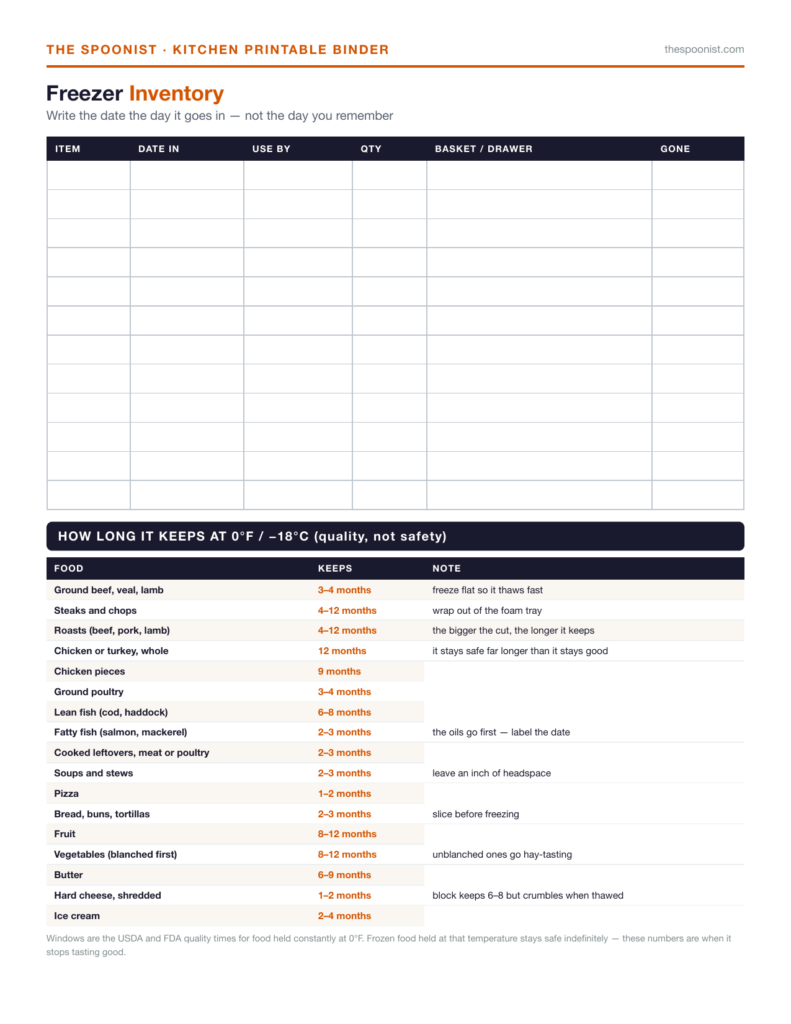
How long things keep at 0°F
Read this as a taste window, not a danger window. The USDA note on its own freezer chart is blunt about it: freezer storage is for quality only, and food held constantly at 0°F stays safe indefinitely. Nothing below is a date you have to throw something out on.
| Food | Keeps | The note that matters |
|---|---|---|
| Ground beef, veal, lamb | 3–4 months | freeze flat so it thaws fast |
| Steaks and chops | 4–12 months | wrap out of the foam tray |
| Roasts (beef, pork, lamb) | 4–12 months | the bigger the cut, the longer it keeps |
| Chicken or turkey, whole | 12 months | it stays safe far longer than it stays good |
| Chicken pieces | 9 months | |
| Ground poultry | 3–4 months | |
| Lean fish (cod, haddock) | 6–8 months | |
| Fatty fish (salmon, mackerel) | 2–3 months | the oils go first — label the date |
| Cooked leftovers, meat or poultry | 2–3 months | |
| Soups and stews | 2–3 months | leave an inch of headspace |
| Pizza | 1–2 months | |
| Bread, buns, tortillas | 2–3 months | slice before freezing |
| Fruit | 8–12 months | |
| Vegetables (blanched first) | 8–12 months | unblanched ones go hay-tasting |
| Butter | 6–9 months | |
| Hard cheese, shredded | 1–2 months | block keeps 6–8 but crumbles when thawed |
| Ice cream | 2–4 months |
Sources: the USDA Cold Food Storage Chart and the FoodKeeper times behind it. The two rows that surprise people are fatty fish at 2 to 3 months, because the oils go rancid long before the texture does, and whole poultry at 12 months, which is a quality window on top of a food that is safe far longer.
What to write on the bag
The sheet is the map; the bag still needs its own label, because the map is in the kitchen and the bag is in the drawer. Three things, in permanent marker, on the top face rather than the side: what it is, how much, and the date. Add "cook from frozen" on anything flat and portioned, which is most of what a freezer is for.
Masking tape and a biro work, and so does a strip of clear packing tape over ordinary pencil, which does not smudge once it is at −18°C. Wax-free labels and permanent marker on a zip bag are the two that survive a year. If you wrap in foil, write on the foil the day you wrap it, because nothing survives six months unlabeled.
Rotation: first in, first out
Newest at the back, oldest at the front, every time you unpack the shopping. Restaurants do it because a health inspector checks it, and homes skip it because nobody checks. It takes one extra second per bag and it is the single change that makes a freezer inventory sheet work, because a sheet you have to reorder by age each week is a sheet you stop filling in.
One drawer, one category. Meats together, vegetables together, the things you eat without thinking about it — bread, waffles, pizza — in the drawer you can reach without a step stool. A freezer organized by when things went in is a freezer you can empty. One organized by accident is a freezer you shop around.
Thawing safely, in the four ways that are
The USDA is direct about this: there are three safe ways to thaw food — in the refrigerator, in cold water, and in the microwave — and a fourth option when you are in a hurry, which is to cook it from frozen. Never on the kitchen counter, and never in the garage, basement, car, dishwasher, a plastic garbage bag, outdoors or on a porch. All of those sit in the temperature band bacteria like.
| Method | How long it takes | The rule that goes with it |
|---|---|---|
| Refrigerator | A full day for a pound of ground meat; at least 24 hours per 5 lb for a whole turkey | Thawed food keeps 1 to 2 days more for poultry, seafood and ground meat, 3 to 5 days for red meat cuts |
| Cold water | About an hour for a pound; 2 to 3 hours for 3 to 4 lb; roughly 30 minutes per pound for a whole turkey | Leak-proof bag, change the water every 30 minutes, cook as soon as it is thawed |
| Microwave | Minutes | Cook immediately after, because parts of it have already started warming |
| From frozen | About 50% longer than the fresh time | Safe, and the reason flat-frozen portions are worth the trouble |
Refreezing has one clean answer: food thawed in the refrigerator can be refrozen without cooking, with some loss of quality. Food thawed in cold water or in the microwave should be cooked before it goes back. Full detail is on the USDA’s Big Thaw page.
When the power goes out
Keep the door shut. A full freezer holds its temperature for roughly 48 hours and a half-full one for about 24, according to USDA emergency guidance, and every time you open it to look costs hours. When the power comes back, food may be refrozen safely if it still has ice crystals in it or reads 40°F or below on a thermometer. Do not taste anything to decide.
This is the argument for keeping a thermometer in the freezer rather than trusting the dial. A $8 probe with a freezer rating tells you the truth after an outage; the appliance light does not.
What does not freeze well
The USDA charts say "do not freeze" or "does not freeze well" about a short list, and it is worth knowing because these are the items that end up in the bin: mayonnaise-based and egg salads, hard-cooked eggs, liquid egg substitutes, custard and chiffon pies, cream cheese, cottage cheese, sour cream, soy milk, processed cheese slices, and the watery produce — lettuce, cucumbers, radishes, artichokes. Cooked casseroles of the same things are usually fine, which is why a freezer works better for cooked food than for raw salads.
Freezer burn is not a safety problem either. It is a dry spot: the surface lost water to the air. Trim it off and cook the rest. The fix is pressure, not time — a vacuum-sealed bag is the reason our vacuum sealer guide is the most useful page on this site for anyone who freezes more than two bags a week.
Freeze it the way you will cook it
The difference between a freezer that gets used and one that gets cleaned out is shape, not space. A block of frozen chicken breasts is a decision you have to make the night before. Five flat portions are a dinner you can start in ninety seconds.
Minced meat: press it flat, then score it. Pour the bag into a zip bag, roll it to a half-inch slab, draw the back of a knife into five squares, freeze flat. Break off a square the size of the meal. A flat slab thaws in the fridge in a day, which is the rule on the USDA page above, and a dense brick takes two.
Breasts, cutlets and fillets: one bag, one meal, no stacking. If two pieces are frozen together you cannot separate them without water, and water is what makes the surface pale instead of brown. Freeze on a tray for an hour, then tip them into a bag and they move around like coins.
Sauces and stocks: an inch, not a pint. Leave a good inch of headspace in a tub, or freeze portions in a muffin tray and transfer them once they are solid. Two of those cubes is a pan sauce, and you never have to defrost the whole batch to get one.
Bread, buns and tortillas: slice first. Everything on that list keeps 2 to 3 months, and a sliced loaf toasted straight from frozen is the reason flat freezing is worth the tray. Same logic for fries, and for the frozen rows in our air fryer cheat sheet, which are written for food that goes from the bag to the basket with no thawing at all.
Anything you are freezing because it will not get eaten in time is a different problem from storage. Herbs, chillies, tomatoes, ginger and the last two avocados do better kept dry than kept cold, and that is the case our food dehydrator guide makes: a freezer is a queue, a dehydrator is a shelf.
Make the sheet do something
A freezer inventory sheet is only worth filling in if it changes the shop. Two habits make that happen. First, photograph the sheet and the pantry shelf before you write a list; the photo is the list. Second, tick the "Gone" column as things leave. After three weeks you can see what you actually eat, which is never quite what you bought, and that gap is where the wasted money is.
Get the printable version
The Kitchen Printable Binder, $12
Page 4 is this sheet: twelve inventory rows with the six columns above, plus the full how-long-it-keeps table on the same page. Seven other pages go with it — conversion charts, a pantry inventory sheet, an aisle-by-aisle grocery list, six recipe cards and a journal for your own numbers. Prints on US Letter as many times as you like.
Freezer inventory sheet FAQ
Is food still safe after the use-by date on my sheet?
Yes, if the freezer has been holding 0°F. The dates on the sheet are quality windows, and the USDA is explicit that frozen food kept at that temperature stays safe indefinitely. What changes is taste and texture, not danger.
How often should I fill the sheet in?
At the moment the bag goes in, and nowhere else. A sheet filled in on Sunday about the previous week is always wrong, which is why the label on the bag matters more than the sheet at first.
Do I need a freezer inventory app?
No. An app needs the same discipline as paper and is harder to update with wet hands in front of an open drawer. The only digital tool that helps is a phone photo of the sheet before you shop.
What about the "best before" date on a frozen packet?
Store-bought frozen food is usually blanched, par-cooked or vacuum-packed, so the packet date is a quality promise from the maker. Treat it as the use-by on your sheet and do not add your own date to it — the clock started at the factory, not at your door.
How long does cooked rice and pasta keep frozen?
The USDA puts cooked grain and potato side dishes at 1 to 2 months and casseroles at 2 to 3. They reheat well if they are still a little underdone when they go in, because freezing finishes the cooking.
Can I freeze anything in a milk carton?
Milk separates and grains when thawed, so it is fine for a sauce or a cake batter and unpleasant as a glass. Leave headspace, thaw in the fridge and shake it. Cream and half-and-half are on the "does not freeze well" list instead.
As an Amazon Associate we earn from qualifying purchases. This page contains no affiliate links; the guides it points to do.