A pantry inventory list is not a tidying exercise. It is the sheet that stops you buying a third jar of the same thing, and the only reliable way to know what a kitchen actually needs this month. Counting takes twenty minutes. The version we use is page 5 of our Kitchen Printable Binder, and the columns below are the ones on it.
The reorder column is the point.
A list of what you own tells you nothing. A list of what you own and the level at which you buy more tells you what to put in the basket before you leave the house.
One more thing this page settles: what the date on the packet means. It is not what most people think it is, and the difference is worth money.
Pantry inventory list: the five columns
| Column | What goes in it | Why it earns the space |
|---|---|---|
| Item | Flour, canned tomatoes, olive oil | One item per row, not one shelf per row |
| In | 2 lb, 6 cans, 1 bottle | Count, not a tick — a tick cannot be reordered against |
| Rebuy at | 1 bag | The level that triggers a buy. This is the column that saves the money |
| Best by | The date on the oldest packet | Only the oldest matters, because that is the one you will reach for |
| Where it lives | Bottom shelf, spice rack, hall cupboard | The row that ends a search, and the reason you find the second jar |
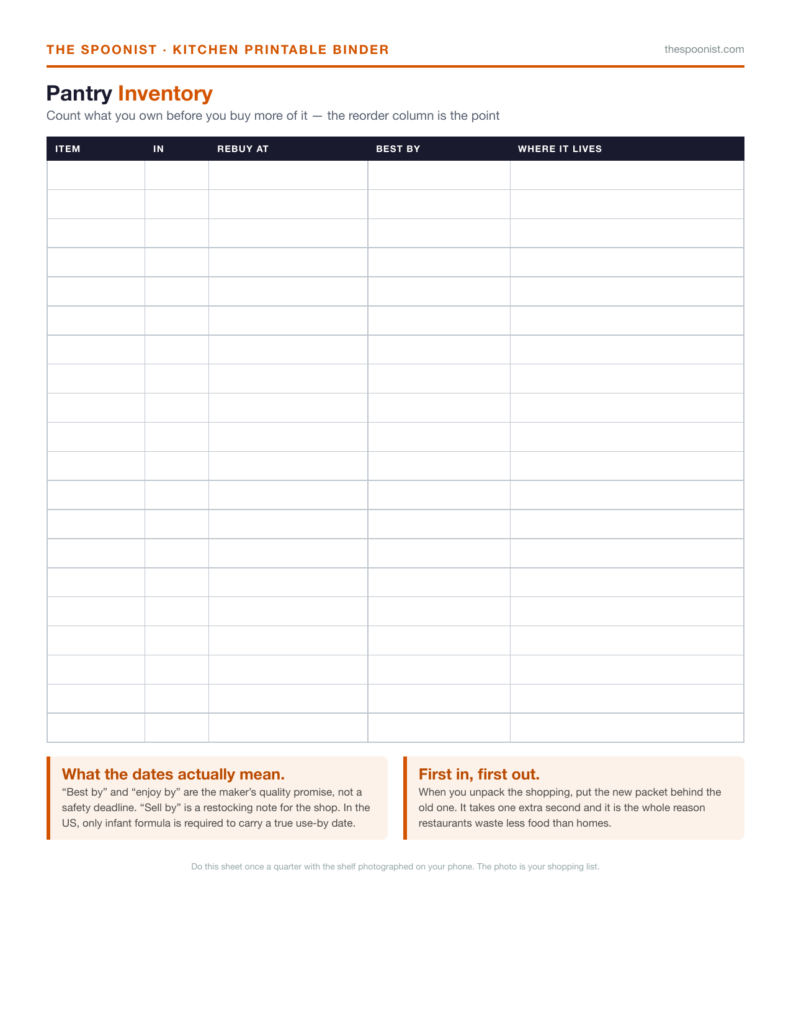
Do it once a quarter with the doors open, and photograph the sheet. The photo goes in your phone and becomes the list you shop from. Doing it weekly is the reason people stop doing it at all.
What the date on the packet actually means
In the United States, only infant formula is required by federal regulation to carry a dated label. Everything else is a manufacturer’s promise about quality, and the wording on the packet tells you which promise was made. The phrases below are the USDA’s own definitions.
| Phrase on the packet | What it means | Is it a safety date? |
|---|---|---|
| Best if Used By / Before | When the product will be of best flavor or quality | No |
| Sell By | How long the store should display it, for their own stock rotation | No |
| Use By | The last date recommended for use at peak quality | No, except on infant formula |
| Freeze By | When a product should go into the freezer to keep its quality | No |
| Coded date (letters and numbers) | The manufacturer’s production code | Not a consumer date at all |
The USDA puts it plainly: except for infant formula, dates are not an indicator of safety. Perishable food past the date may still be safe if it has been handled properly, and the test is what you can see, smell and taste — not the number. The agency also estimates that about 30 percent of the US food supply is lost or wasted at retail and consumer levels, and confusion over these dates is one of the reasons it gives.
How long pantry staples keep
These are the FoodKeeper windows for a cool, dry pantry, unopened unless the row says otherwise. Quality, not safety: dry food does not become dangerous on a date, it goes stale, oily, or loses its raising power.
| Item | Unopened | After opening | The tell |
|---|---|---|---|
| White or wild rice | 2 years | 1 year in the pantry | Cooked grains taste fresh; old rice takes longer and stays chalky |
| Brown rice | 1 year | 1 year, or 6 months in the fridge | The oils in the bran go first — smell it before cooking |
| Dry pasta (no egg) | 2 years | 1 year | Nothing, unless it has been wet |
| Dried beans and lentils | 1 year | 1 year | Older beans need a longer soak and still firm up in salted water |
| Rolled oats | 1 year | 6 to 12 months | A flat, cardboard smell means the oils |
| All-purpose flour | 6 to 12 months | Same, keep it sealed | Sour or bitter means it is done |
| Whole-wheat flour | 3 to 6 months | Fridge or freezer is better | The germ is why whole-grain flours go rancid and white ones do not |
| Granulated and brown sugar | 18 to 24 months | Same | Sugar does not spoil; a brick of brown sugar is only dried out |
| Honey | 2 years | Forever, in practice | Crystallization is not spoilage — warm the jar |
| Olive or vegetable oil | 6 to 12 months | 3 to 5 months, away from the stove | Crappy, waxy or crayon-smelling oil is the one to bin |
| Nuts in a jar or can | 1 year | 4 to 6 months in the fridge, 6 to 12 frozen | Bitter skin, soapy smell |
| Peanut butter | 6 to 24 months | 2 to 3 months in the pantry | Oil that will not re-stir, or any rancid taste |
| Ground spices | 2 to 3 years | Same | Rub a pinch between your fingers and smell it. Nothing is the answer |
| Whole spices | 3 to 4 years | Same | Grind them; they still smell |
| Baking powder | 6 to 18 months | 3 to 6 months | Half a teaspoon into hot water should fizz hard. If not, replace it |
| Canned, low-acid (meat, fish, beans, soup, potatoes) | 2 to 5 years | 3 to 4 days in the fridge | Bulging, rust or a spurting lid means the whole can |
| Canned, high-acid (tomatoes, fruit, juices) | 12 to 18 months | 5 to 7 days in the fridge | Metallic taste and a fading color |
| Tea, bags and loose | 18 to 36 months | Keep it sealed and dark | Flat aroma, and no amount of steeping fixes it |
| Chocolate chips and bars | 1 to 2 years | Same, sealed | Grey bloom is fat or sugar on the surface, not spoilage |
| White vinegar | 2 years | Same | It barely changes; pickles get softer first |
Heat, light and the shelf you put things on
Dry food keeps to the numbers above when it is stored cool, dark and dry. The extension services put the ideal pantry at 50 to 70°F, and note that canned food held above 70°F loses shelf life faster — never above 95°F, which rules out a garden shed, a garage shelf and the cupboard above a fridge.
Three spots in a normal kitchen are worse than the rest: the cupboard over the oven, which is warm every time you cook; anything on a shelf in direct sun, which fades spices and turns oil; and the floor of a under-sink cupboard, where a can that got splashed once will rust from the bottom. Oil, whole-wheat flour, nuts and anything with a raising agent are the four that feel it first. Put them in the fridge and the numbers on this page get longer, not shorter.
Rotation, and the two-inch rule
First in, first out: when you unpack the shopping, the new packet goes behind the old one. That is the whole technique, and it is why restaurants waste less food than homes with better shelving.
The two-inch rule is the one nobody mentions. Keep a gap at the front of every shelf so you can see two rows deep. A shelf packed flush to the edge is how a jar of something gets found eleven months late, and it is why the "where it lives" column on the sheet matters more than it sounds.
Bugs: the two you actually find
Pantry moths and grain weevils, and they arrive in the bag rather than through a window. The signs are silk webbing inside a flour packet or tiny beetles in a cornmeal bag. When you see either, the whole shelf goes, not just the packet: vacuum the corners, wipe the shelf with soapy water, and put every dry good you keep into glass or hard plastic with a gasketed lid. Cardboard, paper bags and the thin zip bags flour comes in are not barriers.
Bay leaves on the shelf are a folk remedy with no evidence behind them, so do not count on the leaves. Sealed containers and a clean shelf are the two things that work, and both are the reason the pantry shelving guides people land here from start with airtight storage rather than pretty jars: our pantry shelving guide and the cabinet organizing guide cover the hardware.
What does not belong on a pantry sheet
Three things do not go on this list, and putting them on it is why people abandon the habit. Fresh produce changes every few days, so it is a photo of the crisper, not a row. Anything in the fridge has a clock measured in days and belongs on the same sheet as the milk, not in the pantry count. And anything frozen has a whole page of its own, because its clock is measured in months.
What the pantry sheet is genuinely for is the slow stuff: the bags, cans, bottles and jars you replace two or three times a year and cannot see behind the front row. Rice, flour, tinned tomatoes, oil, spices, the case of something you bought in bulk and have never opened. Those are the items where a household can hold four of something and buy a fifth without noticing.
From the sheet to the shop
The inventory list and the grocery list are the same job in two sittings. Work down the "rebuy at" column, write the hits onto the aisle list, then shop the list in the order the store is built so you walk it once. Page 6 of the binder is that list, split into the eight aisles a US supermarket actually has: Produce, Meat & Fish, Dairy & Eggs, Bakery, Pantry, Frozen, Spices & Oils and Household, with 65 lines to write on.
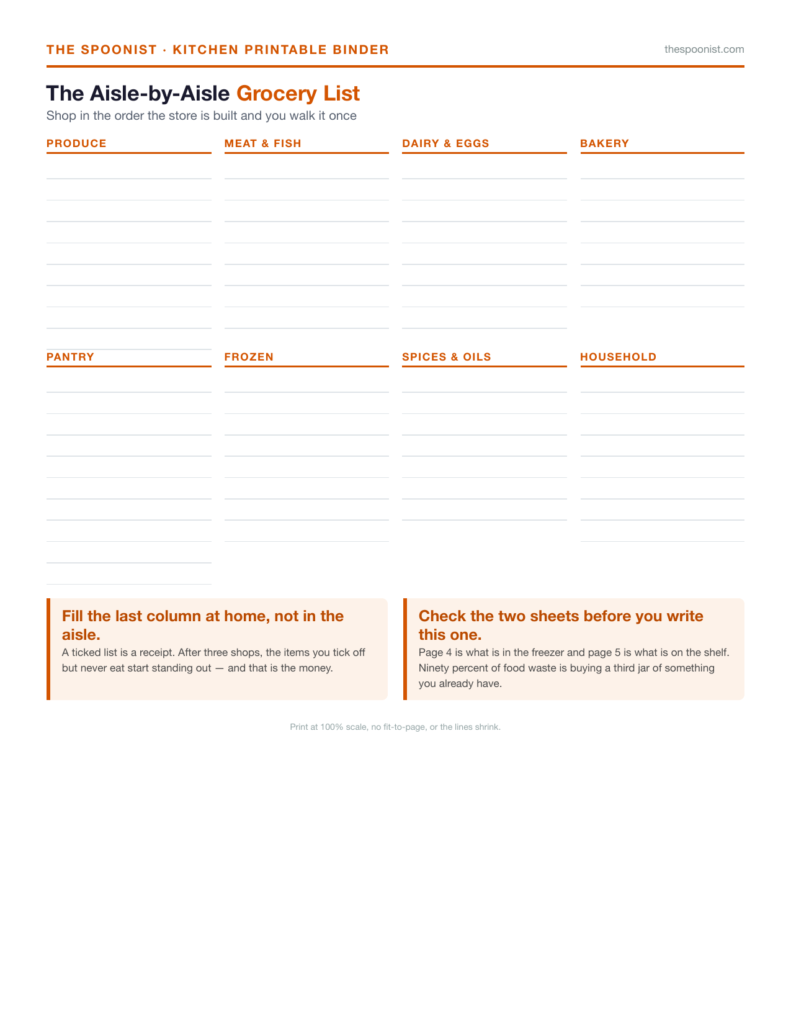
Fill the tick column at the kitchen table, not in the shop. After three trips you can see the items you keep buying and never eat, and that column is usually worth more than the whole rest of the binder.
Get the printable version
The Kitchen Printable Binder, $12
Eight US Letter pages: this pantry sheet with twenty rows, the freezer inventory sheet, the conversion charts, the aisle-by-aisle grocery list, six blank recipe cards and a 20-row journal for your own numbers. One price, print it as many times as you like, and every later version comes to you free.
Pantry inventory list FAQ
Is a pantry inventory list worth the time?
Twenty minutes a quarter against a shop you make every week. The payback is not the tidying, it is the duplicate jars and the things that expire behind a shelf, which are the two lines most households never count.
Can I use an app instead?
Apps work if you already scan barcodes at the till, and stop working the week you do not. A sheet on the fridge door gets filled in by everyone in the house; an account gets filled in by whoever set it up.
What about food past its best-by date?
Judge the food, not the date. Except for infant formula, US dates are quality promises rather than safety limits. Smell it, look at it, and if a dry good tastes flat or an oil tastes waxy, that is the answer — not the number on the lid.
How do I know how much to write in the rebuy-at column?
Start with one of whatever you use in a normal week, and let the sheet correct you. If you ever ran out of oats, the rebuy-at was too low. If you found three cans, it was too high. Two quarters and the numbers are yours rather than guessed.
Does rice really last two years?
White rice does, and it is one of the few pantry items that is close to indefinite if it stays dry and sealed. Brown rice is the exception at about a year, because the bran still has oil in it and that oil goes rancid.
Where does the freezer fit into a pantry list?
Same sheet, different temperature. The binder keeps them on separate pages because the freezer clock runs on weeks and the pantry clock runs on years, and a single list with both columns gets filled in wrongly. See the air fryer cheat sheet for what to do with the frozen things once they are out.
As an Amazon Associate we earn from qualifying purchases. This page contains no affiliate links; the guides it points to do.