A kitchen conversion chart answers three questions and no others: how much space something takes, how much it weighs, and how hot the oven is. Cups and spoons are volume. Grams and ounces are weight. Fahrenheit, Celsius and gas marks are heat. Once the three are separated, almost every conversion in a recipe book is one line off a table rather than a calculation.
The four numbers worth memorizing.
1 tablespoon = 3 teaspoons. 1 cup = 16 tablespoons = 240 ml. 1 pound = 454 g. 350°F = 180°C = gas mark 4. Everything else on this page is built out of those.
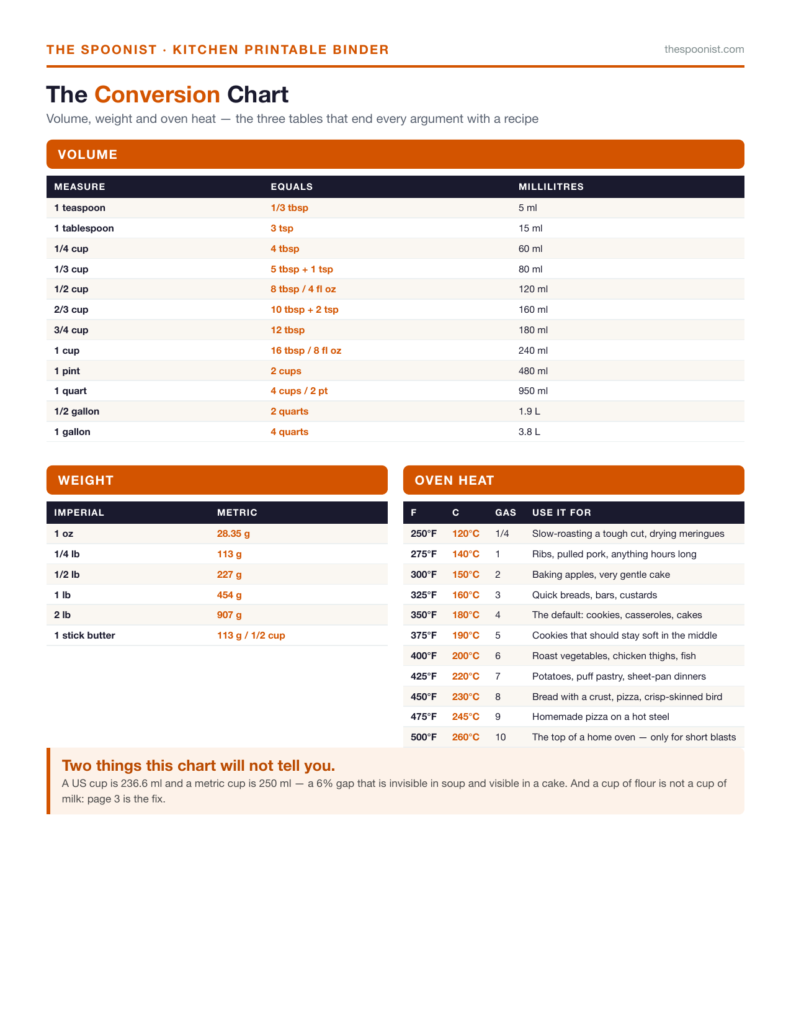
Below is the whole sheet we keep in our own kitchen, in the same order it prints in: volume, weight, oven settings, then the table that causes most of the trouble — what a cup of each ingredient actually weighs. It is page 2 and page 3 of our Kitchen Printable Binder, and the air fryer conversion chart covers the one direction this page does not.
Kitchen conversion chart: volume
US volume, in the order you reach for the tools. The milliliter column is the one that lets you use a metric recipe without a second book open.
| US measure | Equals | Milliliters |
|---|---|---|
| 1 teaspoon | 1/3 tbsp | 5 ml |
| 1 tablespoon | 3 tsp | 15 ml |
| 1/4 cup | 4 tbsp | 60 ml |
| 1/3 cup | 5 tbsp + 1 tsp | 80 ml |
| 1/2 cup | 8 tbsp / 4 fl oz | 120 ml |
| 2/3 cup | 10 tbsp + 2 tsp | 160 ml |
| 3/4 cup | 12 tbsp | 180 ml |
| 1 cup | 16 tbsp / 8 fl oz | 240 ml |
| 1 pint | 2 cups | 480 ml |
| 1 quart | 4 cups / 2 pt | 950 ml |
| 1/2 gallon | 2 quarts | 1.9 L |
| 1 gallon | 4 quarts | 3.8 L |
Two rows people get wrong. A third of a cup is not 5 tablespoons, it is 5 tablespoons plus 1 teaspoon, because 1/3 cup is 80 ml and 5 tablespoons is 75. And two-thirds is 10 tablespoons plus 2 teaspoons. Those two rows are why a metric scale ends up on most recipe testers’ counters.
Weight: the six that come up every week
| Imperial | Grams |
|---|---|
| 1 oz | 28.35 g |
| 1/4 lb | 113 g |
| 1/2 lb | 227 g |
| 1 lb | 454 g |
| 2 lb | 907 g |
| 1 stick butter | 113 g / 1/2 cup |
A stick of butter is the row to know by heart: 113 g, half a cup, a quarter of a pound. European butter comes in 250 g blocks, which is 2.2 sticks, and that fraction is the reason a French pastry recipe looks odd in US cups.
Oven temperature in Fahrenheit, Celsius and gas mark
Gas marks are a British thing, and they are on this page because half the older cookbooks worth reading were written with them. The column that matters most is the last one: what each heat is actually good for.
| Fahrenheit | Celsius | Gas mark | What it is for |
|---|---|---|---|
| 250°F | 120°C | 1/4 | Slow-roasting a tough cut, drying meringues |
| 275°F | 140°C | 1 | Ribs, pulled pork, anything hours long |
| 300°F | 150°C | 2 | Baking apples, very gentle cake |
| 325°F | 160°C | 3 | Quick breads, bars, custards |
| 350°F | 180°C | 4 | The default: cookies, casseroles, cakes |
| 375°F | 190°C | 5 | Cookies that should stay soft in the middle |
| 400°F | 200°C | 6 | Roast vegetables, chicken thighs, fish |
| 425°F | 220°C | 7 | Potatoes, puff pastry, sheet-pan dinners |
| 450°F | 230°C | 8 | Bread with a crust, pizza, crisp-skinned bird |
| 475°F | 245°C | 9 | Homemade pizza on a hot steel |
| 500°F | 260°C | 10 | The top of a home oven — only for short blasts |
The middle of this table is where home cooking lives. 350°F is the default for anything with a raising agent, 400°F is where browning starts to pay for itself, and 450°F is for bread and pizza. Below 300°F you are no longer baking, you are drying.
What a cup weighs, ingredient by ingredient
Volume and weight only agree about water. A cup of honey is three times the mass of a cup of sifted flour, which is why "1 cup of flour" is the least precise instruction in baking. These are the spoon-and-level figures at room temperature: dip the cup in the bag, scoop up, and you can get 150 g of flour into the same cup. That extra 30 g is a dry cake.
| Ingredient | One cup weighs | How to fill the cup |
|---|---|---|
| All-purpose flour | 120 g | spooned & levelled |
| Whole-wheat flour | 113 g | spooned & levelled |
| Cake flour | 100 g | sifted, then lightly packed |
| Granulated sugar | 200 g | pour it straight in |
| Brown sugar, packed | 213 g | press it firm, no air pockets |
| Powdered sugar | 113 g | sifted, unsifted is nearer 130 g |
| Cocoa powder | 85 g | sifted into the cup |
| Cornstarch | 128 g | it packs down — level twice |
| Rolled oats | 80 g | spooned, not scooped |
| Almond flour | 96 g | give the bag a stir first |
| White rice, uncooked | 185 g | long grain |
| Chocolate chips | 170 g | semi-sweet |
| Chopped nuts | 120 g | walnuts, pecans, peanuts |
| Shredded cheese | 113 g | loosely, not pressed in |
| Butter | 227 g | exactly 2 sticks |
| Milk | 244 g | whole or semi-skimmed, same to the gram |
| Water | 237 g | the liquid everyone else is measured against |
| Honey | 339 g | the heaviest cup in the pantry |
If a recipe gives both a cup and a weight, use the weight. If it gives only cups and it is a cake, a pastry or anything with baking powder, weigh it: spoon the flour into the cup, level it with the back of a knife, and tip it onto the scale. A kitchen scale that reads to the gram costs about what a bag of flour costs, and ours is in the baking scale guide.
How to convert a recipe instead of scaling it blindly
Halving. Cut the spoon measures in half and round to the next measure you own: 1/3 cup becomes 2 tablespoons plus 2 teaspoons, 1 teaspoon becomes 1/2, 1/2 teaspoon becomes 1/4. Salt and baking powder halve exactly; nothing else needs to be perfect.
Doubling. Double everything except the raising agent and the salt. Two teaspoons of baking powder in a doubled cake is enough to make it rise and then fall; use three. Same reason a doubled curry needs less than twice the chilli.
Making it a third more. 3/4 cup becomes 1 cup plus 2 tablespoons. Do that one on the scale and it is 160 g instead of 120, which takes four seconds.
Converting pan size. Volume, not diameter. A 9-inch round tin and an 8-inch square hold nearly the same batter; a 9×13 loaf dish holds about twice a 9×5. Same batter, shallower depth, so it bakes faster: check ten minutes early.
Converting a still-oven recipe for a fan. A fan moves heat onto the surface faster, so the usual advice is the same 25°F drop we use for an air fryer, with the time left alone and the first check moved earlier. Our time and temperature chart has the same rule in air fryer bands.
Four conversions that are not the same thing
Fluid ounces and ounces. A fluid ounce is 30 ml of space. An ounce is 28.35 g of weight. They only match when the liquid is water. An 8 fl oz cup of rolled oats is 80 g, not 227 g, and a recipe that says "8 ounces of pasta" means weight.
Packed and loose. Brown sugar is pressed in: 213 g a cup. Powdered sugar is sifted: 113 g, and 130 g if you scoop it straight from the bag. The recipe is describing a technique, not just an amount.
Drained and undrained. A cup of canned tomatoes and a cup of tinned tuna are different quantities of food once the liquid is off. Weigh the solids if the dish cares, which is most dishes with a sauce.
Grated by weight and grated by volume. 113 g of cheese is a cup grated loosely. Press it into the cup and you have 150 g of cheese in a dish that was built for 113.
Why the metric cup is not the US cup
A US legal cup is 240 ml, an Australian and Canadian metric cup is 250 ml, and a UK imperial cup is 284 ml. That is a 4% and an 18% difference, which is nothing in a soup and a real problem in a cake. The practical answer is the same one as everywhere else on this page: for anything that rises, follow the grams, which are the same in every country.
Printing a kitchen conversion chart that survives being used
Print at 100% scaling, US Letter, portrait, and do not let the driver fit it to the page — that is what shrinks the table until it is unreadable from a meter away. Card stock, because a page that curls off the counter ends up in the bin. If it lives on the fridge, put clear tape over the front, or slide it into a plastic sleeve and write your own corrections on the sleeve with a chinagraph pencil.
Leave the bottom block blank. Your oven, your spoons and your flour bag will disagree with the chart on three or four lines, and those are the numbers worth keeping. The journal page at the back of our binder is 20 blank rows for exactly that.
What this chart does not do
It does not convert cooking methods. Turning an oven recipe into an air fryer one is a temperature and time change rather than a units change, and it has its own sheet: the air fryer conversion chart, which uses the same 25°F rule with 20% off the time. It also does not tell you how long food keeps, which is what the freezer and pantry sheets in the binder are for.
Get the printable version
The Kitchen Printable Binder, $12
Eight US Letter pages: this conversion chart, the cup-weights table, a freezer inventory sheet with the how-long-it-keeps times, a pantry inventory sheet, an aisle-by-aisle grocery list, six blank recipe cards and a 20-row journal for your own numbers. One price, prints as many times as you like, and every later version comes to you free.
Kitchen conversion chart FAQ
What is the easiest kitchen conversion to remember?
1 cup = 16 tablespoons = 240 ml. Everything in the volume table hangs off it, and it lets you rebuild half a teaspoon or two-thirds of a cup out of tools you already own.
Is 350°F the same as 180°C?
Close enough to use. The exact conversion is 176.7°C, and every oven dial and gas mark rounds it to 180. The same rounding is why 400°F is printed as 200°C rather than 204.
Why do my cups and a scale disagree?
Because a cup measures space and a scale measures mass, and only water agrees about the two. A packed cup of flour can weigh 150 g where a spooned and leveled one weighs 120 g, and that 25% difference is the whole reason the same recipe works for one person and not another.
Do I need a scale to use this chart?
No, but it changes the result. Weighing takes the guessing out of flour, sugar and anything else that settles in the bag, and it makes leftovers and batch cooking reproducible. Our pick of the cheap ones is in the baking scale guide.
What is gas mark 4 in a US oven?
350°F, or 180°C. Gas mark 5 is 375°F, gas 6 is 400°F, and each step is 25°F apart through the middle of the range, which is the part worth memorizing.
Can I use this chart for the air fryer too?
For units, yes. For heat, use the air fryer rule on top of it: 25°F lower than the oven and about a fifth less time. The air fryer cheat sheet has the finished numbers for 32 everyday foods.
As an Amazon Associate we earn from qualifying purchases. This page contains no affiliate links; the guides it points to do.