An air fryer conversion chart comes down to two numbers: take the oven temperature down 25°F, and cook for 20% less time. A recipe that says 400°F for 30 minutes becomes 375°F for 24 minutes. That is the whole trick, and it works for most things you would put in an oven.
Oven 400°F for 30 minutes → air fryer 375°F for 24 minutes.
Subtract 25°F. Multiply the minutes by 0.8. Check the food two-thirds of the way through.
Below is the full chart in Fahrenheit and Celsius, a minute-by-minute time table, the deep-fryer version, and the handful of foods where the rule needs a nudge. There is a free PDF at the end of the chart that prints on one sheet. No email, no sign-up.
An air fryer is a small oven with a fan sitting right next to the food. Moving air pushes heat into the surface faster than the still air of a conventional oven, so the outside races ahead of the middle. Lower heat and a shorter cook keep the two in step. Cuisinart publishes the same pair of numbers in its own air fryer conversion chart, and the time table below matches theirs minute for minute.
The printable air fryer conversion chart
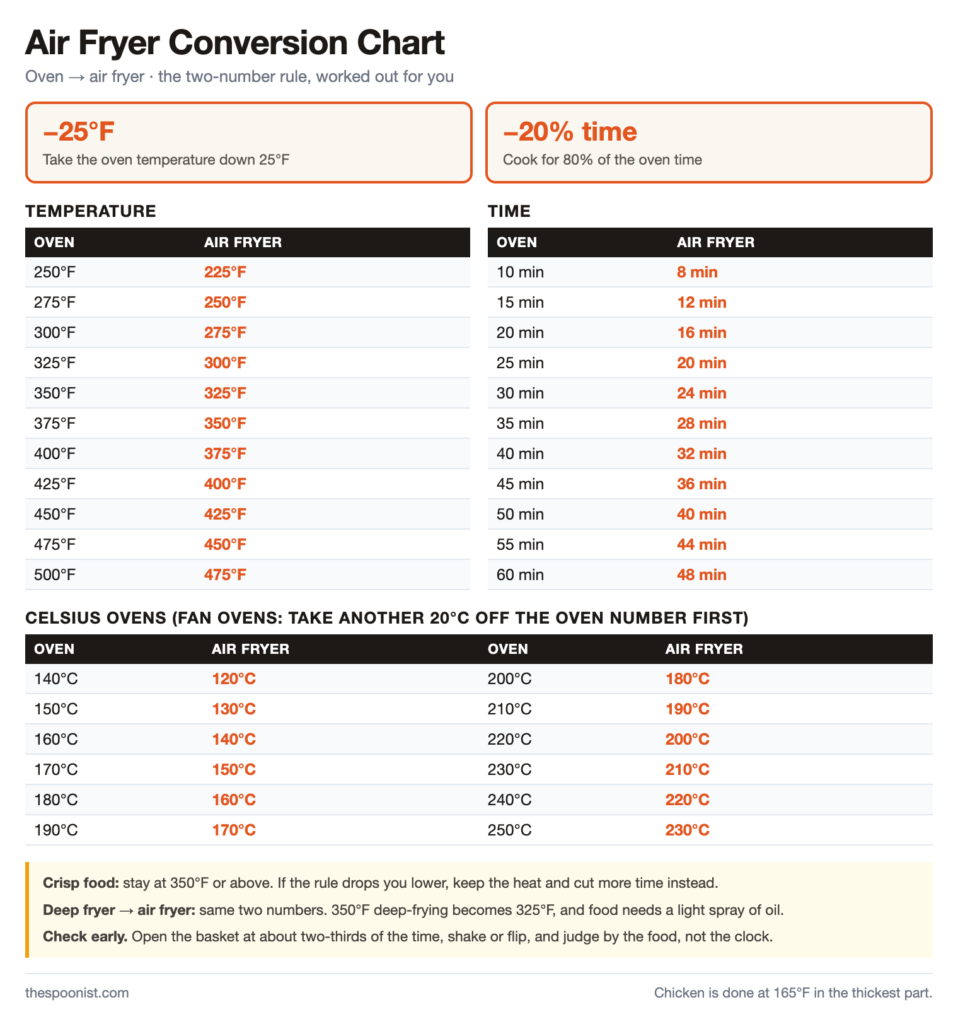
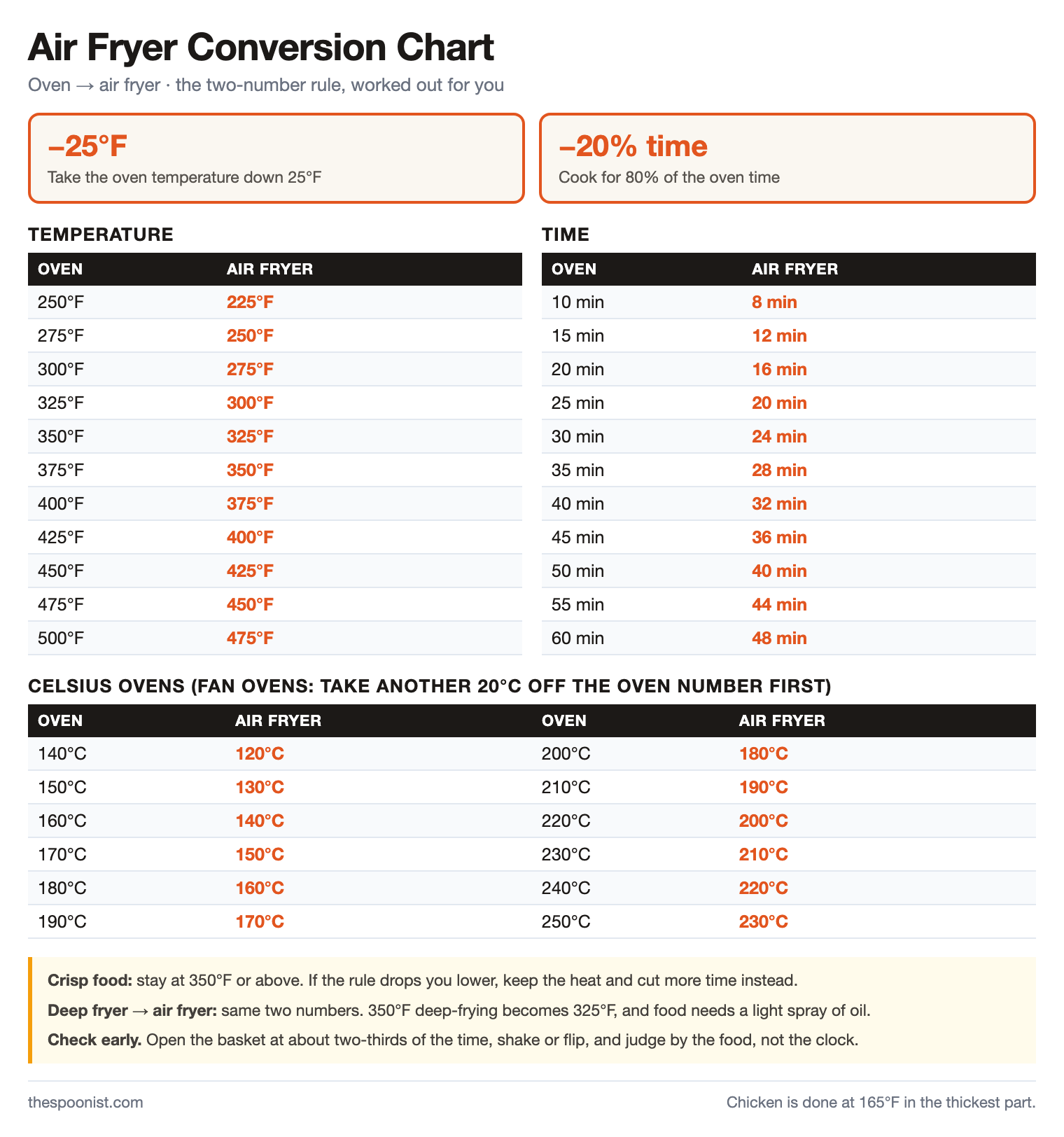
The PDF is a single US Letter page, so it prints without shrinking. If you would rather keep it on your phone, open the image and save it to your photos.
Go deeper than one page
This page gives you the oven converter. The Chart Pack adds 94 foods with time and temperature in both °F and °C, starting points for nine popular machines, a rescue guide for soggy fries, burnt outsides and dry chicken, and a blank journal to record what your own fryer actually needs. Seven printable pages, $9, and every later version comes to you free.
Only need the twenty foods you cook most? The free two-page chart arrives by email instead.
How to convert an oven recipe to an air fryer
Step 1: take 25°F off the temperature
Read the temperature the recipe gives you and subtract 25. That is the setting to dial in. 375°F becomes 350°F, 425°F becomes 400°F. If your air fryer only offers temperatures in 10-degree steps, round down rather than up.
Step 2: cut the cooking time by 20%
Take four-fifths of the stated time. Thirty minutes becomes 24, forty becomes 32, an hour becomes 48. Do not round up here either. It is much easier to add three minutes to something pale than to rescue something scorched.
Step 3: look at the food, not the clock
Pull the basket out at about two-thirds of the converted time. Shake it or flip whatever is in there, then judge the color. Every air fryer is a slightly different size and wattage, so the chart is a starting line, not a guarantee. The first time you convert a recipe, write down what actually worked.
Oven to air fryer temperature chart
Fahrenheit, in the 25-degree steps most recipes are written in.
| Oven temperature | Air fryer temperature |
|---|---|
| 250°F | 225°F |
| 275°F | 250°F |
| 300°F | 275°F |
| 325°F | 300°F |
| 350°F | 325°F |
| 375°F | 350°F |
| 400°F | 375°F |
| 425°F | 400°F |
| 450°F | 425°F |
| 475°F | 450°F |
| 500°F | 475°F |
One exception worth knowing. For anything that should come out crisp — fries, wings, breaded chicken, roast potatoes — do not go below 350°F. If subtracting 25 drops you under that line, keep the higher temperature and take a little more off the time instead. Color needs heat, and a low-and-slow air fryer turns food leathery rather than crisp.
Oven to air fryer time chart
Twenty percent off, worked out for the times recipes actually use.
| Oven time | Air fryer time |
|---|---|
| 10 minutes | 8 minutes |
| 15 minutes | 12 minutes |
| 20 minutes | 16 minutes |
| 25 minutes | 20 minutes |
| 30 minutes | 24 minutes |
| 35 minutes | 28 minutes |
| 40 minutes | 32 minutes |
| 45 minutes | 36 minutes |
| 50 minutes | 40 minutes |
| 55 minutes | 44 minutes |
| 60 minutes | 48 minutes |
For anything longer than an hour, keep multiplying by 0.8. Ninety minutes in the oven is about 72 in the air fryer, though a cook that long is usually a sign the dish wants the oven.
Common oven settings, already converted
The pairings that come up most often, with both numbers done for you.
| Oven setting | Air fryer setting |
|---|---|
| 325°F for 45 min | 300°F for 36 min |
| 350°F for 20 min | 325°F for 16 min |
| 350°F for 30 min | 325°F for 24 min |
| 375°F for 25 min | 350°F for 20 min |
| 400°F for 15 min | 375°F for 12 min |
| 400°F for 30 min | 375°F for 24 min |
| 425°F for 20 min | 400°F for 16 min |
| 450°F for 15 min | 425°F for 12 min |
Celsius ovens: oven to air fryer conversion
The Celsius version of the rule is a 20°C drop, which is the same adjustment written in the other unit. The Air Fryer Kitchen, which cooks in Celsius, uses exactly this: 220°C in the oven becomes 200°C in the air fryer, with the same 20% cut in time.
| Oven | Air fryer | Oven | Air fryer |
|---|---|---|---|
| 140°C | 120°C | 200°C | 180°C |
| 150°C | 130°C | 210°C | 190°C |
| 160°C | 140°C | 220°C | 200°C |
| 170°C | 150°C | 230°C | 210°C |
| 180°C | 160°C | 240°C | 220°C |
| 190°C | 170°C | 250°C | 230°C |
If your recipe is written for a fan oven, that number is already the lowered one. Start at the temperature the recipe gives, still cut the time by about a fifth, and check early.
Deep fryer to air fryer conversion
The same two numbers apply. Oil at 350°F in a deep fryer becomes 325°F in the air fryer, and the cooking time comes down by roughly a fifth. The difference is the oil: food that was going to be submerged now needs a light spray or a toss in a teaspoon of oil, or it will come out dry and floury instead of golden.
Breaded things do best on a rack with space around them. Wet batter — the kind you would dip a fish fillet into and drop straight into hot oil — does not work in an air fryer at all. It runs off the food and through the basket before it has set. Use a crumb coating instead.
When the rule needs adjusting
Frozen food. If the bag gives air fryer instructions, follow the bag. Frozen food starts 30 degrees colder than the recipe assumed, so it often wants the full temperature and a couple of extra minutes rather than the converted pair.
A full basket. The rule assumes one layer with air moving around it. Pile chips three deep and the steam has nowhere to go. Cook in two batches, or add time and shake more often.
Thick cuts. A whole chicken breast or a thick pork chop can brown before the middle is safe. Drop the temperature another 25°F and give the time back. A probe thermometer settles it: poultry is done at 165°F in the thickest part.
Small baskets. A 2-quart drawer sits the food closer to the element than a 7-quart one does, and it runs hotter in practice. If you cook in a compact model, check at half time rather than two-thirds. Our guides to the best 4-quart air fryers and the best 7-quart air fryers cover which size suits how much you cook at once.
Reheating. Leftovers do not need the full converted time. Start at 320°F for three or four minutes and look. Reheating is about warming through, not cooking again.
Three recipes worked through
Roast potatoes, oven 425°F for 45 minutes. Set 400°F for 36 minutes. Shake the basket at 24 minutes. If they are pale at the end, give them three more minutes rather than turning the heat up.
Chicken thighs, oven 400°F for 35 minutes. Set 375°F for 28 minutes, skin side down first, flip at 18 minutes. Check the thickest thigh reads 165°F. If you cook wings more than anything else, we tested the models that crisp them best in our chicken wing air fryer guide.
A cake, oven 350°F for 30 minutes. This is the one that catches people out. The rule says 325°F for 24 minutes, and that is right, but use a tin that fits with an inch of clearance all round or the top will set before the middle rises. Cover loosely with foil if the top browns early.
What makes the conversion easier
None of this needs new equipment. Two things help more than anything else: a probe thermometer so you stop guessing at doneness, and a rack or liner that keeps food off the base so air reaches the underside. Both are covered in our air fryer accessories guide. If you are still deciding how much basket you need for the number of people you feed, we answered that in is a 7-quart air fryer big enough for a family of six. And when the basket starts sticking, the cleaning kit guide covers what actually shifts baked-on grease without stripping the coating.
Calibrate your machine in one evening
Air fryers drift. Wattage, the gap between element and food and how tight the drawer seals all differ, and the only fix is to find out how your machine behaves and write the offset on the chart. It takes two dinners.
Test one: the fry test, for temperature. Frozen shoestring fries are a fixed quantity, which is why the chart puts them at 400°F for 12 to 14 minutes. Run a single layer for 13 minutes with no shake adjustments. Pale means your machine runs cool; note how much color you expected and add 10°F next time. Dark at the edges and soft in the middle means it runs hot and crowded.
Test two: the breast test, for time. Two chicken breasts pounded to the same thickness, 380°F, probe at 18 minutes. If 165°F arrives at 15 minutes your machine is fast, and every row on the chart should lose a few minutes. If it takes 22, it is slow, and the low end of every range here is the number to ignore.
Then write it down. One line at the top of the sheet, "mine runs +10°F, -2 min", is worth more than any generic chart. Every row on this page is written for an average machine; those two numbers are the difference between an average result and yours.
What “done when” actually means
The last column is the part most charts leave out, and it is the part that saves dinner. A good chart gives three kinds of cue:
Temperature. Poultry is done at 165°F in the thickest part, ground meat at 160°F, pork chops and tenderloin at 145°F with a small rest. Those numbers beat any timer, and a probe thermometer costs less than a bag of frozen food you had to throw away.
Texture. Salmon flakes when you press it. Asparagus bends without snapping. Chickpeas rattle in the basket. Steak slices warm through at a low temperature rather than a fast one.
Color. Crisped edges on sprouts, deep gold on tots, no pale patches on fish sticks. Color needs heat, which is why we never go below 350°F for anything meant to be crisp.
Why the same food takes different times in different kitchens
Size beats everything. A 6-ounce chicken breast flat enough to be 2 centimetres thick is 18 minutes. The same weight from a big bird, uneven and thick in the middle, is 24 minutes and still pink. Pound it even and the chart works.
Crowding steals the crisp. One layer with gaps is the assumption behind every number on the chart. A packed drawer holds steam, and steamed food takes longer and never browns. Two batches of fries is faster than one bad batch.
Frozen is not the same as fresh. Fries straight from the bag want 400°F for 12 to 14 minutes; cut from a raw potato they want 18 to 20. Frozen vegetables want a higher temperature than fresh, not a longer time.
Wattage and basket shape. A tall narrow drawer and a wide shallow one move air differently. Where you fall in each range on the chart is a property of your machine, which is why the ranges are ranges.
Air fryer conversion chart FAQ
Do I need to preheat the air fryer?
It is optional. Give it three minutes when you want a crust or a sear, because the food hits hot metal instead of warming metal. Skip it for reheating and for anything already cooked. If you do preheat, the converted time stays the same.
Can I use the same dish I use in the oven?
Any oven-safe dish that fits is safe to use, but a solid dish blocks the airflow that makes the conversion work in the first place. A perforated tray or the basket itself cooks faster and more evenly. If you do use a dish, expect to add a few minutes.
Why is my food burnt outside and raw inside?
The heat is too high for the thickness of the food. Take another 25°F off and add back the time you cut. That is the standard fix for thick chicken breasts, sausages and stuffed things.
Does this chart work for every air fryer brand?
It works as a starting point for all of them. Basket size, wattage and how close the element sits to the food all move the real answer by a few degrees or a couple of minutes. Treat the first cook as a test and note what your own machine did.
Do I need to add oil?
For anything breaded, dry or starchy, a light spray gives you color. For fatty food like sausages, bacon or chicken thighs with the skin on, there is already enough fat in the food and extra oil just makes it smoke.
Is an air fryer just a small convection oven?
Yes, and that is exactly why the conversion works. Both move hot air with a fan; the air fryer does it in a much smaller box, so the air moves faster over the food. If a recipe is already written for a convection oven, you are most of the way there before you change anything.
As an Amazon Associate we earn from qualifying purchases. This chart contains no affiliate links; the guides it points to do.